AI Cover Letter Guide: How to Use ChatGPT Without Sounding Robotic (2026)
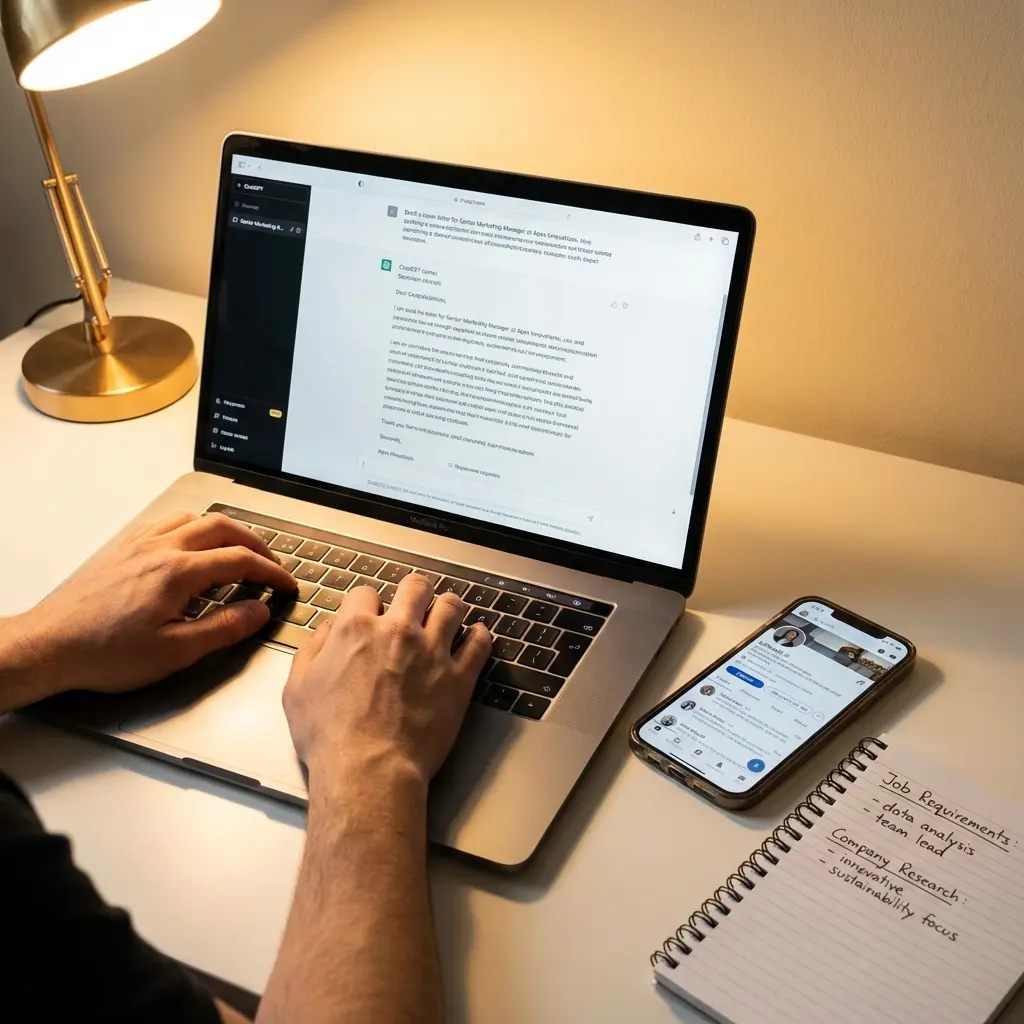
Why AI Cover Letters Fail (And How to Fix Them)
I've tested ChatGPT for cover letters dozens of times across different industries and roles. Here's the truth: raw AI output is terrible. It's generic, overly formal, and screams "I didn't actually write this."
But here's the hack: AI is an incredible drafting tool if you know how to use it. I've used ChatGPT to speed up my cover letter writing by 70%, but I never copy-paste. The secret is treating AI like a junior assistant who needs heavy supervision.
Let me show you exactly how to use ChatGPT and other AI tools to write cover letters that get interviews—without sounding like a robot.
The Right Way to Use ChatGPT for Cover Letters
For comprehensive guidance on all your application materials, our career pitch mastery guide covers the complete strategy.
What ChatGPT Is Good At
ChatGPT is a tool, not a writer. It gives you raw material. Your job is to refine it until it sounds like you.
What ChatGPT Is Bad At
If you submit a raw ChatGPT cover letter, hiring managers will know. I can spot AI-generated text in seconds, and so can they.
Stop Struggling with Cover Letters—Let AI Draft It, Then Make It Yours
Step-by-Step: How to Write a Cover Letter with ChatGPT
Step 1: Gather Your Context
Before you open ChatGPT, collect:
The more context you give ChatGPT, the better the output. Garbage in, garbage out.
Step 2: Write a Detailed Prompt
Here's a proven prompt template I use:
You are a professional career coach helping me write a cover letter.

Job Title: [Title]
Company: [Company Name]
Industry: [Industry]

Key Requirements from Job Description:
- [Requirement 1]
- [Requirement 2]
- [Requirement 3]

My Background:
- Current Role: [Your Current Job Title]
- Relevant Experience: [X years in Y field]
- Key Achievements:
  1. [Achievement with metric]
  2. [Achievement with metric]
  3. [Achievement with metric]

My Unique Value:
[1-2 sentences on why you're uniquely suited for this role]

Please write a 300-word cover letter that:
1. Opens with a strong hook (not "I am writing to apply")
2. Highlights my 2-3 most relevant achievements with metrics
3. Shows genuine interest in [Company]'s work on [Specific Initiative]
4. Sounds conversational and authentic, not overly formal
5. Ends with a confident call-to-action

Use a warm, professional tone. Avoid clichés.
Why this works: You're giving ChatGPT a framework, your data, and clear constraints. This produces output that's 70% usable right away.
Step 3: Generate and Review the First Draft
ChatGPT will generate a cover letter. It will probably include phrases like:
- "I am writing to express my strong interest in..."
- "I am confident that my skills and experience make me an ideal candidate..."
- "I would welcome the opportunity to discuss..."
This is normal. AI defaults to formal, safe language. Your job is to fix it in the next step.
Step 4: Edit Ruthlessly for Voice
Now comes the critical part. Open the AI output and:
Before (AI-generated):
"I am writing to express my strong interest in the Senior Marketing Manager position at BrightPath. I am confident that my 8 years of experience in digital marketing make me an ideal candidate for this role."
After (human-edited):
"I'm applying for the Senior Marketing Manager role at BrightPath because I've been using your AI-powered content tools for the past year, and I'm genuinely excited about where you're headed. With 8 years leading digital marketing teams, I know I can help you scale."
See the difference? The second version sounds like a real person wrote it.
Step 5: Add Specificity
AI loves to be vague. Your job is to add concrete details:
Generic cover letters get ignored. Specific ones get interviews.
Step 6: Read Aloud and Refine
This is the final test. Read your cover letter out loud. If it sounds like something you'd actually say to a friend or colleague, it's good. If it sounds like a corporate press release, keep editing.
Ask yourself:
- Would I say this in a conversation?
- Does this sound like me, or like a robot?
- Is every sentence necessary, or am I padding for length?
Cut ruthlessly. Shorter and authentic beats longer and robotic every time.
The Best ChatGPT Prompts for Cover Letters
Prompt 1: Career Change Cover Letter
I'm transitioning from [Old Industry] to [New Industry]. Write a cover letter for the [Job Title] role at [Company] that:
1. Addresses the career change head-on
2. Highlights transferable skills: [Skill 1], [Skill 2], [Skill 3]
3. Shows I've been deliberately building expertise in [New Field] through [Courses/Projects]
4. Keeps the tone confident and forward-looking, not apologetic

Background:
- Previous Role: [Title]
- Achievement from previous career: [Metric-driven example]
- Why I'm switching: [1-2 sentences]

Make it 300 words, conversational, and genuine.
Prompt 2: Entry-Level Cover Letter (No Experience)
I'm a recent [Degree] graduate applying for the [Job Title] role at [Company]. I have no full-time work experience but have:
- Internship at [Company] where I [Achievement with metric]
- Academic project: [Brief description and outcome]
- Relevant skills: [Skill 1], [Skill 2]

Write a cover letter that:
1. Acknowledges I'm early-career but frames it as fresh perspective
2. Emphasizes my eagerness to learn and my specific skills
3. Shows I've researched [Company] by referencing [Specific Initiative]
4. Sounds enthusiastic but not desperate

Keep it 250-300 words, warm and professional.
Prompt 3: Senior-Level Executive Cover Letter
I'm applying for the [Executive Title] position at [Company]. I have [X years] of [Industry] leadership experience.

Key Achievements:
- [Achievement 1 with revenue/growth metric]
- [Achievement 2 with team/operational impact]
- [Strategic initiative I led]

Write a cover letter that:
1. Opens with a strategic insight about [Company's Challenge/Opportunity]
2. Demonstrates my executive-level impact with metrics
3. Positions me as a strategic partner, not just a candidate
4. Keeps the tone authoritative but not arrogant

Make it 350 words, sophisticated, and confident.
Prompt 4: Cold Email / Networking Cover Letter
I'm reaching out cold to [Company] because I'm genuinely impressed by [Specific Work/Product]. There's no open role, but I want to introduce myself.

My Background:
- Current Role: [Title]
- Relevant Achievement: [Metric-driven example]
- Why I'm interested in [Company]: [Personal connection/admiration]

Write a networking email that:
1. Opens with a genuine compliment about their work (specific, not generic)
2. Briefly introduces my background and relevant skills
3. Asks for a conversation, not a job
4. Sounds humble and curious, not pushy

Keep it 200 words, conversational, and warm.
ChatGPT vs. Claude vs. Gemini: Which AI Is Best for Cover Letters?
I've tested all three. Here's my honest comparison:
ChatGPT (GPT-4 / GPT-4o)
Pros:
Cons:
Best for: General-purpose cover letters, multiple iterations, fast drafts.
Claude (Anthropic)
Pros:
Cons:
Best for: Creative roles, personal storytelling, avoiding robotic tone.
Gemini (Google)
Pros:
Cons:
Best for: Quick drafts, Google users, experimentation.
My recommendation: Start with ChatGPT for structure, then use Claude if you need a more human tone. Test both and see which matches your voice better. For comprehensive guidance on cover letters and examples, check our cover letter examples and templates guide.
Common AI Cover Letter Mistakes (And How to Avoid Them)
Mistake 1: Copying and Pasting Raw AI Output
The Problem: Raw ChatGPT output is generic and detectable. Hiring managers have seen hundreds of AI-generated cover letters. They know the patterns.
The Fix: Always edit. Spend at least 10-15 minutes personalizing the AI draft. Add your stories, remove clichés, and read it aloud.
Mistake 2: Using the Same Prompt for Every Job
The Problem: If your prompt is too generic, the output will be too. You'll end up with a one-size-fits-all cover letter that doesn't stand out.
The Fix: Customize your prompt for each application. Include company-specific details, 2-3 key job requirements, and your most relevant achievements.
Mistake 3: Not Fact-Checking AI Output
The Problem: AI can hallucinate facts, misinterpret your achievements, or exaggerate claims. If you submit inaccurate information, you lose credibility.
The Fix: Double-check every metric, company name, and claim. Make sure the AI didn't invent achievements or misrepresent your experience.
Mistake 4: Ignoring Company Culture
The Problem: AI defaults to formal, corporate language. This works for finance or law but fails for startups or creative roles.
The Fix: Tell the AI about the company culture in your prompt:
"The company is a casual tech startup. Use a warm, conversational tone. Avoid overly formal language."
Mistake 5: Overusing AI for Every Step
The Problem: If you use AI to write your resume, cover letter, and LinkedIn profile, everything will sound the same. Hiring managers notice patterns.
The Fix: Use AI strategically. Let it draft your cover letter, but write your resume yourself (or vice versa). Mix AI-assisted content with original writing.
How to Make Your AI Cover Letter Sound 100% Human
Here are my top editing tactics:
AI-generated:
"I am excited to leverage my extensive experience in data analytics to drive meaningful insights for your organization."
Human-edited:
"I've spent the past 5 years turning messy datasets into actionable strategies. When I saw your team's work on predictive models for supply chains, I knew this was the role for me."
Which one would you respond to?
When NOT to Use AI for Cover Letters
Sometimes, AI isn't the right tool. Skip it when:
AI is a tool, not a replacement for effort. Use it to save time, not to avoid work.
Advanced AI Cover Letter Tactics
Tactic 1: Use AI to Generate 3 Opening Paragraphs
Don't settle for the first AI output. Ask ChatGPT for three different opening paragraphs, then pick the best one (or combine elements from each).
Prompt:
"Give me 3 different opening paragraphs for this cover letter. Make them varied: one data-driven, one storytelling, one direct and confident."
Tactic 2: Ask AI to Critique Your Draft
After you've written your cover letter (or edited an AI draft), ask the AI to critique it:
Prompt:
"Here's my cover letter. Please critique it for:
- Generic or clichéd phrases
- Lack of specificity
- Overly formal tone
- Missing personal anecdotes
Be brutally honest."
This reverse-engineering helps you catch blind spots.
Tactic 3: Use AI to Tailor One Cover Letter to Multiple Companies
If you have a strong base cover letter, you can use AI to quickly tailor it:
Prompt:
"Here's my cover letter for Company A. Adapt it for Company B, which focuses on [Different Industry/Product]. Replace generic praise with specific references to their [Recent News/Product/Initiative]. Keep the structure and tone identical."
This saves time while maintaining personalization.
Real Example: AI Draft vs. Final Human-Edited Version
AI-Generated (Raw ChatGPT Output)
"Dear Hiring Manager,
I am writing to express my strong interest in the Senior Marketing Manager position at BrightPath. With over 8 years of experience in digital marketing and a proven track record of driving growth, I am confident that I would be an ideal candidate for this role.
In my current position at TechCorp, I have successfully led numerous campaigns that increased brand awareness and customer engagement. I am particularly skilled in data-driven marketing strategies and have consistently delivered measurable results.
I am excited about the opportunity to bring my expertise to BrightPath and contribute to your continued success. I would welcome the opportunity to discuss how my background aligns with your needs.
Thank you for your consideration.
Sincerely, Jordan Kim"
Problems:
- Generic opening ("I am writing to express...")
- Vague achievements ("successfully led numerous campaigns")
- No company-specific details
- Overly formal tone
- Sounds like every other AI cover letter
Human-Edited (Final Version)
"Hi Sarah,
I'm applying for the Senior Marketing Manager role at BrightPath because I've been using your AI content tools for the past year, and honestly, they've changed how I approach content strategy. I'm excited about where you're headed.
For the past 8 years, I've led digital marketing teams at TechCorp, where I built a content program that increased organic traffic by 240% and generated 15,000+ qualified leads annually. I also launched our AI-powered personalization engine, which boosted email conversion rates by 68%.
What excites me about BrightPath is your focus on AI transparency and ethical automation—something I've championed internally at TechCorp. I'd love to bring my experience scaling content programs to your team.
Let's talk. I'm confident I can help you hit your growth targets.
Best, Jordan Kim"
What Changed:
- Personalized greeting (found hiring manager's name)
- Specific opening hook (personal experience with product)
- Concrete metrics (240% traffic increase, 68% conversion boost)
- Company-specific reference (AI transparency)
- Casual, confident tone
- Sounds like a real person
Result: The second version gets interviews. The first gets ignored.
Tools and Resources for AI-Assisted Cover Letters
Here are the tools I use:
- ChatGPT (GPT-4 recommended, but GPT-3.5 works for drafts)
- Claude by Anthropic (better natural tone)
- Google Gemini (free, integrated with Google)
- Grammarly (catches AI-generated clichés and tone issues)
- Hemingway Editor (simplifies overly complex AI writing)
Workflow: Draft in ChatGPT → Edit for voice → Run through Grammarly → Final read-aloud check.
Frequently Asked Questions
Can ChatGPT write a good cover letter?
Yes, but only if you provide detailed context and heavily edit the output. Raw ChatGPT cover letters sound generic and get rejected. Use AI as a drafting tool, then personalize extensively to sound human.
Can employers tell if you used AI to write your cover letter?
Yes, often. AI-generated text has telltale signs: overly formal language, generic phrases like "I am writing to express my interest," and lack of specific personal anecdotes. Always edit AI output to add your authentic voice.
What is the best AI tool for writing cover letters?
ChatGPT (GPT-4 or GPT-4o), Claude (Anthropic), and Gemini are top choices. ChatGPT is most popular, but Claude often produces more natural-sounding text. Test both and see which matches your voice.
How do I make my ChatGPT cover letter sound more human?
Add specific personal anecdotes, remove overly formal phrases, use contractions (I'm, you're), vary sentence length, and read it aloud. If it sounds like a robot wrote it, edit ruthlessly until it sounds like you.
Should I tell employers I used AI to write my cover letter?
No. There's no upside. Using AI as a drafting tool is acceptable, but the final product should sound 100% like you. If you can't tell it was AI-assisted, neither can they.
What are the risks of using ChatGPT for cover letters?
Generic output, lack of personalization, detectable AI patterns, and potential plagiarism if multiple candidates use the same prompts. Always customize, fact-check, and add unique personal details.
Final Thoughts
AI tools like ChatGPT can save you hours on cover letter drafting, but they're not magic. Raw AI output will get your application rejected. The secret is using AI as a starting point, then editing ruthlessly to sound like a real human.
Follow this process: detailed prompt → generate draft → edit for voice → add specificity → read aloud → refine. If you do this, you'll have a cover letter that's 70% faster to write and 100% authentic.
Remember: hiring managers don't care if you used AI. They care if your cover letter sounds generic, robotic, or lazy. Make it specific, make it personal, and make it sound like you. That's what gets interviews.
Now go open ChatGPT, use one of these prompts, and write a cover letter that actually works.