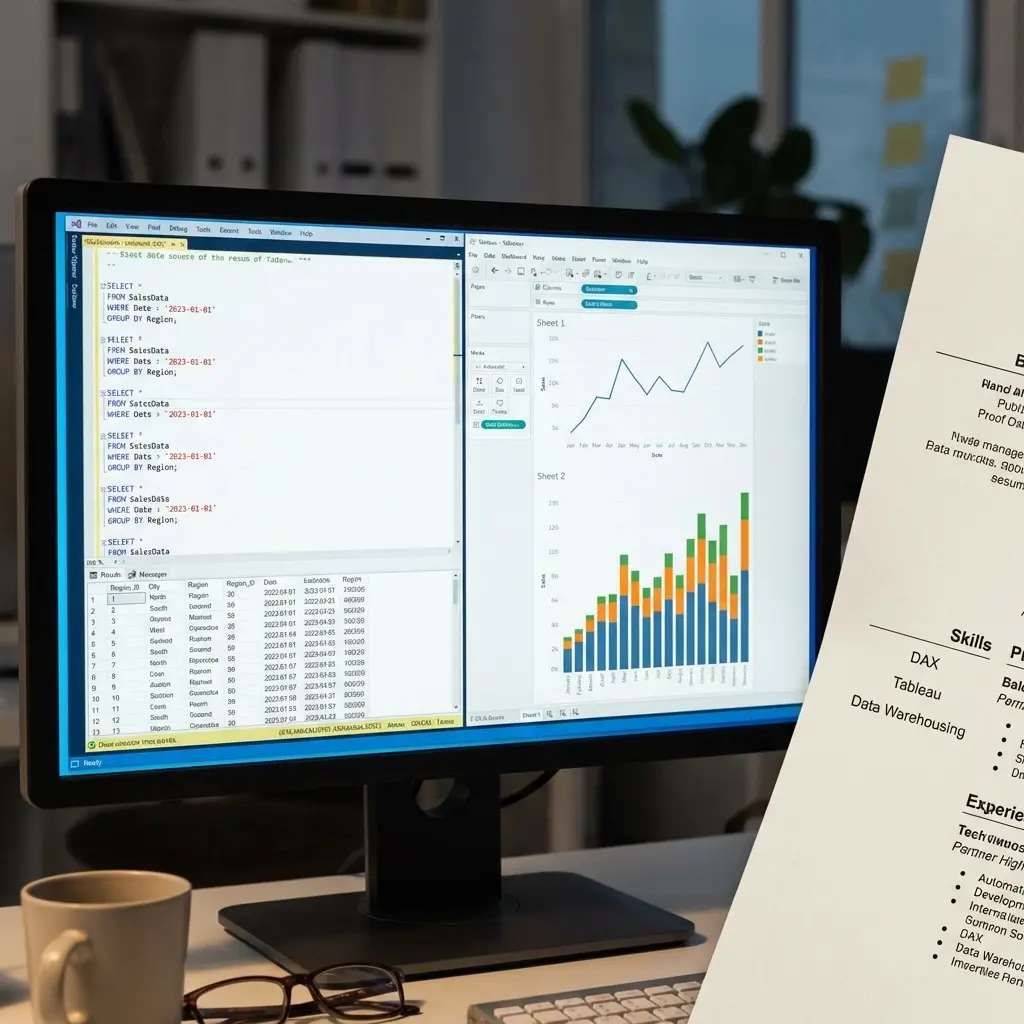
Data Analyst Resume That Gets Interviews: Examples & Templates 2025

Here's what I've learned testing different approaches to data analysis resumes: the ones that get interviews tell a story of business impact, not just technical skills.
I've analyzed hundreds of data analyst job postings and interviewed with dozens of companies. The pattern is clear: hiring managers want to see how your analysis drove decisions and delivered results.
Your resume needs to prove you can turn messy data into actionable insights. Here's exactly how to build a data analyst resume that gets you past ATS and into interviews.
Essential Technical Skills for Data Analysts
For comprehensive strategies on optimizing your resume language, our professional impact dictionary covers the exact verbs and metrics for data analyst roles.
Your technical skills section is critical. Here's what actually matters in 2025:
Programming & Query Languages (Must-haves):
- SQL (your #1 skill—master it)
- Python (pandas, NumPy, matplotlib, seaborn)
- R (ggplot2, dplyr, tidyr)
- Excel (VLOOKUP, pivot tables, macros, Power Query)
Data Visualization Tools:
- Tableau, Power BI, Looker
- Google Data Studio
- Matplotlib, Seaborn, Plotly (Python libraries)
- D3.js (if you have web visualization experience)
Databases & Data Warehousing:
- MySQL, PostgreSQL, SQL Server
- MongoDB, NoSQL databases
- Snowflake, Redshift, BigQuery
- ETL processes and data pipelines
Statistical & Analytical Methods:
- A/B testing and hypothesis testing
- Regression analysis (linear, logistic)
- Predictive modeling and forecasting
- Statistical significance and p-values
- Cohort analysis, funnel analysis
Additional Tools:
- Git/GitHub (version control)
- Jupyter Notebooks
- Google Analytics, Adobe Analytics
- SPSS, SAS (if relevant to your industry)
- Cloud platforms (AWS, Google Cloud, Azure)
Pro tip: Organize your skills by category and prioritize based on the job description. If they emphasize Tableau, put it first in your visualization tools list.
How to Structure Your Data Analyst Resume
Here's the format that works for analytics roles:
1. Header
- Full name
- Phone | Email | LinkedIn | Portfolio/GitHub | Tableau Public
- Location (City, State)
2. Professional Summary (3-4 lines)
- Years of experience + industry focus
- Key technical skills (SQL, Python, Tableau)
- Biggest achievement with business impact
Example: "Data Analyst with 5+ years transforming complex datasets into strategic insights for e-commerce and fintech. Expert in SQL, Python, and Tableau. Delivered analysis that increased revenue by $3M, reduced customer churn by 22%, and improved marketing ROI by 45%."
3. Technical Skills (categorized)
- Programming: SQL, Python (pandas, NumPy, matplotlib), R
- Visualization: Tableau, Power BI, Looker
- Databases: MySQL, PostgreSQL, MongoDB, Snowflake
- Statistical Analysis: A/B testing, regression, predictive modeling
- Tools: Excel (advanced), Git, Jupyter, Google Analytics
4. Professional Experience
- Company, Location | Dates
- Job Title
- 4-5 bullets per role focusing on analysis and business impact
- Include data size, tools used, and quantified results
5. Projects (2-3 standout projects)
- Personal, portfolio, or significant work projects
- Include portfolio/GitHub links
6. Education
- Degree, University, Year
- Relevant coursework (Statistics, Data Mining, Machine Learning)
7. Certifications (if applicable)
- Google Data Analytics Professional Certificate
- Microsoft Certified: Data Analyst Associate
- Tableau Desktop Specialist
Keep it to 1 page for early-career analysts (0-3 years), 1-2 pages for experienced analysts (3+ years).
Writing Achievement Bullets That Show Business Impact
This is where most data analyst resumes fail. They describe what they did, not what it accomplished.
Here's the formula I use:
Analyzed [Data Source/Size] using [Tools] to [Insight/Finding], resulting in [Business Impact with Metrics]
Before & After Examples
Before: "Performed data analysis using SQL and Python" After: "Analyzed 5M customer transactions using SQL and Python to identify purchase patterns, leading to personalized recommendation engine that increased average order value by 28% ($1.2M annual revenue)"
Before: "Created dashboards in Tableau" After: "Built executive Tableau dashboard consolidating data from 6 sources, reducing reporting time from 20 hours to 2 hours weekly and enabling real-time decision-making for C-suite"
Before: "Conducted A/B testing for marketing campaigns" After: "Designed and analyzed A/B tests for 15 email campaigns using Python and statistical hypothesis testing, optimizing subject lines and CTAs that improved conversion rate from 2.1% to 3.4% (62% increase)"
Before: "Worked with large datasets" After: "Processed and cleaned 10M+ records using Python pandas, identifying data quality issues that prevented $500K in erroneous payments and improved forecast accuracy by 35%"
Metrics That Matter for Data Analysts
Hiring managers want to see:
- Revenue Impact: Generated $X revenue, increased sales by Y%
- Cost Savings: Saved $X, reduced expenses by Y%
- Efficiency Gains: Reduced processing time by X hours, automated Y% of reporting
- Accuracy Improvements: Increased forecast accuracy by X%, reduced errors by Y%
- Decision Impact: Insights led to X% improvement in [metric]
- Data Scale: Analyzed X million records, processed Y GB of data
Always connect your technical work to business outcomes. "Wrote complex SQL queries" is weak. "Wrote SQL queries analyzing 2M customer records that identified $800K in revenue opportunities" shows real value.
How to Showcase Data Analysis Projects
Projects prove you can actually do the work. Here's how to present them effectively:
Customer Churn Prediction Model | GitHub: <your-link> | Dashboard: <your-link> Predictive analysis to identify at-risk customers for SaaS company
- Tools: Python (scikit-learn, pandas), SQL, Tableau
- Data: 50K customer records with 30+ behavioral features
- Built logistic regression model with 82% accuracy in predicting churn within 30 days
- Identified top 5 churn indicators, enabling proactive retention campaigns that reduced churn by 18%
- Created interactive Tableau dashboard for customer success team to monitor at-risk accounts
What to Include for Each Project:
- Project name and brief description (1 line)
- Tools and technologies used
- Data source and size
- Analytical methods applied
- Key findings or insights
- Business impact or results
- Links to GitHub repo, live dashboard, or portfolio
Project Selection Tips:
- Show variety: one SQL-heavy project, one visualization project, one statistical analysis
- Include at least one end-to-end project (data collection → cleaning → analysis → visualization → insights)
- Demonstrate different industries or business problems
- Make sure GitHub repos have clean README files explaining the project
- Include visualizations—screenshots of dashboards or charts
Build Your Data Analyst Resume With Our Free Tool
Common Data Analyst Resume Mistakes
I've made some of these mistakes myself. Here's what to avoid:
1. Listing Tools Without Context Don't just say "Proficient in SQL." Say "Wrote complex SQL queries with CTEs and window functions to analyze user behavior across 8 database tables, processing 5M+ daily records."
2. No Business Impact Every analysis should connect to a business outcome. "Analyzed sales data" is meaningless. "Analyzed sales data to identify underperforming products, leading to inventory optimization that saved $300K" shows value.
3. Ignoring Data Visualization Data analysts need to communicate insights visually. If you don't mention Tableau, Power BI, or visualization libraries, you're missing a key skill.
4. Weak Project Descriptions "Built a dashboard" tells me nothing. "Built executive dashboard tracking 12 KPIs across 4 departments, reducing manual reporting time by 85% and enabling data-driven decisions" shows impact.
5. Not Quantifying Data Scale "Worked with large datasets" is vague. "Processed 10M customer records and 50GB of transaction data" gives concrete scale.
6. Overloading with Jargon Balance technical depth with accessibility. HR might screen your resume first. Explain what your analysis accomplished in business terms, not just technical terms.
7. Missing Portfolio Links If you don't include links to your GitHub, Tableau Public, or portfolio, you're missing a huge opportunity to showcase your work.
Frequently Asked Questions
What technical skills should I include on a data analyst resume?
Include SQL (your most important skill), Python or R, Excel (advanced functions, pivot tables), data visualization tools (Tableau, Power BI, Looker), statistical analysis, and database systems (MySQL, PostgreSQL, MongoDB). Also list any cloud platforms (AWS, Google Cloud) and version control (Git) if relevant.
How do I show data analysis projects on my resume?
For each project, include: project name, brief description, tools/technologies used (SQL, Python, Tableau), data sources and size, analysis methods, and business impact with metrics. Example: "Analyzed 2M customer records using SQL and Python to identify churn patterns, resulting in retention strategy that reduced churn by 15%."
Should I include a portfolio or GitHub link on my data analyst resume?
Yes, absolutely. Include links to your portfolio website, GitHub with analysis projects, Tableau Public profile, or Kaggle competitions. Make sure your portfolio showcases clean, well-documented projects with clear business insights and visualizations.
How do I quantify achievements as a data analyst?
Focus on business impact: revenue generated ($X increase), costs saved ($Y reduction), efficiency gains (Z% faster processing), accuracy improvements (increased forecast accuracy by X%), or decision impact (insights led to Y% improvement in metric). Always connect your analysis to business outcomes.
What's the difference between a data analyst and business analyst resume?
Data analyst resumes emphasize technical skills (SQL, Python, statistical analysis) and data manipulation. Business analyst resumes focus more on requirements gathering, process improvement, and stakeholder communication. If the role is hybrid, balance both technical and business skills.
How technical should my data analyst resume be?
Balance technical depth with accessibility. Include specific tools and methods (SQL joins, Python pandas, regression analysis) but also explain business context and impact. Remember, HR might screen your resume first, so avoid excessive jargon while still demonstrating technical competence.
Should I list SQL queries or code samples on my resume?
No, don't include actual code on your resume. Instead, describe what you did: "Wrote complex SQL queries with multiple joins and subqueries to analyze customer behavior across 5 databases" or "Developed Python scripts using pandas and matplotlib to automate weekly reporting, saving 10 hours per week."
How do I make my data analyst resume ATS-friendly?
Use standard section headings, include keywords from the job description (SQL, Python, Tableau, etc.), avoid tables or graphics in your main content, save as .docx or PDF, and use a simple single-column format. List technical skills explicitly rather than embedding them only in paragraphs.
Final Thoughts
Your data analyst resume should prove you can turn data into decisions, not just run queries.
Focus on business impact, showcase your technical skills with specific examples, and include portfolio links that demonstrate your analytical abilities. Every bullet should answer: "What data did I analyze, and what business outcome did it drive?"
Customize your resume for each application, emphasizing the tools and industries most relevant to the role. And remember: hiring managers want analysts who can communicate insights, not just crunch numbers.
Now build a resume that shows you're the analyst who delivers results.
Related Guides
Looking for more specialized resume advice? Check out these related guides:
- Software Engineer Resume Guide — For analysts with coding skills
- Data Scientist AI Resume Guide — For advanced analytics and ML roles
- Financial Analyst Resume Guide — For finance-focused data roles
- Business Analyst Resume Guide — For business-focused analysis roles