Translating Resume Bullets to Interview Stories: The Conversion Method
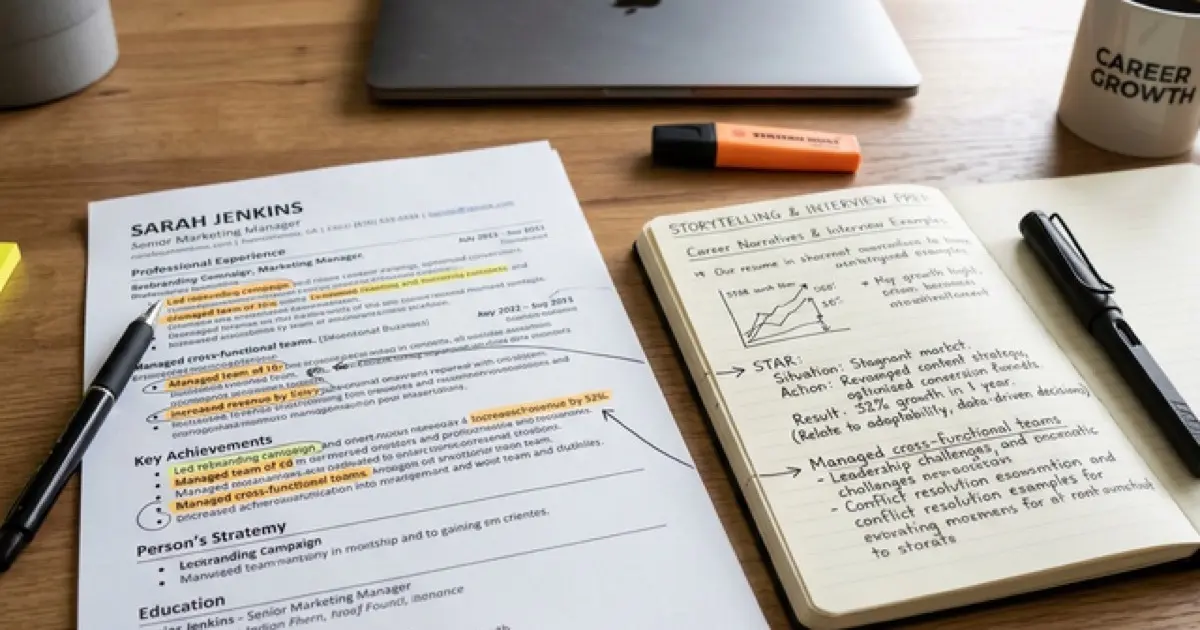
I have sat in over 2,000 interviews. The pattern is always the same. A candidate has a resume full of strong metrics. Impressive bullets. Real accomplishments. Then the interviewer asks "Tell me about a time you led a difficult project," and the candidate freezes. Rambles. Gives a 4-minute answer that buries the metric in irrelevant context. The number that looked powerful on paper becomes invisible in conversation.
The problem is not nervousness. The problem is that nobody taught them how to convert a written achievement into a spoken story. These are two completely different formats, and most candidates treat them as the same thing. They read their resume bullet out loud and hope it lands. It does not.
I reviewed 50,000+ resumes in my recruiting career. The candidates who got offers were rarely the ones with the best bullets. They were the ones who could expand a single bullet into a 90-second story that made the interviewer lean forward. Master the pitch with our Career Pitch Mastery guide for the complete verbal positioning system.
Why Resume Bullets Fail in Interviews
Resume bullets are compressed. They are designed to be scanned in 6 seconds. They strip out context, tension, and process to deliver a clean metric. That compression is exactly what makes them effective on paper and ineffective in conversation.
The gap: Your resume says "Reduced customer churn by 28%." The interviewer reads that and thinks, "Interesting." But in the interview, they want to know: What was churn before? Why did it matter? What did you try that didn't work? What did you actually do? How did you measure it? How long did it take? The bullet has none of this. The story has all of it.
The Expansion Method
Every resume bullet contains a compressed story. The Expansion Method reverse-engineers that story by working backward from the result.
Step 1: Start With the Result (Your Bullet)
Take the bullet exactly as it appears on your resume. This is the ending of your story.
Example bullet: "Reduced average customer support resolution time from 4.2 hours to 45 minutes, improving CSAT from 72% to 91%."
Step 2: Reverse-Engineer the Situation
What was happening before you acted? What was the state of things? Keep this brief. 2-3 sentences maximum.
Expanded Situation: "When I joined the support team, we were handling 800 tickets daily with an average resolution time of 4.2 hours. Customer satisfaction was at 72%, and we were losing accounts directly tied to support experience."
Step 3: Add the Tension
Why did this matter? What was at stake? Tension is what makes a story compelling. Without it, you are just describing a project.
Expanded Tension: "The CEO flagged support as the number one reason for enterprise churn in the quarterly business review. We had 90 days to show measurable improvement or the company was going to outsource the entire function."
Step 4: Detail Your Actions
This is the longest section. What did you specifically do? Not what the team did. What you did. Use first person. Be concrete.
Expanded Actions: "I pulled 6 months of ticket data and categorized every resolution by type, complexity, and time. Three patterns emerged: 40% of tickets were repeat issues with known solutions, 25% required cross-team escalation that had no defined process, and the remaining 35% were genuinely complex. I built a knowledge base for the repeat issues, created an escalation matrix with SLAs for the cross-team tickets, and restructured the queue so complex issues went directly to senior agents instead of being triaged twice."
Step 5: Deliver the Result
Return to your bullet. But now it has context, weight, and proof.
Expanded Result: "Within 60 days, average resolution time dropped from 4.2 hours to 45 minutes. CSAT went from 72% to 91%. The outsourcing conversation was permanently shelved, and we actually grew the team by 4 headcount based on the improved metrics."
The Complete Story (90 Seconds)
"When I joined the support team, we were handling 800 tickets daily with a 4.2-hour average resolution time and 72% CSAT. The CEO had flagged support as the top driver of enterprise churn, and we had 90 days to fix it or the function was getting outsourced. I analyzed 6 months of ticket data and found that 40% were repeat issues with known solutions and 25% were getting stuck in undefined escalation paths. I built a knowledge base for the repeats, created an escalation matrix with SLAs for cross-team handoffs, and restructured the queue so complex issues bypassed first-level triage entirely. Resolution time dropped from 4.2 hours to 45 minutes. CSAT went from 72% to 91%. The outsourcing conversation was shelved, and we grew the team by 4."
Same bullet. Completely different impact.
The Story Mapping System
You do not need a unique story for every possible interview question. You need 8-10 strong stories mapped to question categories.
The 7 Question Categories
Every behavioral interview question maps to one of these categories:
- Leadership: "Tell me about a time you led a team through a challenge"
- Problem-Solving: "Describe a complex problem you solved"
- Conflict: "Tell me about a disagreement with a colleague"
- Failure: "Describe a time something went wrong"
- Collaboration: "Give an example of cross-functional teamwork"
- Pressure: "Tell me about a tight deadline you met"
- Innovation: "Describe a time you improved a process"
How to Map Your Stories
Take your 8-10 expanded stories and tag each one with the categories it can answer. Most stories can serve 2-3 categories by adjusting which element you emphasize.
Example: The support resolution story above can answer:
- Problem-Solving: Emphasize the data analysis and root-cause identification
- Leadership: Emphasize the team restructuring and queue redesign
- Pressure: Emphasize the 90-day deadline and outsourcing threat
- Innovation: Emphasize the knowledge base and escalation matrix
One story, four possible interview questions. That is efficient preparation.
Conversion Examples by Role
Software Engineer
Resume bullet: "Architected microservices migration for legacy monolith, reducing deployment time from 4 hours to 12 minutes and enabling 3x release frequency."
Interview story:
"Our monolith had grown to 2M lines of code over 6 years. Every deployment took 4 hours, required a maintenance window, and had a 15% rollback rate. The CTO gave engineering 2 quarters to move to microservices or accept a perpetual release bottleneck. I mapped the dependency graph, identified 8 bounded contexts, and proposed a strangler fig migration path starting with the lowest-risk, highest-deploy-frequency services. I led the architecture for the first 3 services, built the CI/CD pipeline templates, and documented the migration playbook so other teams could self-serve. Deployment time dropped from 4 hours to 12 minutes, rollback rate went to under 1%, and we tripled our release frequency within 5 months."
Marketing Manager
Resume bullet: "Launched ABM program targeting enterprise accounts, generating $3.2M pipeline and 22 qualified opportunities in first quarter."
Interview story:
"We had a classic marketing efficiency problem: 80% of MQLs were SMB accounts, but 70% of revenue came from enterprise. Our pipeline was full but misaligned. I proposed an ABM pilot targeting our top 50 enterprise accounts. I built the account scoring model using firmographic and intent data, created personalized content tracks for 5 industry verticals, and coordinated a multi-channel campaign across LinkedIn, direct mail, and SDR outreach. The key was aligning marketing and sales on the same account list with shared metrics. In the first quarter, we generated $3.2M in qualified pipeline and 22 opportunities from the target list. The pilot became the permanent enterprise marketing strategy."
Operations Manager
Resume bullet: "Reduced warehouse operating costs by $1.4M annually through workflow redesign and automation of pick-pack-ship process."
Interview story:
"Our 3PL costs were climbing 12% year-over-year while order volume only grew 5%. The gap was in our pick-pack-ship workflow, which had not been redesigned since we were processing half the current volume. I shadowed the warehouse floor for 2 weeks, mapped every step, and found that pickers were walking an average of 6 miles per shift due to poor zone layout. I redesigned the zones based on velocity data, implemented batch picking for multi-item orders, and automated label generation and carton selection. The walk distance dropped to 2.1 miles per shift, picks per hour increased from 45 to 78, and total operating costs dropped by $1.4M annually. We handled a 30% volume increase the following peak season without adding headcount."
Common Conversion Mistakes
Mistake 1: Reading the Bullet Out Loud
Candidate says: "I reduced churn by 28%." Then stops. The interviewer waits. Awkward silence. The bullet was designed to be read, not spoken. In conversation, it needs the story around it.
Mistake 2: Too Much Situation, Not Enough Action
Candidate spends 2 minutes describing the company, the team, the market conditions, the history of the product. Then rushes through the action in 15 seconds. Invert this. Situation should be 15-20 seconds. Action is where your value lives.
Mistake 3: Using "We" Instead of "I"
"We built a new onboarding process" tells the interviewer nothing about your contribution. Replace every "we" with "I" and specify your role: "I designed the curriculum, I built the assessment rubric, I trained the 4 facilitators." Teamwork is important. But the interviewer is hiring you, not your team.
Mistake 4: No Tension
"I was asked to improve the onboarding process, so I did, and it worked." There is no stakes, no conflict, no reason to care. Add tension: "New hire ramp time was 12 weeks, and we were losing 30% of new hires before they hit full productivity. The VP of Sales gave me one quarter to cut ramp time in half or we were going to restructure the entire hiring pipeline."
Convert your resume bullets into offer-winning interview stories
Frequently Asked Questions
How do I practice interview stories without sounding rehearsed?
Practice the structure, not the script. Know your Situation (2 sentences), Tension (1 sentence), Actions (3-4 specific steps), and Result (the metric). Then tell the story conversationally, using different words each time. If you memorize word-for-word, any interruption derails you. If you memorize the structure, you can adapt to any follow-up question naturally.
What if my best resume bullets are from jobs several years ago?
Use them. Strong stories do not expire. Frame with: "One of my most relevant experiences was at [Company] three years ago, where I faced a very similar challenge." Then tell the story. Recency matters less than relevance. A 3-year-old story that directly maps to their current problem beats a recent story that is only tangentially related.
Should I tell the same story to multiple interviewers in a panel?
Different interviewers, different stories. In panel interviews with sequential rounds, assume each interviewer will compare notes. Having 8-10 stories ensures you never repeat. If the same question comes up, pick a different story from the same category. This also demonstrates the depth of your experience, not just the breadth.
How do I convert a resume bullet that was a team achievement?
Identify your specific contribution within the team outcome. "The team launched a new product that generated $5M in first-year revenue" becomes "I led the go-to-market research, identified the 3 highest-value customer segments, and built the pricing model that the team used for launch. The product generated $5M in first-year revenue." The team result is the metric. Your individual actions are the story.
Final Thoughts
Your resume is a compression algorithm. Your interview is a decompression algorithm. Every strong bullet on your resume contains a story that could win you an offer, but only if you know how to expand it. Use the Expansion Method: start with your result, reverse-engineer the situation and tension, detail your specific actions, and deliver the metric with context. Eight to ten stories, mapped to seven question categories, rehearsed to 90 seconds each. That is interview preparation that actually works. The metric on your resume opens the door. The story behind it closes the deal.