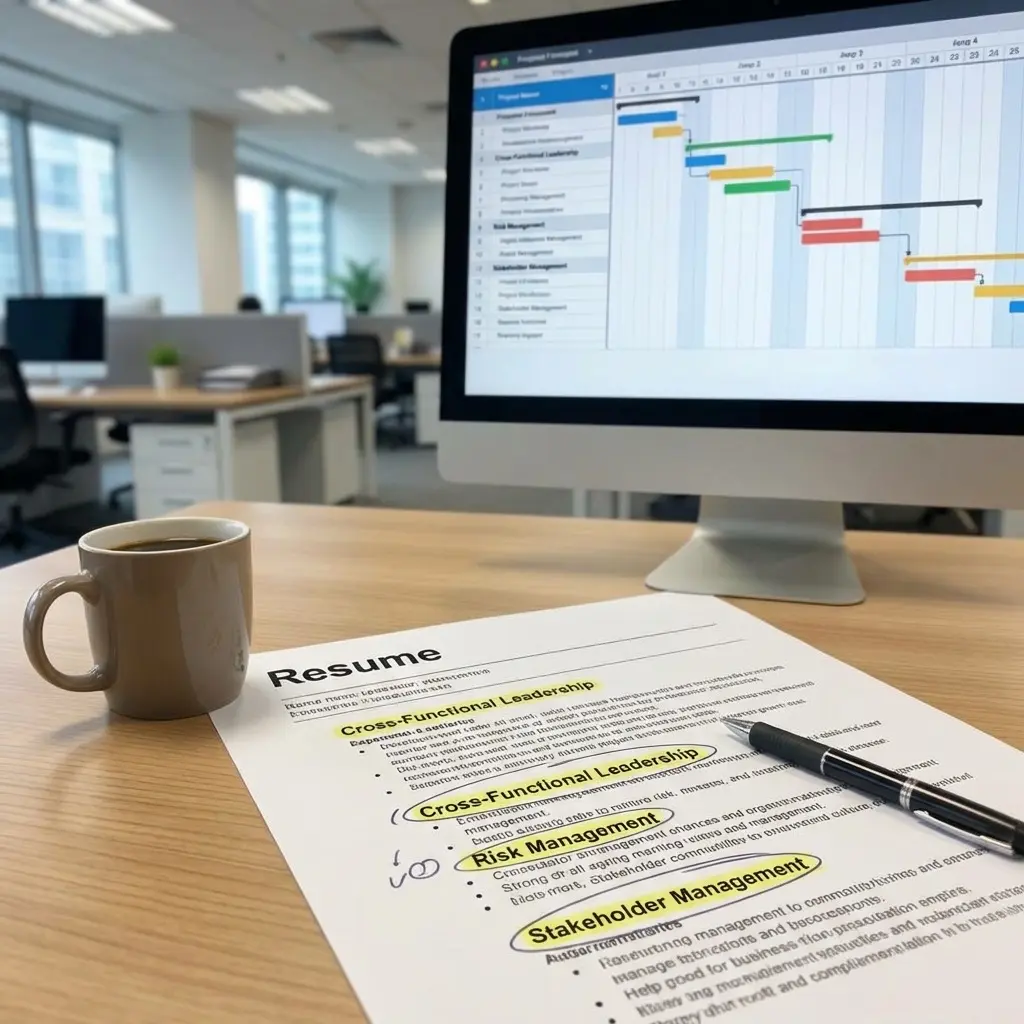
Technical Program Manager Resume: Execution, Complexity & Scale

Technical program managers drive the most complex initiatives in engineering organizations. Your resume needs to show you can handle ambiguity, coordinate across teams, and deliver programs that nobody else can hold together.
The difference between a TPM and a project manager is technical depth. You are not just tracking Gantt charts. You are understanding system architecture well enough to identify risks, resolve dependencies, and make trade-off recommendations that engineering teams trust.
Find exact formulas for translating program management outcomes into measurable impact in our Professional Impact Dictionary.
Why TPM Resumes Fail
Most TPM resumes read like project manager resumes with "technical" added to the title. They list activities instead of outcomes: "managed timelines," "tracked progress," "facilitated meetings." None of these tell me whether you can drive a complex program to completion.
The second failure mode is missing technical context. If your resume does not reference the systems, architectures, or technical decisions involved in your programs, hiring managers will assume you were a glorified scheduler.
What TPM Hiring Managers Evaluate
| Dimension | What They Look For | Resume Signal |
|---|---|---|
| Program Scope | Complexity handled | Teams, engineers, systems, budget |
| Technical Depth | Engineering credibility | Architecture context, technical risk |
| Execution | Delivery track record | On-time delivery, milestone achievement |
| Risk Management | Proactive problem solving | Blockers resolved, dependencies managed |
| Stakeholder Management | Executive communication | VP/C-level engagement, cross-org alignment |
TPM Resume Template
Professional Summary
Establish three things: program scale, technical domain, and delivery track record.
Weak: "Experienced program manager passionate about delivering complex projects on time."
Strong: "Technical Program Manager driving platform migrations and infrastructure modernization across 6 engineering teams (50+ engineers). Delivered $15M cloud migration program 3 weeks early, reducing infrastructure costs by 35%. Track record of 94% on-time milestone delivery across 12 major programs."
Experience Section
Structure each role around major programs, not generic responsibilities.
Program: Cloud Infrastructure Migration ($15M, 18 months)
- "Coordinated migration of 200+ services from on-premise to AWS across 6 engineering teams and 3 infrastructure teams"
- "Identified and resolved 47 cross-team dependencies, preventing 3 potential launch blockers through early risk assessment"
- "Delivered program 3 weeks ahead of revised timeline, resulting in 35% infrastructure cost reduction ($5.2M annual savings)"
- "Managed weekly executive steering committee updates for VP Engineering and CTO, maintaining program alignment through 2 scope changes"
Program: Payment Platform Redesign (8 months)
- "Led technical coordination for PCI-compliant payment platform rebuild across payments, fraud, and identity teams (28 engineers)"
- "Designed and maintained cross-team dependency map tracking 120+ integration points between 15 services"
- "Established risk registry and weekly risk review, resolving 23 technical blockers with average resolution time of 3 days"
- "Enabled processing of $500M+ daily transaction volume on new platform with 99.99% uptime from day one"
Technical Skills
TPMs need a technical skills section that establishes credibility without claiming engineer-level depth:
Program Management: Program planning, Risk management, Dependency management, Stakeholder management, Executive communication, Budget management, Vendor management
Technical Knowledge: Distributed systems, Cloud architecture (AWS/GCP), Microservices, API design, CI/CD, System design, Data pipelines
Tools: Jira, Confluence, Asana, Smartsheet, Google Workspace, Lucidchart, Miro
Common TPM Resume Mistakes
Mistake 1: Activity-Based Bullets
The most common TPM resume mistake. Listing what you did daily instead of what your programs achieved.
Activity-based: "Managed project timelines and tracked deliverables across multiple teams"
Outcome-based: "Drove on-time delivery of 3 concurrent platform programs across 8 teams, achieving 95% milestone adherence while absorbing 2 mid-program scope changes"
Mistake 2: No Technical Context
If I remove your title and your resume could belong to any project manager in any industry, you have a problem.
Each bullet proves you understand the engineering, not just the schedule.
Mistake 3: Missing Stakeholder Evidence
TPMs work across organizational boundaries. Your resume needs to show you can communicate with engineers, directors, and executives equally.
Include specific stakeholder references: "Presented program status and risk assessment to VP Engineering and CTO biweekly" or "Facilitated alignment between Product, Engineering, and Legal teams on compliance requirements."
Mistake 4: No Risk Management Evidence
Risk management is the TPM superpower. If your resume does not show you finding and fixing problems before they derail programs, you are underselling yourself.
Show the pattern: identified risk, assessed impact, drove resolution.
"Identified critical data migration dependency 6 weeks before launch that would have caused 2-week delay. Coordinated parallel workstream with data engineering team, maintaining original timeline."
TPM Resume by Program Type
Infrastructure / Platform Programs
Emphasize: system complexity, migration scale, reliability targets, cost optimization, cross-team technical dependencies.
Key metrics: services migrated, infrastructure cost reduction, downtime during migration, teams coordinated, timeline adherence.
Product Launch Programs
Emphasize: cross-functional coordination (eng, product, design, marketing), launch readiness, feature completion tracking, go-to-market alignment.
Key metrics: features delivered, launch date adherence, revenue impact, user adoption, stakeholder satisfaction.
Compliance / Security Programs
Emphasize: regulatory requirements, audit readiness, cross-functional legal and engineering coordination, risk assessment.
Key metrics: compliance achieved (SOC 2, PCI, GDPR), audit findings resolved, timeline to compliance, cost of compliance.
M&A / Integration Programs
Emphasize: system integration, organizational alignment, technical due diligence, platform consolidation.
Key metrics: systems integrated, teams onboarded, integration timeline, cost synergies achieved, user migration completion.
Build your TPM resume that proves program delivery at scale
Frequently Asked Questions
How is a TPM different from an engineering manager?
Engineering managers own teams and people development. TPMs own programs and cross-team execution. Your resume should emphasize program delivery and coordination, not team management. If you managed people, mention it briefly but do not let it dominate.
Should I list every program I have managed?
No. Feature your 3-5 most complex and impactful programs. Smaller programs can be aggregated: "Delivered 8 additional programs ranging from 4-12 weeks, maintaining 90%+ on-time delivery."
How do I handle a program that failed or was cancelled?
Frame it honestly. "Led technical assessment for [program] resulting in recommendation to discontinue based on cost-benefit analysis, saving $3M in projected engineering investment." Knowing when to stop a program is a TPM skill.
What if I do not have a CS degree?
Many successful TPMs come from non-CS backgrounds. Your resume needs to compensate with demonstrated technical credibility: certifications, technical training, and bullets showing you deeply understood the engineering context of your programs.
How do I show cross-functional leadership on my resume?
Name the specific functions you coordinated: engineering, product, design, legal, compliance, security. Include the organizational level of your stakeholders (VP, Director, C-level). Quantify the coordination scope: "Aligned 5 engineering teams, product management, and legal on PCI compliance program with biweekly steering committee updates to CTO."
Certifications That Matter for TPMs
Not all certifications carry equal weight in TPM hiring. PMP (Project Management Professional) remains the most widely recognized credential, but it signals traditional project management rather than technical program management.
More relevant for TPMs: AWS Solutions Architect or Google Cloud certifications demonstrate technical depth. SAFe Program Consultant (SPC) or SAFe Agilist (SA) show you can operate in scaled Agile environments. CSM or PSM is useful if your programs run Scrum.
List certifications in a dedicated section, but do not rely on them. Your program delivery track record matters ten times more than any certification. A TPM who delivered a $20M platform migration will always beat a TPM with five certifications and vague program descriptions.
Resume Length and Formatting
Senior TPMs with 8+ years of experience should use a two-page resume. Allocate the first page to your summary, your two most impactful programs, and your technical skills. The second page covers earlier career history and additional programs.
Use a clean, single-column format. TPM resumes often include complex program descriptions, and two-column layouts make these harder to scan. White space matters. Do not cram every program onto one page at the expense of readability.
Bold your program names and scope metrics so hiring managers can scan your impact in six seconds.
Final Thoughts
The TPM resume sells one capability: the ability to drive complex, cross-functional technical programs to completion. Every bullet should demonstrate scope, technical depth, and measurable outcomes.
Lead with program scale, show technical context, quantify delivery, and prove you manage risk before it manages you. The best TPM resumes read like a portfolio of successfully delivered programs, not a list of project management activities.