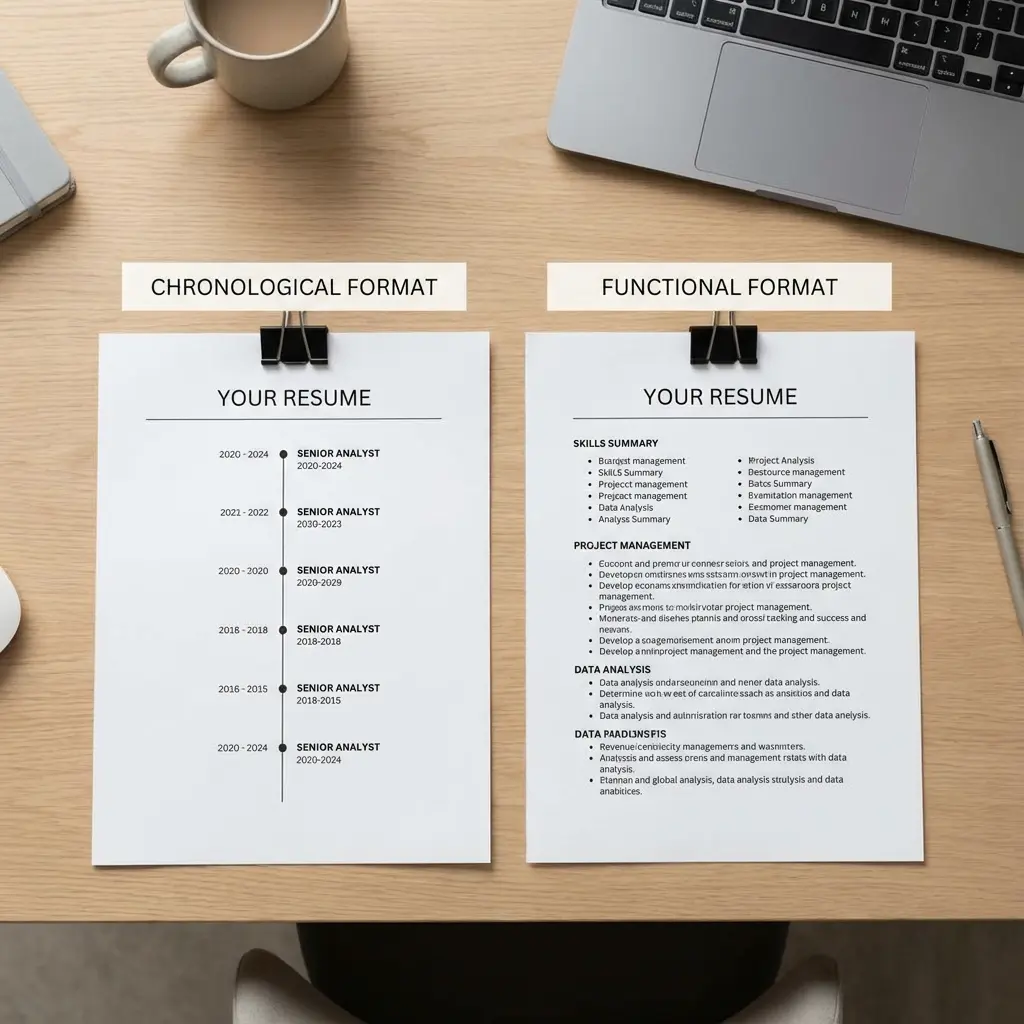
Chronological vs Functional Resume: The 2026 Verdict
Here's what I see every day as a tech recruiter: candidates with employment gaps, career changes, or unconventional paths who think a functional resume will "hide" their timeline issues.
It doesn't hide anything. It just pisses off the ATS system and makes recruiters suspicious.
I'm going to show you the 2026 data on why functional resumes fail—and what actually works when you have a non-traditional career path.
The verdict isn't even close. For comprehensive strategies on making any resume format ATS-friendly, our ATS logic guide breaks down exactly how modern systems parse resumes.
Build an ATS-optimized chronological resume with our templates
What's the Difference? (Format Breakdown)
Chronological Resume
Structure:
Example:
WORK EXPERIENCE

Senior Product Manager | TechCorp
2023 - Present
• Launched 3 B2B SaaS products generating $2.4M ARR
• Led cross-functional team of 12 (design, eng, marketing)
• Reduced feature deployment time 40% through agile adoption

Product Manager | StartupXYZ
2021 - 2023
• Shipped mobile app to 50K+ users in 6 months
• Drove 25% increase in user retention through data analysis
What recruiters see immediately: Your trajectory. Title progression. Tenure at each company. Timeline gaps (if any).
Functional Resume
Structure:
Example:
LEADERSHIP SKILLS
• Led cross-functional teams of 12+ members
• Launched 3 products generating $2.4M revenue
• Reduced deployment time 40% through process optimization

TECHNICAL SKILLS
• Data analysis and user research
• Mobile app development oversight
• Agile methodology implementation

EMPLOYMENT HISTORY
Senior Product Manager, TechCorp (2023-Present)
Product Manager, StartupXYZ (2021-2023)
What recruiters see: Skill categories with no context. Achievements with no dates. Work history buried at the bottom with no details.
The 2026 Data: Why Functional Resumes Fail
ATS Parsing Failure Rate
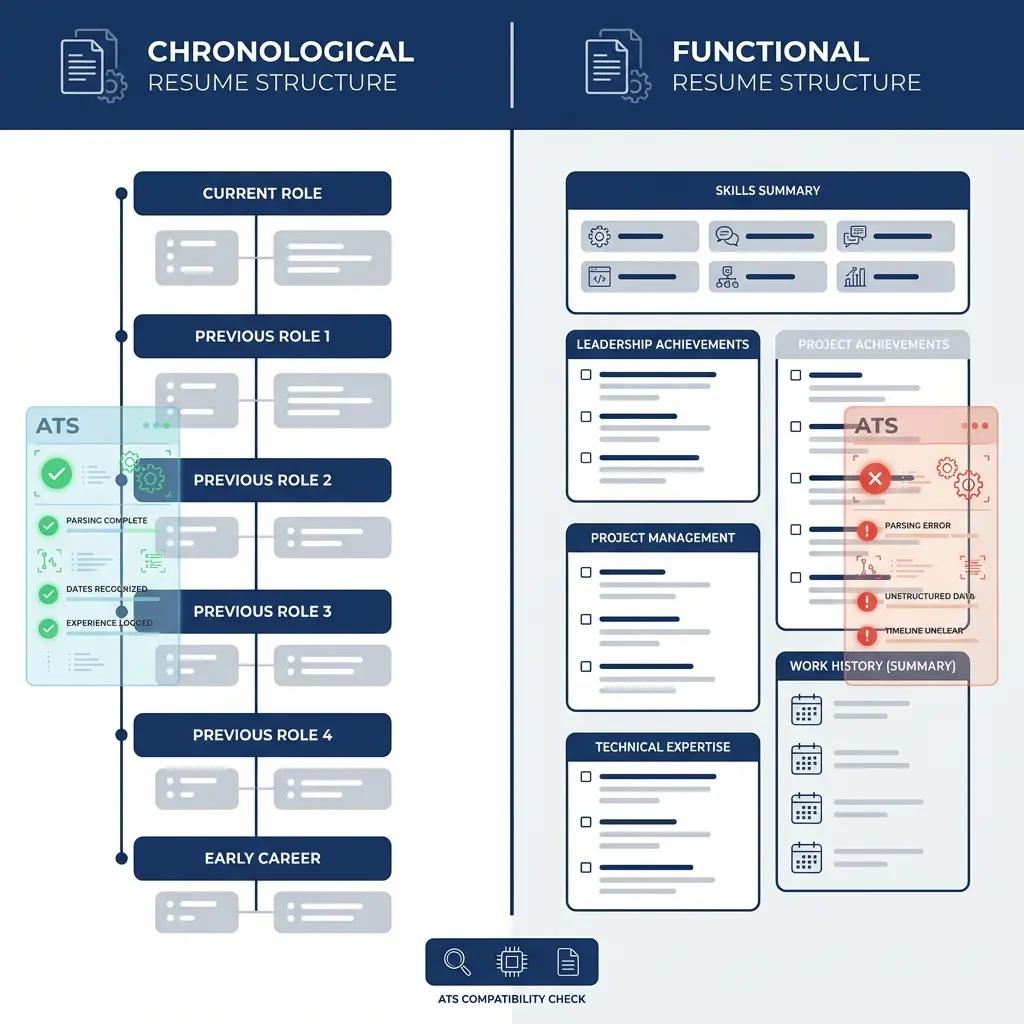
Chronological Resume:
- 89% ATS compatibility (Jobscan 2025 analysis, 10K+ resume tests)
- All job titles, dates, companies correctly extracted
- Work history mapped to timeline
- Candidate profile complete
Functional Resume:
- 35% ATS compatibility
- Skills extracted but not linked to specific jobs
- Achievements listed without dates or employers
- Incomplete candidate profiles → automatic rejection
Real ATS output comparison:
Chronological Resume Parsed Data:
Work History:
- Senior PM, TechCorp (2023-Present): 2 years tenure
- PM, StartupXYZ (2021-2023): 2 years tenure
Skills: Product Management, Team Leadership, Data Analysis
Total Experience: 4 years
Functional Resume Parsed Data:
Work History:
- Senior PM, TechCorp (dates unknown)
- PM, StartupXYZ (dates unknown)
Skills: Product Management, Team Leadership, Data Analysis
Total Experience: UNKNOWN
^ Flagged for manual review or rejection
When the ATS can't calculate your total years of experience or map skills to jobs, you're filtered out before a human even sees your resume.
Recruiter Eye-Tracking Studies
Tobii Pro research (2024) on 500+ recruiters:
Chronological Resume:
- 6.2 seconds average scan time
- Eye path: Name → Current title → Current company → Dates → Top 2 bullets → Next job
- 84% could recall candidate's current role after viewing
- 72% could identify career progression pattern
Functional Resume:
- 3.8 seconds average scan time (38% faster abandonment)
- Eye path: Scattered. No clear pattern. Confusion visible in heat maps.
- 31% could recall candidate's current role
- 12% could identify career progression
What this means: Recruiters give up on functional resumes 40% faster because the format forces them to work harder to extract basic information.
Why Recruiters Hate Functional Resumes
I've reviewed 10,000+ resumes personally. Here's what goes through my head when I see a functional format:
Immediate red flags:
The trust problem:
When you obscure your timeline, you force me to assume the worst. I've seen enough resumes to know that most people hiding their work history have one of these issues:
- Frequent job changes (5+ jobs in 5 years)
- Long employment gaps (6+ months)
- Career change with "irrelevant" experience
- Being fired or laid off multiple times
- Age (trying to hide 20+ years of experience)
Here's the thing: None of those are automatically disqualifying. But making me dig for information is.
When People Think Functional Resumes Work
"I have employment gaps"
What you think functional format does: Hides the gaps.
What it actually does: Makes recruiters immediately search for the gaps. When they can't find clear dates, they assume the worst.
Better approach: Use chronological format with strategic date formatting.
"I'm changing careers"
What you think functional format does: Highlights transferable skills so recruiters ignore your "irrelevant" background.
What it actually does: Confuses recruiters about what you actually did and when.
Better approach: Chronological with reframed bullets.
Wrong (functional):
PROJECT MANAGEMENT SKILLS
• Managed timelines and budgets for complex initiatives
• Coordinated cross-functional stakeholders
Right (chronological):
High School Teacher | Lincoln High School | 2020-2024
• Managed curriculum projects for 120+ students across 4 courses
• Coordinated with parents, administrators, and counselors on student success initiatives
• Developed lesson plans meeting budget and time constraints
Same experience. Different framing. The chronological version gives me context—I can see you were a teacher and you're translating those skills to project management. The functional version just lists generic skills with no proof.
"I'm over 50 and worried about age discrimination"
What you think functional format does: Hides your age by not showing 20+ years of history.
What it actually does: Signals exactly what you're trying to hide (making age discrimination easier, ironically).
Better approach:
The Only Time Functional (Kind Of) Works
Academic CV to Industry Resume:
If you're pivoting from academia where publication lists, teaching, and research are core—and these don't fit chronological structure well—a hybrid format can work:
Structure:
- Summary
- Research Highlights (bullet list, not by job)
- Publications (separate section)
- Work History (reverse chronological, abbreviated)
- Education
But even here: Maintain a clear chronological employment section. Never eliminate the timeline entirely.
What Actually Works: The Chronological Fix
For Employment Gaps
Marketing Manager | CompanyA | 2023 - Present
• [Achievements]

Career Break | Personal | 2022 - 2023
• Completed Google Analytics & SEO certifications
• Freelance consulting for 2 local businesses

Marketing Coordinator | CompanyB | 2020 - 2022
• [Achievements]
Result: Gap is explained, not hidden. I see you stayed productive. No red flag.
For Career Changes
Product Manager | TechCorp | 2024 - Present
• [Achievements in PM role]

High School Teacher | Lincoln HS | 2020 - 2024
• Managed curriculum development for 120+ students (project management)
• Analyzed student performance data to adjust teaching strategies (data analysis)
• Collaborated with parents and admin on student success plans (stakeholder management)
Result: I see the career change clearly. Your teacher bullets are reframed to show PM-relevant skills. Chronological order maintained. No confusion.
For Lots of Short Jobs
RECENT EXPERIENCE

Software Engineer | CompanyD (Contract) | 2024 - Present
• [Achievements]

Software Engineer | StartupC (Acquired) | 2023 - 2024
• [Achievements]
• Note: Startup acquired by MegaCorp; position eliminated post-acquisition

Software Engineer | CompanyB | 2022 - 2023
• [Achievements]

EARLIER EXPERIENCE (2018-2022)

Software Engineer | Multiple contract roles in fintech and healthtech
• Delivered 5+ projects on time and within budget
• Specialized in backend development and API design
Result: I see the job changes. You've added context (contract, acquisition). Earlier roles are condensed but chronology is clear.
The Hybrid Compromise (Use Cautiously)
If you absolutely must highlight skills upfront, use this structure:
Top Section: Skills Summary
CORE COMPETENCIES

Product Strategy | Data Analysis | Agile Leadership | Stakeholder Management
OR:
PROFESSIONAL SUMMARY

Product Manager with 6+ years driving B2B SaaS products from concept to $5M+ ARR. Expert in roadmap prioritization, cross-functional leadership, and data-driven decision making.
Bottom Section: Full Chronological Work History
PROFESSIONAL EXPERIENCE

Senior Product Manager | TechCorp | 2023 - Present
• [Full achievements with context]

Product Manager | StartupXYZ | 2021 - 2023
• [Full achievements with context]
Key rules:
ATS Compatibility Checklist
Frequently Asked Questions
Should I use a chronological or functional resume in 2026?
Use chronological. ATS systems parse chronological resumes 54% more accurately than functional formats. Recruiters spend 6 seconds scanning—chronological format matches their eye-tracking patterns. Functional resumes signal you're hiding something.
Do functional resumes work with ATS systems?
No. Most ATS systems fail to properly parse functional resumes because they can't map skills to employment dates. This results in incomplete candidate profiles and automatic rejections. Chronological format has 89% ATS compatibility vs 35% for functional.
What if I have employment gaps?
Use chronological format with strategic date formatting (years only for short gaps) and add a brief explanation line if the gap exceeds 6 months. Functional resumes don't hide gaps—they just make you look evasive.
Can I use a hybrid resume format?
Yes, but carefully. A skills summary at the top followed by chronological experience works well. The key is maintaining reverse-chronological job history—never bury or reorganize your work timeline.
Why do recruiters hate functional resumes?
Recruiters see 100+ resumes daily. Functional format forces them to reverse-engineer your timeline, which takes mental effort. Eye-tracking studies show recruiters abandon functional resumes 3x faster than chronological ones.
The Bottom Line
Functional resumes don't work in 2026. They fail ATS parsing, frustrate recruiters, and signal you're hiding something—even if you're not.
If you have gaps, career changes, or non-traditional experience, the solution isn't to obscure your timeline. It's to own your timeline and frame it strategically within a chronological structure.
Your resume's job is to get you an interview—not to hide information. Clarity wins.