Civil Engineer Resume Guide: Structural, Transportation & Water Resources
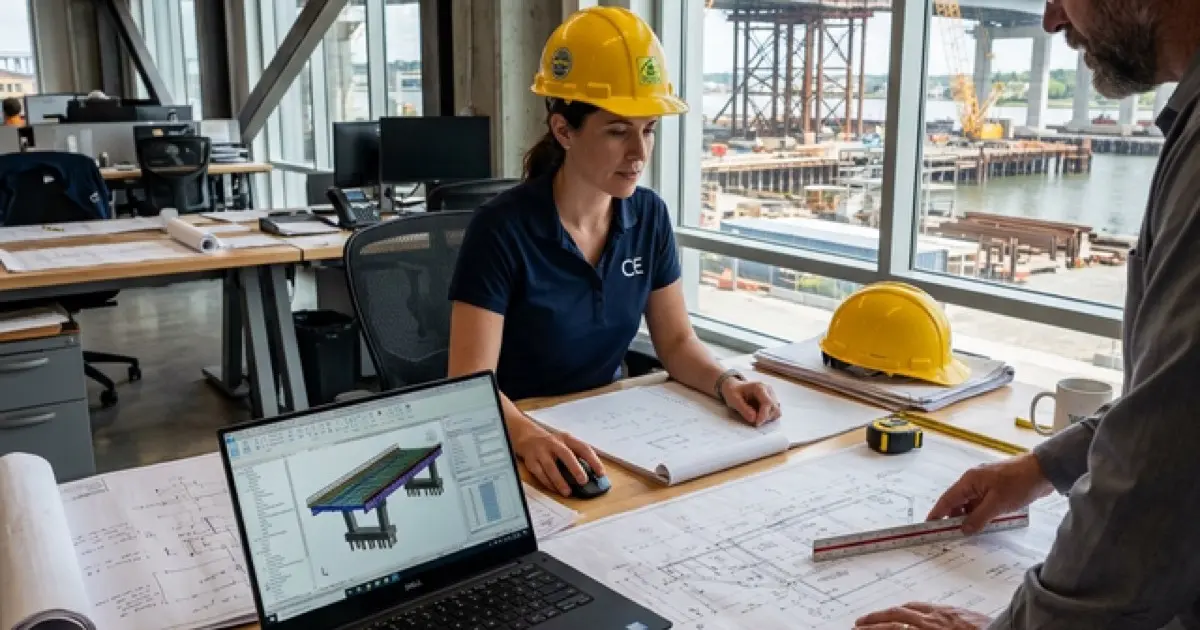
I've recruited for civil engineering firms ranging from 10-person consultancies to multinational firms with 50,000+ employees. The pattern is always the same: the best civil engineers describe their work through project scope and engineering outcomes. The weakest resumes list daily tasks without context. "Designed drainage systems" could mean a backyard French drain or a $50M stormwater management system for a 2,000-acre development. Details matter.
Civil engineering is unique in that your PE license is often worth more than your degree on a resume. It's the first thing I look for, and it's frequently used as a hard ATS filter. After that, I'm scanning for project scale, software proficiency, and standards knowledge.
Here's the complete guide to building a civil engineer resume that gets you past ATS and into the interview. Find exact formulas in our Professional Impact Dictionary.
Resume Format for Civil Engineers
Optimal Structure
Section Order
- Contact Information - Name, PE (if applicable), city/state, email, phone, LinkedIn
- Professional Summary - Specialization, years, PE status, signature project
- Technical Skills - Software, codes, certifications
- Professional Experience - Project-focused bullets with scope
- Education - BSCE/MSCE, university, relevant coursework (early career only)
- Certifications & Licenses - PE, EIT, LEED, PMP
- Professional Affiliations - ASCE, local engineering societies
- Key Projects - Optional, for portfolio-style presentation
Writing Your Professional Summary
Formula
[PE status] + [Years] + [Specialization] + [Project Scale] + [Industry Focus]
Examples
Entry Level (EIT):
Civil engineer (EIT) with BSCE and 2 years of experience in transportation design. Developed geometric design packages for 3 highway improvement projects totaling $28M in construction value using AutoCAD Civil 3D and MicroStation. AASHTO design standards proficient.
Mid-Level (PE):
Licensed Professional Engineer (PE) with 7 years in structural engineering for commercial and institutional buildings. Led structural design for $45M, 12-story mixed-use development from schematic through construction administration. Proficient in SAP2000, ETABS, and Revit Structure.
Senior Level (PE):
Senior civil engineer and PE with 15 years leading infrastructure projects totaling $300M+ in construction value. Managed multi-discipline teams of 20+ engineers on highway, bridge, and water/wastewater projects for state DOT and municipal clients. Proven record of on-time, under-budget delivery.
Technical Skills Section
Design Software
- AutoCAD Civil 3D, MicroStation, OpenRoads Designer
- Revit (Structure, MEP), Navisworks
- ArcGIS, QGIS (geospatial analysis)
- Bluebeam Revu, Adobe Acrobat
- ProjectWise (document management)
Analysis Software
- SAP2000, ETABS (structural analysis)
- STAAD.Pro (structural design)
- RISA-3D (structural modeling)
- HEC-RAS, HEC-HMS (hydraulics/hydrology)
- SWMM, StormCAD (stormwater modeling)
- WaterCAD, WaterGEMS (water distribution)
- MODFLOW (groundwater modeling)
- Synchro, HCS (traffic analysis)
- PLAXIS, GeoStudio (geotechnical analysis)
- MATLAB (engineering analysis)
Design Codes and Standards
- ACI 318 (concrete design)
- AISC 360 (steel design)
- AASHTO LRFD (bridge design)
- AASHTO Green Book (highway design)
- IBC/IRC (building codes)
- MUTCD (traffic control)
- Clean Water Act / NPDES
- ADA accessibility standards
- Local municipal codes
Writing Experience Bullets by Discipline
Structural Engineering
Before:
"Designed concrete and steel structures"
After:
"Designed structural system for 8-story, 180,000 SF post-tensioned concrete office building, performing gravity and lateral analysis in ETABS, developing construction documents in Revit, and managing $32M project through CA with zero structural RFIs"
"Performed seismic retrofit analysis for 1960s-era 4-story concrete frame hospital using ASCE 41 nonlinear procedures in SAP2000, developing strengthening scheme that achieved Immediate Occupancy performance level while minimizing tenant disruption"
"Led structural peer review for $85M steel-framed data center, identifying connection design deficiency that prevented potential $1.2M construction change order"
Transportation Engineering
Before:
"Worked on highway design projects"
After:
"Developed geometric design for 4.5-mile, $67M highway widening project (4-lane to 6-lane) using OpenRoads Designer, coordinating with drainage, structures, and traffic signal design disciplines, achieving FHWA environmental clearance on first submission"
"Designed roundabout interchange at 2 intersections with 35,000 ADT, performing traffic simulation in Synchro/SimTraffic demonstrating 45% reduction in intersection delay and eliminating 85% of angle crash potential"
"Prepared traffic impact study for 1,200-unit mixed-use development, analyzing 15 study intersections and recommending mitigation improvements adopted by county planning commission"
Water Resources and Environmental
Before:
"Designed stormwater systems"
After:
"Designed stormwater management system for 350-acre master-planned community using SWMM and StormCAD, sizing 12 detention basins and 8 miles of storm sewer to meet 100-year flood criteria with zero post-development runoff increase"
"Developed NPDES permit compliance plan for $120M industrial facility, designing treatment train achieving 95% TSS removal and meeting all EPA effluent limits, avoiding $50K/day potential penalty exposure"
"Modeled 25-mile watershed in HEC-HMS and HEC-RAS for FEMA flood map revision (LOMR), resulting in removal of 450 properties from Special Flood Hazard Area and saving property owners $2.1M in annual insurance premiums"
Geotechnical Engineering
Before:
"Conducted soil investigations"
After:
"Directed geotechnical investigation program for $200M bridge replacement including 45 soil borings to 120-foot depth, laboratory testing program, and slope stability analysis in PLAXIS, developing deep foundation recommendations for 8 bridge piers"
"Designed mechanically stabilized earth (MSE) retaining wall system for 2,400 linear feet of highway widening project, achieving $3.2M savings compared to cast-in-place alternative while meeting AASHTO LRFD geotechnical requirements"
Construction Management
Before:
"Managed construction projects"
After:
"Served as Resident Engineer for $45M highway reconstruction project, managing daily construction inspection of 12 subcontractors, processing 85 submittals and 120 RFIs, and maintaining project within 3% of original budget through proactive change order management"
"Administered construction contracts totaling $180M for municipal water treatment plant expansion, coordinating with 6 prime contractors, reviewing 400+ pay applications, and delivering project 2 months ahead of 36-month schedule"
Education Section
Recent Graduate
Bachelor of Science in Civil Engineering, ABET Accredited | State University | 2024 Relevant Coursework: Structural Analysis, Foundation Design, Transportation Planning, Hydraulics Senior Capstone: Designed preliminary roadway alignment for 2.5-mile bypass using Civil 3D (team of 4) GPA: 3.6/4.0 | Dean's List, ASCE Student Chapter President
Experienced Engineer
Master of Science in Structural Engineering | University Name | 2019 Bachelor of Science in Civil Engineering | University Name | 2017
Certifications and Licenses
Common Mistakes to Avoid
Mistake 1: Missing Project Scale
Wrong: "Designed bridges" Right: "Designed 3-span, 450-foot prestressed concrete girder bridge with integral abutments for $12M state highway project, performing load rating analysis per AASHTO LRFD"
Mistake 2: Listing Software Without Context
Wrong: "Proficient in AutoCAD, SAP2000, HEC-RAS" Right: In your experience section: "Performed 2D flood modeling in HEC-RAS for 15-mile river reach, developing floodplain maps adopted in county comprehensive plan update"
Mistake 3: Forgetting Standards and Codes
Wrong: "Designed building to meet code requirements" Right: "Designed lateral force-resisting system per ASCE 7-22 and ACI 318-19 for Seismic Design Category D, Risk Category IV essential facility"
Mistake 4: Omitting PE Status
If you're a PE, it should appear in three places: after your name in the header, in your summary, and in your certifications section. This isn't redundancy. It's ensuring the ATS catches it regardless of which section it scans.
Resume Template: Mid-Level Civil Engineer
[YOUR NAME], PE
[City, State] | [email] | [phone] | [LinkedIn URL]

PROFESSIONAL SUMMARY
Licensed Professional Engineer with [X] years in [specialization].
[Top project with scale and outcome]. [Industry/client focus].

TECHNICAL SKILLS
Design: AutoCAD Civil 3D, MicroStation, Revit, Bluebeam Revu
Analysis: [Specialty-specific tools - SAP2000, HEC-RAS, Synchro, etc.]
Standards: [Relevant codes - AASHTO, ACI, IBC, etc.]
Other: GIS (ArcGIS), MATLAB, Microsoft Project, ProjectWise

PROFESSIONAL EXPERIENCE
[Company Name] | [Title] | [Dates]
- [Project-focused bullet: type + scope + tools + standard + outcome]
- [Project-focused bullet: type + scope + tools + standard + outcome]
- [Project-focused bullet: type + scope + tools + standard + outcome]
- [Project-focused bullet: type + scope + tools + standard + outcome]

[Previous Company] | [Title] | [Dates]
- [Project-focused bullet with metrics]
- [Project-focused bullet with metrics]
- [Project-focused bullet with metrics]

EDUCATION
[Degree] in Civil Engineering | [University] | [Year]

LICENSES & CERTIFICATIONS
Professional Engineer (PE) - [State] - License #XXXXX
[Additional certifications]

PROFESSIONAL AFFILIATIONS
American Society of Civil Engineers (ASCE) - Member since [Year]
Frequently Asked Questions
How do I list projects from multiple clients on my resume?
Group by employer, not by client. Under each employer, describe your most impactful projects with enough detail to show scope without revealing confidential client names. Use descriptions like "national retail chain," "state DOT," or "Fortune 500 industrial client" if needed. Name public projects where your firm is publicly listed as engineer of record.
Should I include field experience on a design-focused resume?
Yes. Field experience is a differentiator for design engineers. "Conducted construction observation for $25M project, reviewing 50+ submittals and performing 200+ concrete placement inspections" shows you understand how designs translate to construction. Many firms specifically seek designers with field experience.
How do I handle working on large projects where I was one of many engineers?
Describe your specific contribution, not the overall project. "Led foundation design for 3 of 8 buildings in $200M campus expansion" is honest and specific. "Managed $200M campus expansion project" is misleading if you designed foundations for part of it. Hiring managers respect accuracy and will ask about your specific role in interviews.
Is LEED certification valuable on a civil engineer resume?
Increasingly yes, especially for site/civil, land development, and municipal engineering. LEED AP with BD+C or ND specialty shows sustainability expertise that many clients now require. If you don't have LEED, consider listing experience with green infrastructure: bioswales, permeable pavements, rain gardens, and LID (Low Impact Development) techniques.
How do I transition between civil engineering subdisciplines?
Emphasize transferable engineering fundamentals: project management, AutoCAD/Civil 3D, code compliance, client coordination, and construction administration. Highlight any cross-disciplinary exposure: a structural engineer who coordinated with geotechnical teams, or a transportation engineer who designed drainage. Take one relevant course or certification in your target subdiscipline and list it prominently.
Build your PE-ready civil engineer resume now
Final Thoughts
Civil engineering resumes succeed when they read like project summaries: specific scope, measurable scale, and clear engineering outcomes. Every bridge has a span length, every highway has a budget, and every treatment plant has a capacity. Put those numbers on your resume. Lead with your PE status, organize your skills by engineering discipline, and prove every capability with a project that has a dollar amount, a deadline met, or a standard exceeded. That's the formula that turns a generic engineering resume into an interview-winning one.