Electrical Engineer Resume Guide: Power Systems, PCB & Control Design
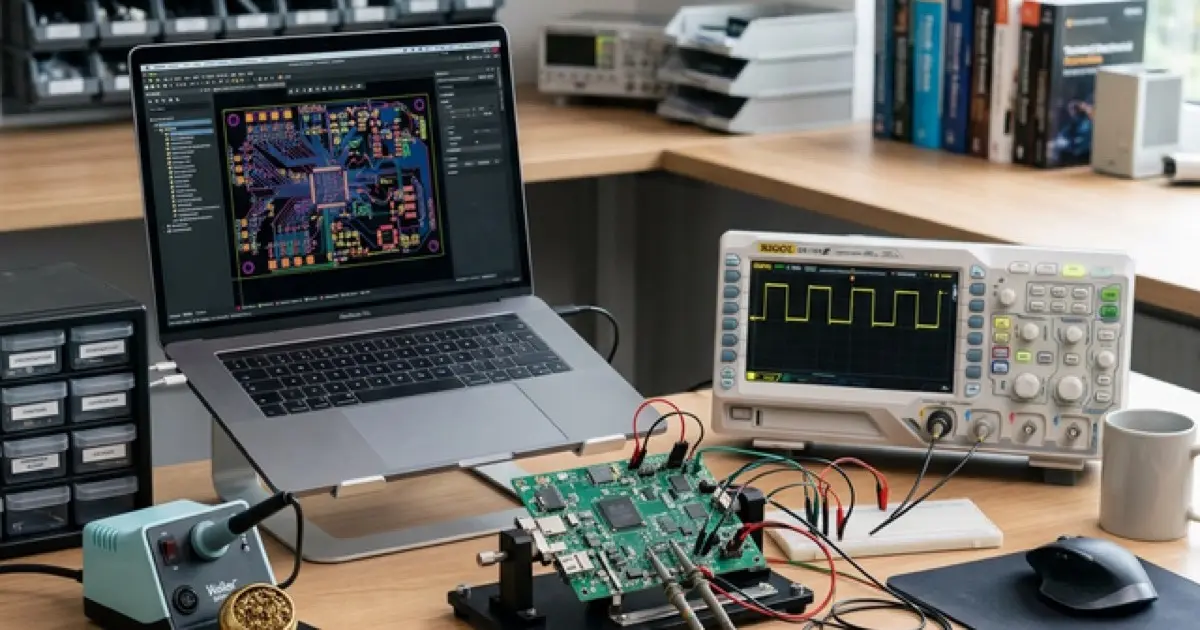
I've recruited electrical engineers for semiconductor companies, power utilities, defense contractors, and consumer electronics firms. The resumes that fail share one trait: they describe responsibilities instead of engineering contributions. "Responsible for circuit design" tells me nothing. "Designed 4-layer mixed-signal PCB with 0.5mm pitch BGA, achieving first-pass DFM approval and reducing board area by 30%" tells me everything.
Electrical engineering is a field where technical precision matters in your work and your resume. Hiring managers scanning EE resumes look for specific tools, standards, specifications, and measurable design outcomes. Vague descriptions suggest vague engineering.
Here's the complete guide to building an electrical engineer resume that passes ATS screening and impresses the engineering manager reviewing it. Find exact formulas in our Professional Impact Dictionary.
Resume Format for Electrical Engineers
The Right Structure
Section Order
For most electrical engineers, this order works best:
- Contact Information - Name, email, phone, LinkedIn, location (city/state only)
- Professional Summary - 2-3 sentences with specialization and top achievements
- Technical Skills - Categorized skill list (15-20 items)
- Professional Experience - Reverse chronological with quantified bullets
- Education - Degree, university, relevant coursework (if early career)
- Certifications - PE, FE, industry certifications
- Projects - Optional, for early career or significant personal projects
- Patents/Publications - If applicable
Writing Your Professional Summary
Your summary is the first thing a hiring manager reads after your name. Make it count.
Formula
[Years] + [Specialization] + [Top Achievement] + [Domain Expertise]
Examples by Experience Level
Entry Level (0-3 years):
Electrical engineer with BSEE and 2 years of experience in analog circuit design and PCB layout using Altium Designer. Designed power management circuits for IoT devices achieving 95% power efficiency. FE certification in progress.
Mid-Level (4-8 years):
Electrical engineer with 6 years of experience in power electronics design for automotive applications. Led development of 800V SiC inverter platform achieving 98.5% efficiency, now in production across 3 vehicle platforms. PE licensed in California.
Senior Level (9+ years):
Senior electrical engineer with 12 years in mixed-signal IC design for medical devices. Led 8-person design team through 4 successful tape-outs, including FDA Class II certified patient monitoring SoC. 5 patents granted, 3 pending.
Key Skills Section
Organize skills by category. This section is your ATS keyword bank.
Design Tools
- Altium Designer, OrCAD/Cadence, KiCad, Eagle
- MATLAB/Simulink, LabVIEW, PSpice/LTSpice
- AutoCAD Electrical, EPLAN, SolidWorks Electrical
- Ansys (HFSS, Maxwell), COMSOL Multiphysics
- Xilinx Vivado, Intel Quartus, ModelSim
Programming Languages
- C/C++ (embedded systems)
- Python (test automation, data analysis)
- VHDL/Verilog (FPGA/ASIC design)
- MATLAB (simulation and analysis)
- Assembly (microcontroller level)
- LabVIEW (test and measurement)
Hardware Platforms
- ARM Cortex-M (STM32, NXP)
- Texas Instruments (MSP430, C2000, Sitara)
- Microchip (PIC, AVR, SAM)
- Xilinx/AMD (Zynq, Artix, Kintex)
- Intel FPGA (Cyclone, Arria)
- Raspberry Pi, Arduino (prototyping)
Test Equipment
- Oscilloscopes (Keysight, Tektronix)
- Spectrum analyzers, network analyzers
- Logic analyzers, protocol analyzers
- Power supplies, electronic loads
- LCR meters, impedance analyzers
- Thermal chambers, EMC test equipment
Writing Experience Bullets by Specialization
Power Electronics
Before:
"Designed power supplies for industrial equipment"
After:
"Designed 5kW AC-DC power supply with PFC achieving 94% efficiency and meeting IEC 61000-3-2 harmonic limits, reducing thermal management cost by $12 per unit across 50K-unit annual production"
"Developed 48V-to-3.3V multi-phase buck converter for server applications using GaN FETs, achieving 97% peak efficiency and 80A output with 0.5% load regulation"
"Led EMC pre-compliance testing and redesign of 3-phase motor drive, resolving conducted emissions failures and achieving first-pass EN 55011 Class B certification"
PCB Design
Before:
"Designed circuit boards"
After:
"Designed 12-layer HDI PCB for 5G base station RF front-end with controlled impedance traces, achieving signal integrity targets across 28GHz mmWave paths with less than 0.5dB insertion loss"
"Developed DFM-optimized 6-layer mixed-signal PCB combining analog sensor interface, digital processing, and isolated power, reducing BOM cost by 22% through component consolidation and achieving 99.2% first-pass yield"
"Created PCB design guidelines library covering stack-up specifications, trace width calculations, and component placement rules, adopted across 4-person design team and reducing layout review cycles by 60%"
Embedded Systems
Before:
"Programmed microcontrollers"
After:
"Developed firmware for STM32-based motor control platform in C, implementing FOC algorithm achieving 0.1% speed regulation at 20kRPM with real-time diagnostics over CAN bus"
"Designed and verified custom FPGA IP block in VHDL for real-time signal processing, implementing 256-point FFT at 100MHz clock with resource utilization under 15% on Xilinx Artix-7"
"Built automated hardware-in-the-loop test system using Python, NI DAQ, and LabVIEW, reducing product validation time from 3 weeks to 4 days across 200+ test cases"
Control Systems
Before:
"Worked on control systems"
After:
"Designed PID control system for precision motion platform using MATLAB/Simulink, achieving 1-micron positioning accuracy and 50ms settling time, deployed on TI C2000 real-time controller"
"Developed model predictive control (MPC) algorithm for HVAC energy management system, reducing building energy consumption by 28% while maintaining temperature within 0.5 degrees C of setpoint across 12 zones"
RF and Communications
Before:
"Designed RF circuits"
After:
"Designed 2.4GHz RF front-end for IoT sensor module achieving -105dBm receiver sensitivity and +18dBm transmit power with 35% PAE, meeting FCC Part 15 requirements on first submission"
"Developed antenna matching network for multi-band (700MHz-2.5GHz) cellular module using Smith chart analysis and HFSS simulation, improving VSWR from 3.2:1 to 1.3:1 across all operating bands"
Education Section
What to Include
For recent graduates (0-3 years):
Bachelor of Science in Electrical Engineering | University Name | 2024 Relevant Coursework: Power Electronics, Control Systems, Digital Signal Processing, VLSI Design Senior Design: Autonomous drone flight controller using STM32 and custom IMU sensor fusion (1st place departmental competition) GPA: 3.7/4.0
For experienced engineers (4+ years):
Master of Science in Electrical Engineering | University Name | 2020 Focus: Power Systems and Renewable Energy
Bachelor of Science in Electrical Engineering | University Name | 2018
Drop GPA after 3 years of experience. Drop coursework after 5 years unless it's directly relevant to a niche role.
Certifications That Matter
Common Mistakes to Avoid
Mistake 1: Listing Responsibilities Instead of Achievements
Wrong: "Responsible for designing power converters" Right: "Designed 3 power converter topologies (flyback, full-bridge, LLC) for 100W-5kW range, all achieving first-pass certification to UL 62368-1"
Mistake 2: Missing Specifications and Numbers
Wrong: "Improved circuit performance" Right: "Improved ADC signal chain SNR from 72dB to 89dB through optimized layout, component selection, and anti-aliasing filter redesign"
Mistake 3: Using Generic Tool Names
Wrong: "Experienced with CAD software" Right: "Altium Designer (8 years, advanced multi-channel design), MATLAB/Simulink (6 years, control system modeling), LTSpice (5 years, power electronics simulation)"
Mistake 4: Ignoring Standards and Certifications
Wrong: "Ensured product safety compliance" Right: "Led product through UL 62368-1, IEC 61000-4 (EMC immunity), and FCC Part 15 Class B certification, managing test lab relationship and resolving 3 non-conformances within 2-week timeline"
Resume Template: Mid-Level Electrical Engineer
Here's a structural template you can follow:
[YOUR NAME]
[City, State] | [email] | [phone] | [LinkedIn URL]

PROFESSIONAL SUMMARY
Electrical engineer with [X] years in [specialization]. [Top achievement with metric].
[Secondary achievement]. [Domain/industry expertise].

TECHNICAL SKILLS
Design Tools: Altium Designer, OrCAD, MATLAB/Simulink, LTSpice, AutoCAD Electrical
Programming: C/C++, Python, VHDL, MATLAB, LabVIEW
Hardware: ARM Cortex-M, TI C2000, Xilinx FPGA, analog sensor interfaces
Standards: UL 62368-1, IEC 61000, IEEE 519, NEC, FCC Part 15
Test: Keysight oscilloscopes, spectrum analyzers, network analyzers, thermal chambers

PROFESSIONAL EXPERIENCE
[Company Name] | [Title] | [Dates]
- [Achievement bullet with technical detail + metric]
- [Achievement bullet with technical detail + metric]
- [Achievement bullet with technical detail + metric]
- [Achievement bullet with technical detail + metric]

[Previous Company] | [Title] | [Dates]
- [Achievement bullet with technical detail + metric]
- [Achievement bullet with technical detail + metric]
- [Achievement bullet with technical detail + metric]

EDUCATION
[Degree] in Electrical Engineering | [University] | [Year]

CERTIFICATIONS
PE License - [State] | FE/EIT Certified
[Other relevant certifications]
Frequently Asked Questions
Should I include personal electronics projects on my resume?
If you're early career (0-5 years), absolutely. Projects demonstrate initiative and hands-on skills. "Designed and built custom Li-ion battery management system with STM32 and CAN bus interface" shows more than a course listing ever could. For senior engineers, include personal projects only if they're relevant to the target role or demonstrate skills outside your work experience.
How do I handle a broad EE background across multiple specializations?
Create a master resume with all specializations, then tailor for each application. For a power electronics role, lead with power design bullets and push digital design to secondary. For an embedded systems role, reverse the emphasis. Your technical skills section can remain broad, but your experience bullets should prioritize what the posting asks for.
Should I include publications and patents?
If you have them, create a separate section. For patent-heavy roles (semiconductor, medical device), patents demonstrate innovation and are actively scanned for. For applied engineering roles, one line per patent is sufficient: "US Patent 11,XXX,XXX - High-efficiency GaN-based power converter topology." Publications matter more for research-oriented positions.
How important is PE licensure for electrical engineers?
Critical for power systems, utilities, consulting, and any role requiring stamping designs. In these fields, PE is a hard ATS filter. For semiconductor, embedded, and consumer electronics, PE is less common but still a differentiator. If you're FE-certified and pursuing PE, list: "FE Certified, PE exam scheduled [date]."
How do I show leadership on an EE resume without a management title?
Use keywords like: "led cross-functional design review," "mentored 2 junior engineers," "coordinated with mechanical, firmware, and test teams," "presented design trade-offs to director-level stakeholders," "established PCB design guidelines adopted by team." Technical leadership counts, and engineering managers recognize it.
Build your precision-engineered electrical resume now
Final Thoughts
Electrical engineering resumes need the same precision you apply to your designs. Every specification matters, every number tells a story, and every tool you list should be one you can discuss in an interview. Use this guide to structure your resume around specific technical contributions, measurable design outcomes, and the professional vocabulary that ATS systems and engineering managers expect. Your resume should read like a design spec: clear, precise, and backed by data.