Cloud Architect Resume: Examples & Template

Introduction
In the remote work world, the "Cloud" isn't just a buzzword; it's the office. And the person who designs that office—the Cloud Architect—is one of the most critical hires a modern company can make.
But here is the problem I see with most Cloud Architect resumes: they look like Senior SysAdmin resumes.
They list 50 tools, 10 operating systems, and every router config they've ever touched. They miss the point. A Cloud Architect isn't just a "Super Admin." They are a strategist. They are a visionary. They bridge the gap between business goals and technical reality. For comprehensive strategies on optimizing your resume language, our professional impact dictionary covers the exact verbs and metrics for cloud engineering roles.
If you want the $200k+ remote roles, your resume needs to stop saying "I built servers" and start saying "I designed the future of our infrastructure."
Here is how to make that shift.
The Architect Mindset Shift
To write a winning resume, you need to understand what hiring managers are actually looking for.
- DevOps Engineer: "Can they build the pipeline?"
- SysAdmin: "Can they keep the server running?"
- Cloud Architect: "Can they design a system that is secure, scalable, cost-effective, and solves our specific business problem?"
Your resume must reflect decision-making. Why did you choose AWS over Azure? Why serverless over containers? Why NoSQL over SQL?
Essential Skills for 2026
When I browse global job listings, the requirements for Cloud Architects have evolved. It's no longer just about "lifting and shifting" VMs.
How to List Skills
Group them to show your architectural thinking. For the complete list of ATS-optimized keywords by cloud platform and architecture pattern, see our cloud architect resume keywords guide.
Core Competencies: Cloud Strategy, Migration Planning, Disaster Recovery, FinOps, Hybrid Cloud Architecture, Zero Trust Security.
Technical Stack:
- AWS: EC2, Lambda, S3, RDS, DynamoDB, VPC, Route53, CloudFront
- Azure: Virtual Machines, Azure Functions, Blob Storage, Cosmos DB, Azure AD
- IaC & Automation: Terraform, Packer, Ansible, CloudFormation
- Containers: Kubernetes (EKS/AKS), Docker, Fargate
The Resume Structure
1. The Strategy-First Summary
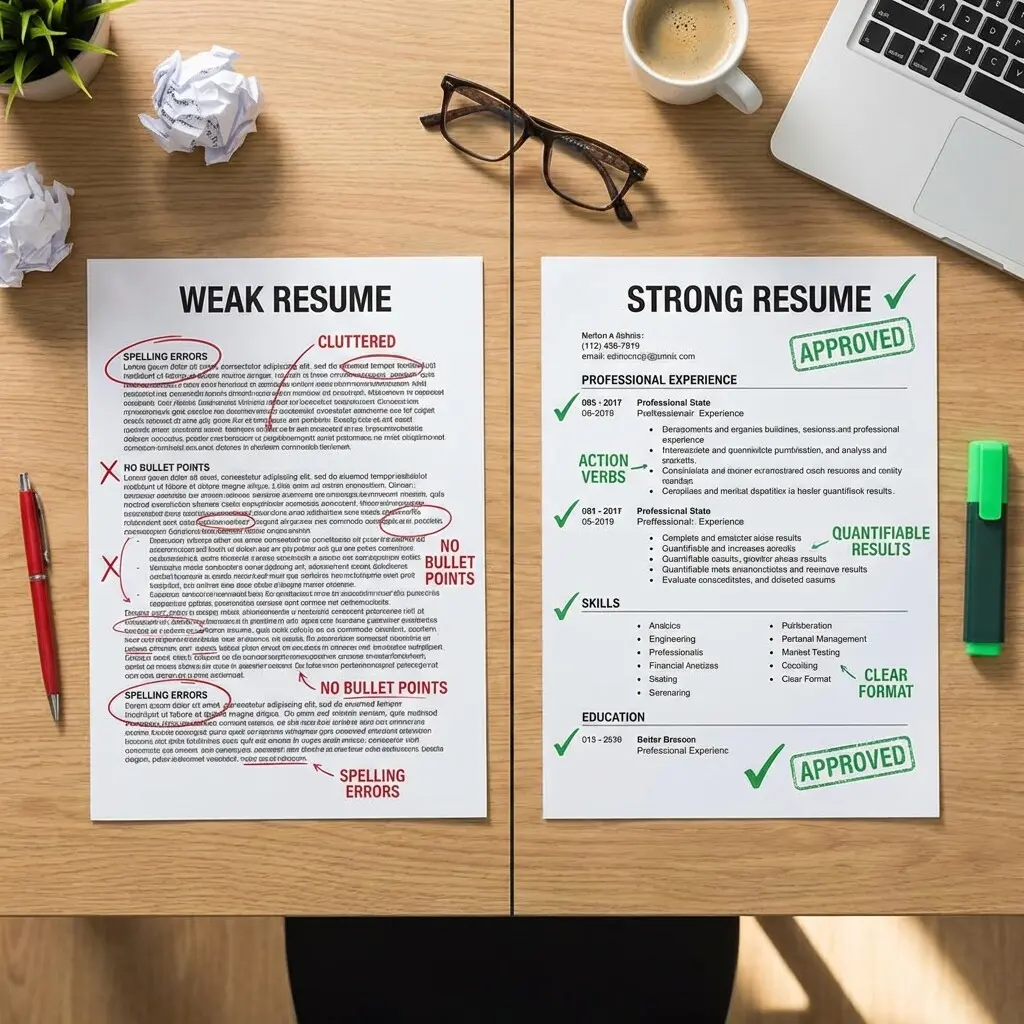
Bad: "Cloud Architect with 10 years experience in IT. Certified in AWS. Looking for a challenging role."
Good: "AWS Certified Solutions Architect Professional with 8+ years designing scalable, fault-tolerant cloud systems. Specialized in migrating legacy on-premise applications to cloud-native microservices architectures. Successfully managed cloud portfolios for FinTech clients with budgets exceeding $5M/year, consistently delivering 20%+ cost reductions."
This summary hits all the marks: Certification, specific focus (migration), industry relevance (FinTech), and financial impact.
2. Experience: The "Problem-Strategy-Outcome" Model
For each role, structure your bullet points to tell a mini-story.
Example 1: The Migration
- Bad: "Migrated servers to AWS."
- Good: "Led the strategic migration of 200+ on-premise servers to AWS, replacing legacy VMs with containerized workload on EKS, resulting in a 40% reduction in licensing costs."
Example 2: The Scalability Fix
- Bad: "Used Auto Scaling."
- Good: "Redesigned e-commerce checkout flow using AWS Lambda and DynamoDB to handle Black Friday traffic spikes of 100k requests/second with zero downtime."
Example 3: The Governance
- Bad: "Wrote Terraform scripts."
- Good: "Established organization-wide Infrastructure as Code (IaC) governance framework using Terraform, reducing provisioning time from days to minutes and ensuring 100% compliance with security standards."
Check out our ultimate resume guide for more on how to frame your achievements.
Resume Templates
The "All-In AWS" Architect
Best for: Roles at AWS partners or AWS-heavy shops.
Headline: Senior AWS Cloud Architect | Serverless & Data Analytics Specialist
Key Project: Data Lake implementation
- Designed a serverless data lake architecture using S3, Glue, and Athena to replace a legacy Data Warehouse.
- Reduced data processing latency by 60% and query costs by 75%.
- Presented architectural proofs-of-concept (POCs) to C-suite stakeholders to secure $500k project funding.
The "Multi-Cloud" Strategist
Best for: Enterprise Corp roles.
Headline: Enterprise Cloud Architect | Azure & Hybrid Cloud Expert
Experience: Global Logistics Firm
- Architected a hybrid connectivity solution using AWS Direct Connect and Azure ExpressRoute to link 3 global data centers.
- Implemented a unified identity management system using Azure AD B2C, simplifying login for 50,000+ users.
- Designed a multi-region Disaster Recovery plan meeting a strict 4-hour RTO (Recovery Time Objective).
Upgrade Your Resume to Architect Level
From Senior Engineer to Architect: The Gap
Many of you reading this are Senior Engineers trying to make the jump. The hardest part of this transition is demonstrating "Architecture" without having the title yet.
How to bridge the gap:
- Lead the Design Phase: Even if you aren't the architect, ask to write the Design Doc (RFC). Adding "Authored technical design documents for [Project]" to your resume is a huge signal.
- Mentorship: Architects teach. Show that you mentor juniors on best practices. For example, help them transition from full stack development to architectural thinking.
- Cost Awareness: Engineers rarely care about billables. Architects must. Start optimizing costs in your current role and put that on your resume. "Reduced development environment costs by 30% by implementing auto-shutdown scripts."
Designing for Cost (FinOps)
In 2026, "FinOps" (Financial Operations) is a required skill. Cloud bills have exploded, and companies are hiring architects specifically to tame them.
If you can prove you save money, you will get hired.
Keywords to add:
- Cost Optimization
- Reserved Instances / Savings Plans
- Spot Instances
- Right-sizing
- Tagging Strategy
- CloudHealth / Cost Explorer
Example Bullet Point: "Implemented comprehensive FinOps tagging strategy across 500+ AWS resources, enabling granular chargeback to business units and identifying $10k/month in wasted spend."
The 3 Types of Cloud Architects
Understanding which "flavor" of architect you are helps tailor your resume.
- The Infrastructure Architect: Focuses on the "Plumbing." Virtual Networks, VPNs, Peering, Subnets, Firewalls. Resume should highlight networking expertise and security. Many Infrastructure Architects transition from traditional IT roles—see our systems administrator resume guide for more on those foundational skills.
- The Application Architect: Focuses on how code runs. Serverless functions, event queues, API Gateways, Microservices patterns. Resume should highlight coding patterns and scalability.
- The Enterprise Architect: Focuses on high-level strategy and governance. Compliance, multi-cloud policy, C-level presentations. Resume should highlight business alignment and risk management.
Experience with Legacy Systems (The Hybrid Reality)
While we love to talk about "Cloud Native," most large companies are still hybrid. They have a mainframe in the basement and a Kubernetes cluster in the cloud.
If you have on-premise experience (VMware, Networking, Data Centers), do not hide it. It is a superpower.
Being able to say, "I understand how to connect your legacy Oracle database to your new AWS Lambda function via Direct Connect" makes you incredibly valuable to banks, hospitals, and insurers. Frame your legacy skills as "Hybrid Connectivity" expertise.
Addressing Non-Disclosure Agreements (NDAs)
A common issue for architects working on sensitive enterprise projects is the NDA. "How do I list my project if I can't name the client or the specific IP?"
The strategy: Focus on the scale and the technology, not the client name.
- Instead of: "Architected key infrastructure for Project X at Apple."
- Say: "Architected high-availability infrastructure for a Top-3 Global Tech Company, supporting 100M+ daily active users, maintaining 99.999% uptime."
This actually sounds more impressive because it forces you to focus on the metrics that matter. Never violate your NDA, but don't let it silence your achievements either.
Certifications: The Proof in the Pudding
Certifications are non-negotiable for most Architect roles. They validate that you haven't just "figured it out" but understand the vendor's intended best practices.
List them prominently:
- AWS: Certified Solutions Architect – Professional (The Holy Grail)
- Azure: Solutions Architect Expert
- Google: Professional Cloud Architect
If you are currently studying for one, list it as "(In Progress - Expected Completion: Jan 2026)."
Final Thoughts
A Cloud Architect resume is a blueprint of your career. It needs to show that you can see the big picture.
Don't get bogged down in the weeds of every script you ever wrote. Elevate your story. Accurate diagrams, solid financial reasoning, and scalable designs are your product.
Your resume should prove that hiring you isn't an expense—it's an investment that will save them money and headaches for years to come.
Now go design your next career move.