Career Fair Resume Preparation: What to Print, Say, and Follow Up
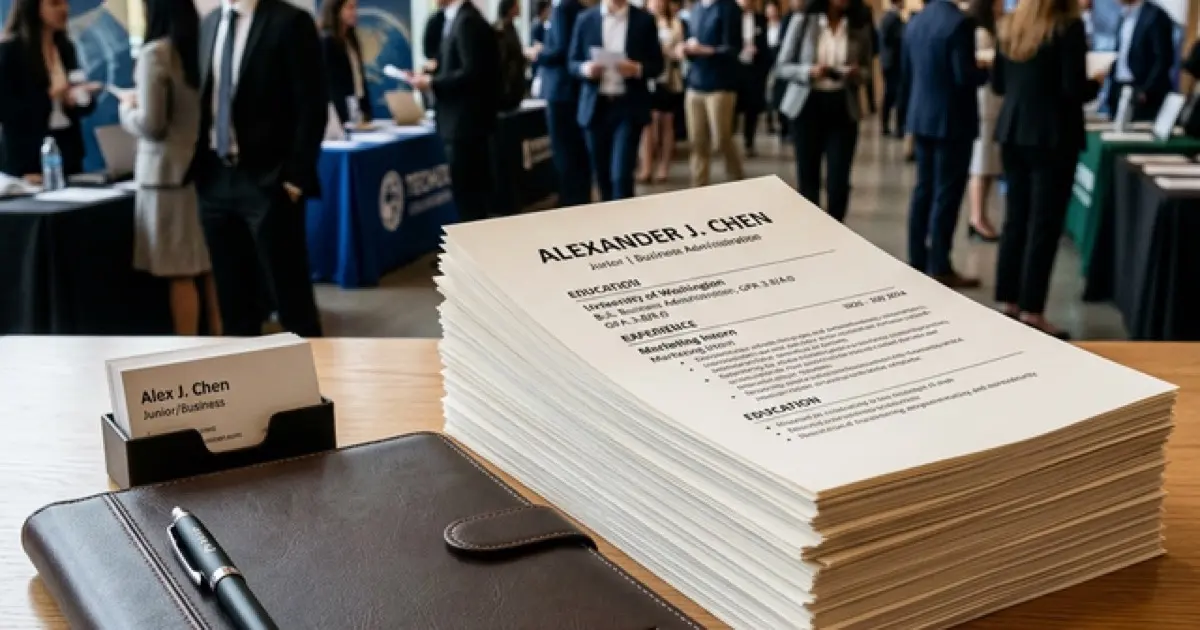
My first career fair was a disaster. I printed 10 copies of a generic resume, wore a blazer that did not fit, and wandered from booth to booth saying "I am interested in any available positions." I left without a single follow-up conversation. My second career fair, I researched 8 companies, prepared two resume versions, practiced a 30-second pitch, and followed up with every recruiter within 12 hours. I got three interviews from that fair, and one of them became my first full-time job.
Career fairs are not casual browsing events. They are compressed networking opportunities where you have 2-3 minutes to make an impression that either advances you toward an interview or gets your resume added to a stack that never gets reviewed. The students who walk out with interview invitations are the ones who treated the fair like a strategic operation: researched targets, prepared materials, delivered a pitch, and followed up fast.
For the complete methodology on translating your experience into compelling resume language, see our Ultimate Experience Translation Guide.
Before the Fair: Research and Preparation
Step 1: Get the Company List Early
Your career center publishes the list of attending companies days or weeks before the fair. Get it immediately. This list is your battle plan.
For each company on your priority list, research:
This research serves two purposes: it helps you tailor your pitch to each company, and it gives you conversation material that demonstrates genuine interest.
Step 2: Prepare Your Resume Versions
You cannot create a unique resume for every company, but you can prepare 2-3 versions targeting different company types.
Version strategy example for a CS student:
| Version | Target Companies | Emphasis |
|---|---|---|
| Version A | Tech companies (Google, Microsoft, startups) | Software engineering projects, coding languages, system design |
| Version B | Consulting firms (Deloitte, Accenture) | Analytical projects, teamwork, business acumen |
| Version C | General (banks, retailers, other) | Broad skills, leadership, adaptability |
Printing specifications:
- Paper: 24-32 lb weight, bright white or ivory
- Format: Clean, single-column, ATS-friendly layout
- Quantity: 20-30 copies total across all versions
- Storage: Professional padfolio or folder, never folded or wrinkled
Step 3: Write Your 30-Second Elevator Pitch
You will repeat this pitch 10-20 times at the fair. It needs to be natural, confident, and tailored.
The formula:
- Name and context (5 seconds): "Hi, I am [Name], a [Major] [Year] at [University]."
- Proof point (10 seconds): "I [one specific achievement or project relevant to this company]."
- Interest statement (10 seconds): "I am looking for [specific role type] where I can [what you want to contribute]."
- Connection (5 seconds): "I noticed [something specific about their company]. Could you tell me about [specific question]?"
Example:
"Hi, I am Alex, a Computer Science senior at State University graduating in May. I recently built a machine learning pipeline that processes 100K daily transactions for fraud detection as part of my capstone project. I am looking for data engineering roles where I can work on real-time data systems. I saw that your team recently launched a new analytics platform. Could you tell me about the engineering challenges behind that?"
Practice until it flows naturally. A rehearsed-sounding pitch is better than no pitch, but a natural-sounding pitch is best.
At the Fair: Execution Strategy
Route Planning
Visit your top-priority companies first, within the first 30-60 minutes of the fair. This is when:
- Recruiters are freshest and most engaged
- Lines are shorter at popular booths
- You have the most energy and confidence
Save your second-tier targets for mid-fair and use the end of the fair for any remaining booths.
The 2-3 Minute Conversation
Career fair conversations follow a predictable pattern. Knowing the structure lets you maximize every interaction.
Phase 1: The Introduction (30 seconds) Deliver your elevator pitch. Make eye contact. Smile. Hand over your resume.
Phase 2: The Exchange (60-90 seconds) The recruiter will ask a question or describe the company. Listen actively. Ask your prepared question about their specific team or role.
Phase 3: The Close (30 seconds) Ask for their business card or LinkedIn connection. Ask about next steps: "What is the best way to follow up with you about the [specific role] opening?" Thank them by name.
What to Bring
What Not to Do
After the Fair: Follow-Up That Converts
The follow-up is where career fairs pay off. Most students never follow up, which means the ones who do stand out immediately.
The 24-Hour Rule
Send a follow-up email to every recruiter you spoke with within 24 hours. After that window, your conversation fades into the blur of hundreds of students.
Follow-Up Email Template
Subject: Great meeting you at [Career Fair Name] - [Your Name], [Major]
Hi [Recruiter Name],
Thank you for taking the time to speak with me at [Career Fair Name] yesterday. I enjoyed learning about [specific detail from your conversation, for example: "the engineering team's work on real-time data processing"].
As we discussed, I am a [Year] [Major] student at [University] with experience in [1-2 relevant skills]. I am very interested in the [specific role or team] opportunity and would welcome the chance to learn more.
I have attached my resume for your reference. Please let me know if there is an application link or any next steps I should take.
Thank you again for your time. I look forward to hearing from you.
Best, [Your Name] [Phone] | [LinkedIn URL] | [Portfolio/GitHub URL]
Follow-Up Timing
| Action | When | Purpose |
|---|---|---|
| Email to recruiter | Within 24 hours | Reference conversation, attach resume |
| LinkedIn connection | Same day as email | Build lasting professional connection |
| Online application | Within 48 hours | Formal application with recruiter's name noted |
| Second follow-up | 7-10 days later | Brief check-in if no response |
The LinkedIn Connection Message
"Hi [Name], it was great meeting you at [Career Fair] today. I enjoyed our conversation about [specific topic]. I would love to stay connected as I explore [role type] opportunities at [Company]. Thank you for your time!"
Preparing Your Resume for Career Fair Scanning
Many companies now use mobile scanning at career fairs, snapping photos of resumes or scanning QR codes. Prepare for this.
Format for Scannability
- Clean single-column layout (no complex multi-column designs)
- Standard section headers (Education, Experience, Projects, Skills)
- Consistent font (11-12pt body, 14-16pt headers)
- Generous margins and white space
- No graphics, icons, or decorative elements that confuse scanners
Optional: QR Code
Add a small QR code in your resume header linking to your portfolio or LinkedIn profile. This gives recruiters instant access to your online presence.
Tailoring Your Pitch by Company Type
For Large Tech Companies
Lead with technical projects. Mention specific technologies that match their stack. Ask about team structure and engineering culture.
For Consulting Firms
Lead with analytical experiences and teamwork. Mention structured problem-solving and business impact. Ask about their project types and client industries.
For Startups
Lead with initiative and breadth. Mention wearing multiple hats, shipping fast, and learning quickly. Ask about their current challenges and team size.
For Financial Services
Lead with quantitative skills and attention to detail. Mention financial projects, data analysis, or relevant coursework. Ask about their training programs and career paths.
Build a career fair resume that converts 2-minute conversations into interview invitations
Frequently Asked Questions
Should I apply online before or after the career fair?
Apply online before the fair if possible. This way, when you speak with the recruiter, you can say "I have already submitted my application for the [role] position, and I wanted to introduce myself in person." This demonstrates seriousness and gives the recruiter a way to find your application in their system. If you cannot apply before the fair, apply within 48 hours after.
What if a company at the fair is not hiring for my target role?
Still have the conversation. Express your interest in the company, ask what roles they are hiring for, and ask the recruiter to connect you with the appropriate team. Career fairs are networking events. A recruiter who does not have your exact role may know someone at the company who does.
How do I handle career fairs as an introvert?
Preparation reduces anxiety. Write out your elevator pitch, practice it 20 times, and memorize your talking points for each target company. Start with your lowest-priority company to warm up before approaching your top targets. Bring a friend for moral support between booths, but approach recruiters individually. And remember: every recruiter at that fair is paid to talk to you. They want the conversation to go well too.
Is it worth attending virtual career fairs?
Yes, but the strategy differs. Virtual fairs offer text and video chats with recruiters, often with shorter wait times. Prepare the same materials (resume, pitch, research) but also have your LinkedIn profile polished since recruiters will check it during the conversation. Follow-up speed matters even more in virtual fairs because the lack of physical interaction makes you easier to forget.
What should I wear to a career fair?
Business professional or business casual depending on the industry. Tech career fairs are more casual (clean chinos, button-down shirt). Finance and consulting career fairs expect suits. When in doubt, overdress. Your appearance is part of your first impression, and career fairs compress that impression into seconds.
Final Thoughts
Career fairs reward preparation, not personality. The students who convert career fair conversations into interviews are the ones who researched companies before arriving, printed tailored resumes, delivered concise pitches, and followed up within 24 hours. The fair itself is just the middle step. The real work happens before (research and resume preparation) and after (follow-up emails and online applications). Treat every career fair like a strategic operation and you will consistently convert those 2-3 minute conversations into interviews that launch your career.