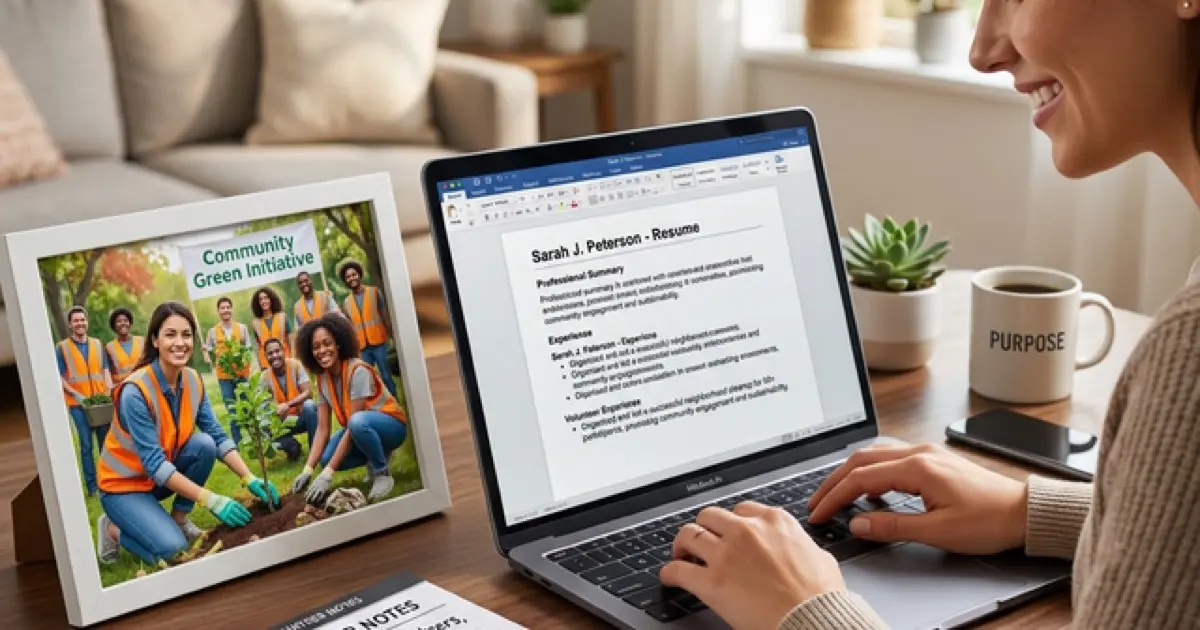
Student Resume: How to Showcase Projects and Build a Portfolio Section

When I graduated two years ago, my resume had one summer internship and a part-time retail job. That was it for "experience." I almost left the projects section off because I thought class projects did not count. My career center advisor told me to add three projects from my coursework and one side project I had built over winter break. Those four projects got me three interviews. The interviewers spent more time asking about my projects than my internship because the projects showed what I could actually build, not just where I had sat for 10 weeks.
If you are a student or recent grad, your projects section is often the most important part of your resume. It is the section where you prove you can do the work, not just study it. Employers hiring junior candidates know you do not have 5 years of experience. What they want to see is evidence that you can apply what you have learned to produce something real. Projects provide that evidence.
For the complete methodology on translating any experience into resume-ready language, see our Ultimate Experience Translation Guide.
Why Projects Matter More Than You Think
Hiring managers evaluating student resumes face a signal problem. Your GPA tells them you can study. Your coursework tells them what you were exposed to. But neither tells them whether you can build, analyze, create, or deliver. Projects are the only resume section that demonstrates applied capability.
A computer science student with a deployed web application is more compelling than one with a 3.9 GPA and no projects. A marketing student who ran a real social media campaign with measurable results is more interesting than one who only studied campaign theory. The project is the proof.
The Project Description Framework: Problem-Approach-Result
Every project on your resume should follow a three-part structure that mirrors how professionals describe their work.
Part 1: The Problem
What challenge did the project address? This establishes context and relevance.
Weak: "Built a web app" Strong: "Built a personal finance tracking application to help college students manage irregular income and expenses"
The strong version names a specific problem (managing irregular income) for a specific audience (college students). This tells the recruiter the project had purpose, not just technical exercise.
Part 2: The Approach
What tools, technologies, or methods did you use? This demonstrates your technical skills.
Weak: "Used programming languages" Strong: "Developed using React frontend, Node.js/Express backend, and PostgreSQL database, deployed on AWS EC2 with CI/CD pipeline via GitHub Actions"
The strong version names every technology, which creates keyword matches with job postings. If a company uses React and Node.js, this project lands directly in their search results.
Part 3: The Result
What was the measurable outcome? This proves the project produced value.
Weak: "The project was completed successfully" Strong: "Acquired 50+ active users through university subreddit launch, processing 1,200+ transactions in first month with 99.8% uptime"
The strong version includes users, volume, and reliability metrics. Even small numbers are better than no numbers because they demonstrate that the project exists in the real world.
Project Types and How to Frame Them
Academic Projects
Class projects are legitimate resume material when framed correctly. Remove references to the class and describe the project as if it were independent work.
Before (class assignment framing):
"For my Database Systems class, created a database project that stored student information."
After (professional framing):
Student Records Management System | Python, SQLAlchemy, PostgreSQL
- Designed normalized relational database with 15 tables supporting 10,000+ student records
- Built REST API with 20+ endpoints for CRUD operations, authentication, and reporting
- Implemented query optimization reducing average response time from 800ms to 120ms
Side Projects
Personal projects that you built on your own time demonstrate initiative and passion. These often impress interviewers more than class projects because they show self-directed learning.
Example:
Budget Buddy - Personal Finance App | React, Firebase, Chart.js | Live Demo | GitHub
- Developed full-stack budgeting application for college students with irregular income
- Implemented automated expense categorization using keyword matching algorithm
- Acquired 50+ active users through campus marketing, processing 1,200+ monthly transactions
Hackathon Projects
Hackathons demonstrate speed, teamwork, and the ability to deliver under pressure. Even if you did not win, the experience is valuable.
Example:
MedConnect - HackHealth 2025 Winner | Python, Flask, OpenAI API
- Built patient-provider communication tool in 36 hours at university hackathon (150+ participants)
- Integrated NLP for symptom triage, matching patients to appropriate care pathways
- Won first place among 30 teams; invited to present at university innovation showcase
Open-Source Contributions
Contributing to open-source projects demonstrates collaboration, code quality, and the ability to work within existing codebases.
Example:
Open-Source Contributor | pandas, scikit-learn
- Submitted 3 merged pull requests to pandas library fixing documentation and test coverage
- Resolved 2 open issues in scikit-learn related to cross-validation edge cases
- Reviewed and commented on 5+ community pull requests for code quality feedback
Research Projects
Academic research demonstrates analytical depth and domain expertise. Frame research in terms of methods and findings, not just the topic.
Example:
Undergraduate Research: NLP Sentiment Analysis | Python, BERT, TensorFlow
- Developed fine-tuned BERT model for financial news sentiment classification
- Achieved 91% accuracy on custom dataset of 15,000 labeled financial headlines
- Co-authored paper accepted at university undergraduate research conference
Building a Portfolio That Supports Your Resume
For Technical Roles (Software, Data, Engineering)
GitHub is your portfolio. Ensure your profile includes:
Each pinned repository should have a README that follows this structure:
- Project title and one-line description
- Problem it solves
- Technologies used
- How to run it locally
- Screenshots or demo link
- What you learned
For Design Roles
Use Behance, Dribbble, or a personal portfolio site. Each project should include:
- The design brief or problem statement
- Your process (research, wireframes, iterations)
- Final deliverables with context
- Results or feedback received
For Business and Marketing Roles
Create a simple portfolio site (even a Notion page or Google Site works) showcasing:
- Case studies of campaigns you designed or analyzed
- Data analysis projects with visualizations
- Writing samples or content you created
- Presentations or strategy documents (anonymized if needed)
Common Mistakes in Student Project Sections
Mistake 1: Listing Technologies Without Context
"Python, JavaScript, SQL, React, TensorFlow" tells recruiters nothing about what you built. Technologies are ingredients, not the meal. Always pair technology lists with descriptions of what you created using them.
Mistake 2: Describing What You Learned Instead of What You Built
"Learned about database management and SQL queries" is education, not a project. "Designed a relational database supporting 10,000 records with optimized query performance" is a project. Focus on the output, not the input.
Mistake 3: Including Too Many Small Projects
Five tiny projects dilute the impact of your best work. Two or three substantial projects with clear descriptions, metrics, and links are far more impressive than a long list of incomplete or trivial items.
Mistake 4: No Links or Proof
If your project exists online, link to it. A live demo URL, a GitHub repository, or a portfolio site makes your project verifiable. Projects without links require interviewers to take your word for it. Projects with links let them see the evidence.
Mistake 5: Outdated or Broken Projects
Before submitting your resume, test every project link. A broken live demo or a GitHub repository with no README is worse than no link at all. It signals that you do not maintain your work.
Formatting the Projects Section
Placement on Resume
For students with limited work experience, place the projects section immediately after Education and before any Work Experience. For students with relevant internships, place projects after Work Experience.
Format Template
## Projects

**Project Name** | Technologies | [Live Demo](url) | [GitHub](url)  |  Date
- Bullet 1: What you built and why (the problem)
- Bullet 2: How you built it (approach and tools)
- Bullet 3: What happened (metrics, users, outcomes)
ATS Optimization
Include keywords from target job postings in your project descriptions. If the posting mentions "React," "REST APIs," or "data visualization," those terms should appear in your project bullets. The projects section is keyword-rich real estate that most students underutilize.
Turn your student projects into resume sections that get interview callbacks
Frequently Asked Questions
Can I list group projects on my resume?
Yes, but clearly describe your individual contribution. Hiring managers want to know what you did, not what your team did. "Led frontend development for 4-person team, building React components for user dashboard and data visualization" is specific about your role. "Worked on a group project to build a web application" is not.
Should I include projects from online courses or bootcamps?
Include them if you extended the project beyond the course requirements. A bootcamp capstone that you deployed, added features to, and attracted real users is a legitimate project. A tutorial you followed step-by-step without modification is not. The differentiator is whether you made it your own.
How do I describe a project I built with AI assistance?
Be honest about the tools you used while emphasizing your decision-making. "Developed using React with GitHub Copilot for code completion" is transparent. Focus your description on the architecture decisions, problem-solving, and outcomes rather than the line-by-line coding. Interviewers will ask about your projects, and you need to be able to explain every technical choice.
When should I remove old projects from my resume?
Replace projects as you build better ones. A first-year class project should be replaced by a senior capstone or internship project as your portfolio grows. Always lead with your most recent and most impressive work. If a project is more than 2 years old and you have stronger alternatives, rotate it out.
Final Thoughts
Your projects section is where you prove that your education translates into capability. Every project should follow the Problem-Approach-Result framework, include specific technologies and metrics, and link to verifiable evidence whenever possible. Two or three well-described projects with clear outcomes are worth more than a long list of vague descriptions. As a student, you may not have years of work experience, but you have something equally valuable: proof that you can build, analyze, and deliver. Put that proof on your resume, and let the projects speak for themselves.