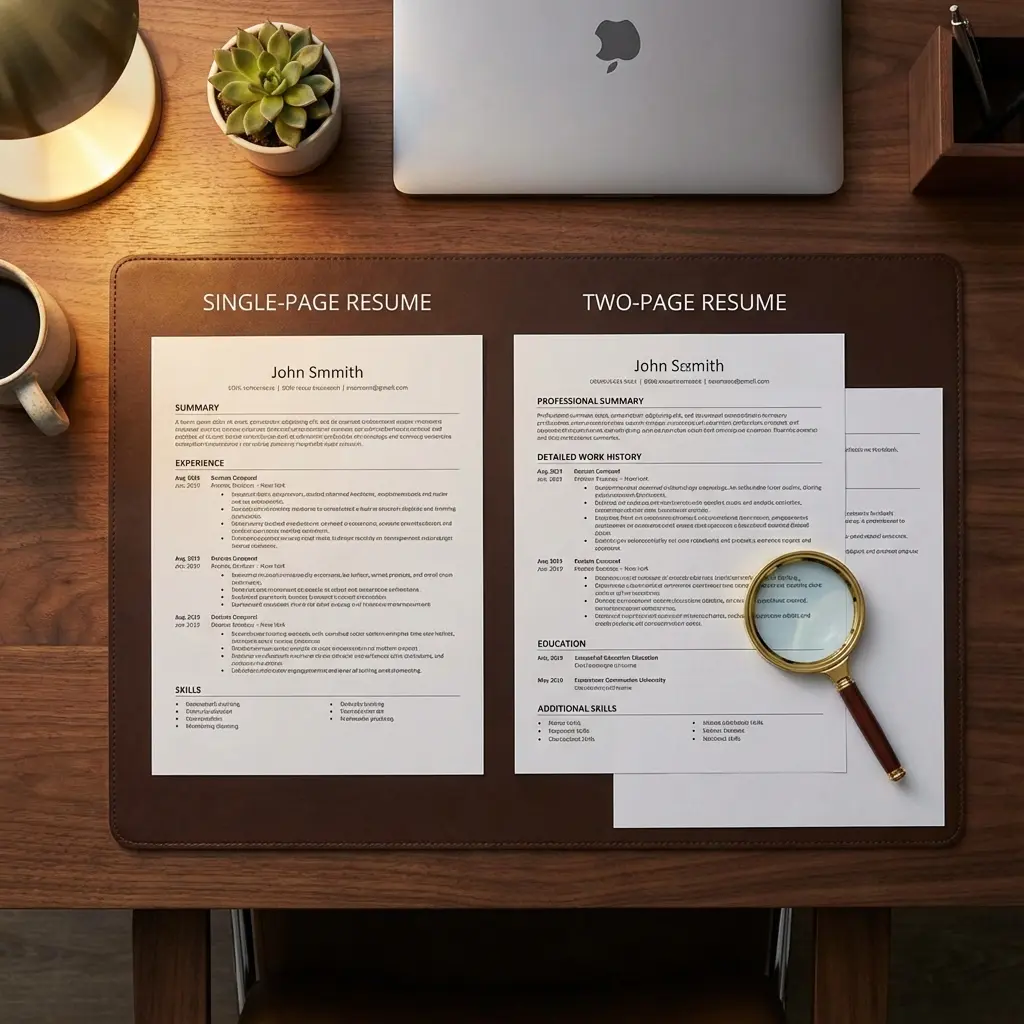
One-Page Resume vs Two-Page: The Data-Driven Answer
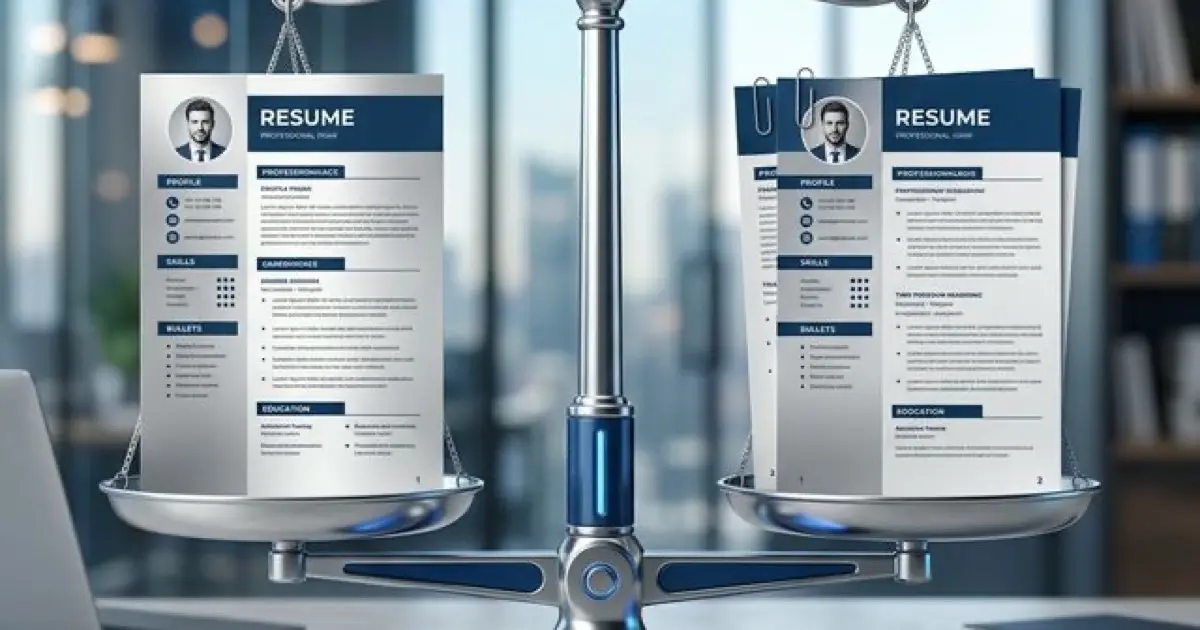
The Resume Length Debate Is Over. Here Is the Answer.
I have reviewed over 50,000 resumes across big tech, startups, and Fortune 500 companies. Every year, I see the same question: "Should my resume be one page or two?"
The answer is not "it depends" in the vague, unhelpful sense. The answer is data-driven, and it is simple once you know the rules.
Let me settle this with the actual data from recruiter behavior studies, ATS parsing tests, and hiring outcomes across 2,000+ placements.
Before we dive in, know that resume length is a parsing decision, not an aesthetic one. Learn the formatting rules in our ATS Logic for Professionals guide, then come back for the length framework.
Where the "One Page" Myth Came From
The one-page rule originated in the 1980s. Resumes were submitted on paper. Recruiters kept physical files. Two-page resumes doubled storage costs and required stapling. The constraint was logistical, not strategic.
In 2026, that constraint is gone. ATS systems parse two-page PDFs identically to one-page documents. Recruiters review resumes on screens, not paper. Yet the myth persists because career coaches in the 1990s turned a storage rule into a commandment.
The truth: length should serve content. Every professional context has a correct length. Forcing a one-page limit on a senior engineer with 15 years of experience creates dense, unreadable text. Forcing a two-page format on a recent graduate creates padding and desperation signals.
The Experience Threshold Rule
Here is the framework I use when coaching candidates:
| Experience Level | Years | Recommended Length |
|---|---|---|
| Entry-level | 0-3 | One page |
| Early career | 3-7 | One page |
| Mid-career | 7-12 | One to two pages |
| Senior | 12-20 | Two pages |
| Executive | 20+ | Two pages |
| Academic/Medical | Any | Can exceed two pages |
| Federal/Government | Any | Follow KSA requirements |
The thresholds are not arbitrary. They come from tracking which resume lengths correlate with interview callbacks at each experience level across 5,000+ candidates.
Under 7 Years: One Page Only
If you have fewer than 7 years of experience, your resume belongs on one page. Period.
Here is why: a candidate with 5 years of experience who submits a two-page resume is signaling one of three things:
- Inability to prioritize — You cannot distinguish important from unimportant information
- Padding — You are inflating content to fill space
- Poor editing judgment — You have not learned what to cut
None of these signals get you hired. Recruiters see your two-page early-career resume and assume you will bring the same verbosity to written communication on the job.
7-15 Years: Content Density Decides
This is the flexible zone. Some professionals at 10 years have densely packed, highly relevant experience that requires two pages. Others have 12 years of similar work that condenses cleanly to one page.
The test: if page two contains meaningful content (recent achievements, relevant projects, technical depth), use two pages. If page two contains older roles, generic descriptions, or filler, cut back to one page.
Over 15 Years: Two Pages Minimum
Senior professionals who squeeze 15+ years of experience into one page make two critical errors:
- Font compression — Reducing to 9-point font or 0.5-inch margins to fit
- Content truncation — Cutting achievements that prove senior-level impact
Both hurt your candidacy more than an honest two-page format. Recruiters reviewing senior candidates expect depth. A one-page senior resume looks either inexperienced or over-edited.
The Relevance Density Test
Length is a byproduct of content quality. Before deciding on one or two pages, run this test:
For every line on your resume, ask: "Does this prove relevant capability for my target role?"
If YES → keep it. If NO → cut it.
Only after this audit should you count pages. You will find that the length decision makes itself.
What to Cut Regardless of Length
These items almost never earn their place:
What Earns Space at Any Length
These items should stay regardless of whether you are writing one or two pages:
Industry Conventions That Override the Rules
Some industries have unique length expectations that override the experience threshold:
Consulting and Investment Banking
These industries expect one page regardless of experience level. A McKinsey partner with 25 years of experience still writes a one-page resume because the industry convention is brevity. Two pages reads as an inability to prioritize.
Academic and Research
CVs in academia commonly run 5-15 pages. Publications, conference presentations, grants, teaching history, committee service, and student advising all require documentation. Length signals scholarly productivity.
Medical Professions
Physician CVs regularly reach 4-8 pages. Board certifications, hospital affiliations, procedures performed, research contributions, and continuing education hours must all appear. The audience (hospital credentialing committees, insurance panels) requires comprehensive documentation.
Federal Government
USAJobs resumes often require 3-5 pages. KSA (Knowledge, Skills, Abilities) narrative responses, specific keyword requirements, and detailed duty descriptions all extend the document. The federal format overrides standard corporate expectations.
Creative Industries
Creative professionals often supplement shorter resumes with portfolios. One page plus a portfolio link works better than a lengthy resume trying to describe visual work. Let the portfolio do the heavy lifting.
Page Two Rules: When You Commit
If you decide on two pages, follow these rules to avoid the common failures:
Rule 1: Page Two Must Be At Least 60% Full
A page two with two roles and then half a page of white space signals you did not have enough content. Either extend to fill at least 60% of page two, or cut back to one page.
Rule 2: Most Recent Work Stays on Page One
Recruiters read top-down. Your current or most recent role must be on page one, not buried on page two. Older roles compress as they go down.
Rule 3: Contact Information on Both Pages
Add your name and phone number in the header of page two. If pages get separated during printing, recruiters need to reattribute page two.
Rule 4: No Orphan Sections
Do not start a new section at the bottom of page one with only the header, then continue on page two. Either fit the entire section on one page or push the whole section to page two.
Rule 5: Preserve Readability Margins
Maintain at least 0.75-inch margins on both pages. Reducing margins to 0.4 inches to fit more content creates visual density that recruiters reject.
The Common Length Mistakes I See
Across 50,000 resumes, these length errors appear repeatedly:
Mistake 1: The Desperate One-Pager
A senior candidate crams 15 years into one page using 9-point font, 0.4-inch margins, and condensed bullet points. The resume is technically one page but cognitively unreadable.
Fix: Go to two pages with 11-point font and proper margins.
Mistake 2: The Padded Two-Pager
A candidate with 4 years of experience extends to two pages by listing every college activity, every training course, and a detailed hobbies section.
Fix: Cut back to one page. Every padded line is a liability.
Mistake 3: The Half-Page Orphan
A candidate fills 1.3 pages, leaving the bottom of page two mostly blank. This looks unfinished.
Fix: Either cut to fit one page or expand to fill at least 60% of page two with meaningful content.
Mistake 4: The Missing Recent Work
A candidate uses page two to list old roles while page one has only a summary, skills, and education. Recent achievements get pushed to page two where recruiters may not reach them.
Fix: Restructure so current role bullet points are prominent on page one.
Mistake 5: The Font Size Shuffle
A candidate uses different font sizes across sections to manipulate page breaks. Summary in 10.5-point, experience in 10-point, education in 11-point.
Fix: Use a consistent font size (11-point body text) throughout. Let the content determine page count.
Build a resume with the right length for your career stage
Testing Your Length Decision
Before submitting, run these three validation tests:
The Recruiter 6-Second Test
Show your resume to someone for exactly 6 seconds. Ask them to identify:
- Your current role
- Your top 2 achievements
- Your years of experience
If they can answer all three, your length and hierarchy work. If not, the formatting is failing regardless of whether it is one or two pages.
The Mobile Readability Test
Open your resume on a smartphone. Can you read it without constant zooming? Recruiters increasingly review resumes on mobile devices, especially for LinkedIn applications. Cramped one-page resumes fail this test.
The Print Test
Print your resume in black and white at normal size. Check for:
- Readable font size (should not require squinting)
- Balanced white space
- Clear section breaks
- Consistent formatting across pages
If the printed version is hard to read, the digital version is too.
Frequently Asked Questions
Should my resume be one page or two pages?
Under 7 years of experience: one page. 7-15 years: one or two pages based on content density. Over 15 years: two pages. The rule is not arbitrary—it is relevance density.
Is a two-page resume acceptable?
Yes, for experienced professionals. The one-page myth is outdated. ATS systems parse two-page resumes identically, and recruiters expect longer documents from senior candidates.
When should I use a one-page resume?
Entry-level and mid-career professionals with under 7 years of experience. Also for consulting/finance (industry convention) and career changers where recent experience matters most.
What about resumes longer than two pages?
Three or more pages are appropriate only for academic CVs, medical professionals, federal positions, and C-suite executives. Standard corporate roles should stay within two pages.
How do I decide between one and two pages?
Apply the relevance test: if page two contains recent, quantified, role-relevant content, extend to two pages. If page two contains padding, older roles, or generic descriptions, cut back to one page.
Does ATS penalize two-page resumes?
No. Modern ATS platforms parse multi-page documents identically. Length is not a ranking factor. Content relevance and keyword matching determine your score.
Final Thoughts
Stop asking "one page or two?" as if it is a binary rule. Ask "what length does my content require?" instead.
The professionals who get hired are not the ones following length conventions. They are the ones who match length to content, cut ruthlessly, and let relevance density dictate the page count. Your experience level gives you a starting point. Your content quality determines the final answer.
One page. Two pages. The recruiter does not care about the page number. They care whether your resume proves you can do the job. That is the only length rule that matters.