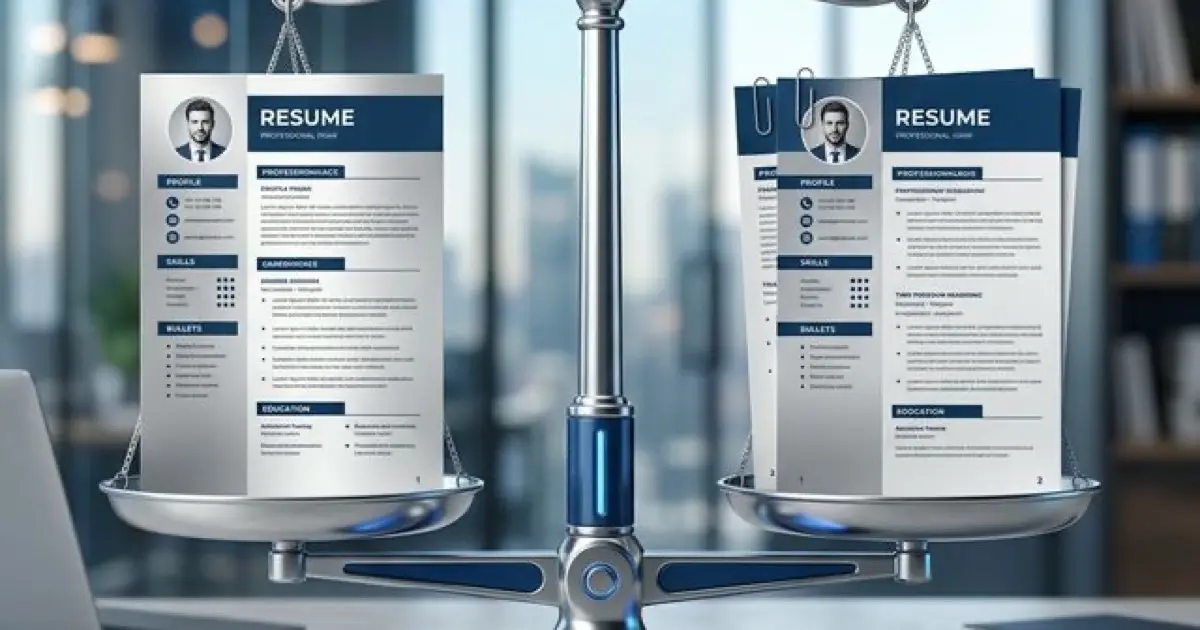
Resume Length: One Page or Two? The Definitive 2026 Answer
The Resume Length Question Everyone Gets Wrong
I've reviewed over 50,000 resumes in my career. And the question I hear most often—"Should my resume be one page or two?"—is almost always asked the wrong way.
The real question isn't about page count. It's about value density.
Let me explain what I mean, and give you the definitive framework for deciding your resume length in 2026.
The One-Page Rule: Where It Came From
The one-page resume rule originated decades ago when resumes were physical documents reviewed by hand. Recruiters literally didn't want to flip pages. Filing cabinets had limits. Paper cost money.
None of that applies anymore.
Today, your resume lives as a digital file. It's parsed by ATS systems, searched by keywords, and viewed on screens. The physical constraints are gone—but the confusion remains. For comprehensive strategies on translating your experience, our ultimate experience translation guide covers the complete framework.
Here's the truth from someone who actually screens candidates: I don't care if your resume is one page or two. I care if every single line earns its place.
When One Page Is Right
One-page resumes work best when you fit these criteria:
Less than 10 years of experience – If you're early or mid-career, you probably don't have enough relevant content to justify two pages. Padding with irrelevant details hurts you.
Targeting a career change – When switching industries, focus on transferable skills. Your extensive experience in an unrelated field dilutes your message.
Entry-level or recent graduate – You're expected to have a one-page resume. Anything longer suggests you don't understand professional norms.
The role is highly specialized – Sometimes a tight, focused resume beats a comprehensive one. If the job requires three specific skills, prove you have them without the noise.
If you're building your first professional resume, our comprehensive resume guide covers the fundamentals of creating a focused one-pager.
When Two Pages Work Better
Two-page resumes make sense when:
You have 10+ years of relevant experience – Key word: relevant. Twenty years of experience doesn't mean twenty years of resume content. Only include what matters to your target role.
You're targeting senior or executive positions – Leadership roles require demonstrated impact across multiple domains. One page rarely captures the breadth needed.
Your field expects detail – Academia, research, engineering, and some government roles traditionally use longer documents. Follow industry norms.
You have quantifiable achievements worth showing – If you have strong metrics, awards, publications, or projects that differentiate you, include them. A second page full of results beats a cramped one-pager.
The Value Density Test
Here's my framework for deciding resume length. I call it the Value Density Test.
For every line on your resume, ask:
- Does this directly relate to my target role?
- Can I quantify the impact?
- Would removing this weaken my candidacy?
If you answer "no" to any question, the line probably shouldn't exist.
Apply this test ruthlessly. Most two-page resumes I see could be one page with higher value density. Most one-page resumes I see are missing achievements that would justify a second page.
The 6-Second Reality
Let me share what actually happens when I review resumes.
I spend about 6 seconds on initial screening. In that time, I scan:
- Your most recent job title and company
- A few bullet points from that role
- Your skills section
- Education (briefly)
If those 6 seconds interest me, I read more carefully. If not, I move on.
Page count doesn't factor in. Value does.
This means your first page matters most. If you're using two pages, the second page should contain strong supporting content—not the stuff that didn't fit.
What About ATS Systems?
Some candidates worry that two-page resumes confuse applicant tracking systems. Let me clear this up.
Modern ATS platforms handle multi-page documents fine. The parsing issues come from:
- Complex formatting (tables, columns, graphics)
- Non-standard fonts
- Headers and footers containing important information
- Unusual file formats
Length itself isn't the problem. A clean two-page resume parses better than a cluttered one-pager with dense columns.
Resume Length by Industry
Different industries have different expectations. Here's what I've observed:
Tech/Startups – One to two pages. Focus on skills, projects, and impact. Startups especially value conciseness.
Finance/Consulting – One to two pages. Heavy emphasis on education, certifications, and quantified achievements.
Healthcare – Often two pages. Certifications, licenses, and clinical experience need space. Industry norms favor comprehensive documentation.
Academia/Research – CVs, not resumes. Multiple pages expected. Publications, grants, and presentations require space.
Government/Federal – Often requires longer formats. Federal resumes can run 4-5 pages with detailed experience descriptions.
Creative Fields – Portfolio matters more than resume. Keep the resume tight (one page) and let your work samples speak.
What About the "Three-Second Rule"?
You may have heard that recruiters decide in three seconds. That's partially true—but misleading.
We decide whether to keep reading in three seconds. That's not the same as making a hiring decision.
If your resume hooks me in three seconds, I'll spend another 30 seconds reviewing it. If it's compelling, I'll spend a few minutes. Then I might call you.
The point: your resume needs to earn attention quickly. Length matters less than clarity and impact.
How to Cut Your Resume Without Losing Value
If you're struggling to fit one page, try these tactics:
Remove objective statements – Replace with a strong summary if needed, or cut entirely. Objectives are outdated.
Combine early roles – Instead of listing every job from 15+ years ago, create an "Earlier Experience" section with brief mentions.
Cut responsibilities, keep achievements – "Managed team of 5" is weak. "Led team of 5 to 40% productivity increase" is strong. Often, converting to achievements naturally shortens content.
Remove obvious skills – Microsoft Office, email, basic software—everyone has these. They waste space.
Delete high school education – If you have a college degree, high school doesn't belong on your resume.
Tighten language – "Responsible for managing" becomes "Managed." "Successfully implemented" becomes "Implemented." Every word should earn its place.
How to Expand to Two Pages Strategically
If you have the experience to justify two pages, make them count:
Add a strong summary section – 3-4 lines that position you for the target role. This is prime real estate.
Expand achievement bullets – If you have strong metrics, let them breathe. "Increased revenue 47% ($2.3M)..." is better than cramming.
Include relevant projects – Major initiatives, publications, speaking engagements, or certifications that differentiate you.
Add a skills section with context – Don't just list skills. Group them strategically by relevance to the role.
Consider a "Key Achievements" section – Highlight 4-5 career-defining accomplishments at the top, then detail experience below.
Formatting for Any Length
Regardless of page count, follow these principles:
The Page Break Problem
If you're using two pages, watch where your page breaks.
A bad break:
- Splits a job entry across pages
- Leaves only 2-3 lines on page two
- Separates a header from its content
A good break:
- Occurs between complete sections
- Leaves substantial content on page two
- Maintains visual hierarchy
If your natural content ends at 1.3 pages, edit down to one. If it ends at 1.7 pages, you can either edit down or add value to justify a full two.
Real Examples From My Desk
Let me share what I actually see:
Bad one-page resume: Cramped, 9pt font, margins nearly eliminated, three columns of tiny text. Technically one page. Practically unreadable.
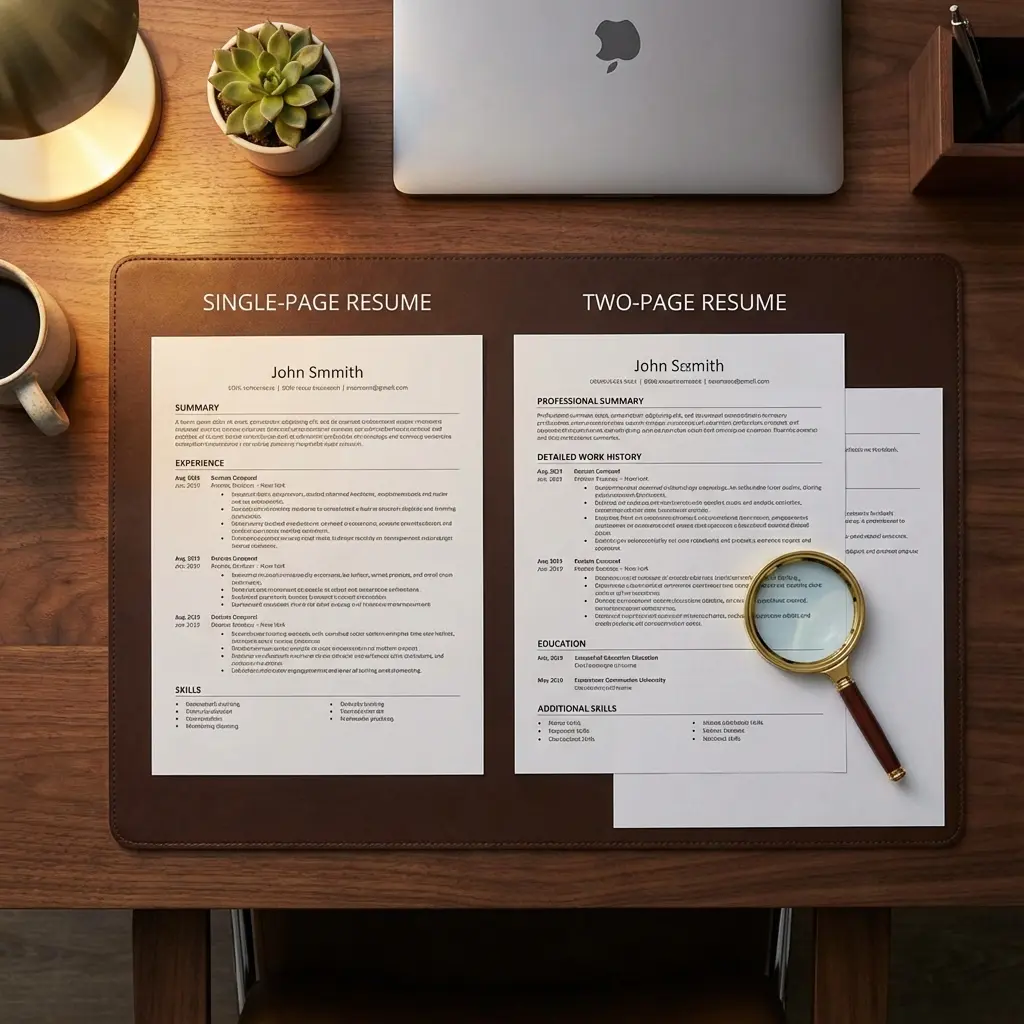
Good one-page resume: Clean layout, strong summary, 5-6 impactful bullets per role, relevant skills highlighted. Every line counts.
Bad two-page resume: First page is decent. Second page trails off with outdated experience, irrelevant hobbies, and "References available upon request."
Good two-page resume: Strong content throughout. Second page contains mid-career experience that's still relevant, plus key projects and certifications. No filler.
The Final Answer
So, one page or two?
Start with value, not length. Write everything that matters for your target role. Include achievements, quantified results, and relevant experience.
Then edit:
- If it fits one page cleanly with proper formatting—one page.
- If valuable content requires two pages—two pages.
- If you're padding to reach two pages—cut to one.
- If you're cramping to reach one page—allow two.
The goal is maximum impact per square inch. A tight one-pager beats a fluffy two-pager. A substantial two-pager beats a cramped one-pager.
Focus on value density. Let the page count follow naturally.
Frequently Asked Questions
How long should my resume be in 2026?
For most professionals with less than 10 years of experience, one page is ideal. Those with 10+ years of relevant experience can use two pages. Never exceed two pages unless you're in academia or research.
Is a 2 page resume OK?
Yes, a two-page resume is acceptable if you have 10+ years of relevant experience, are applying for senior/executive roles, or work in fields like academia where longer documents are standard. The key is that every line must add value.
Will a two-page resume hurt my chances?
Only if it's padded with irrelevant content. A well-organized two-page resume won't hurt you if the content is relevant and valuable. A one-page resume with filler is worse than a tight two-pager.
Do recruiters read two-page resumes?
Yes, recruiters will read two-page resumes if the content is compelling. We spend about 6-7 seconds on initial screening. If your first page captures attention, we continue to page two.
Should I shrink my font to fit one page?
Never shrink below 10pt font. If you need to squeeze content, cut the content instead of making it unreadable. The ATS and recruiters both need legible text.
What about a three-page resume?
Three-page resumes are only appropriate for federal/government applications, academic CVs, or positions that specifically request detailed experience. For corporate roles, stick to two pages maximum.
Next Steps
Still unsure about your resume length? Here's what to do:
- Apply the Value Density Test to every line
- Have a colleague review for clarity and conciseness
- Test your resume in an ATS simulator
- Get feedback from a recruiter or hiring manager in your field
The page count question becomes irrelevant when every line of your resume earns its place.