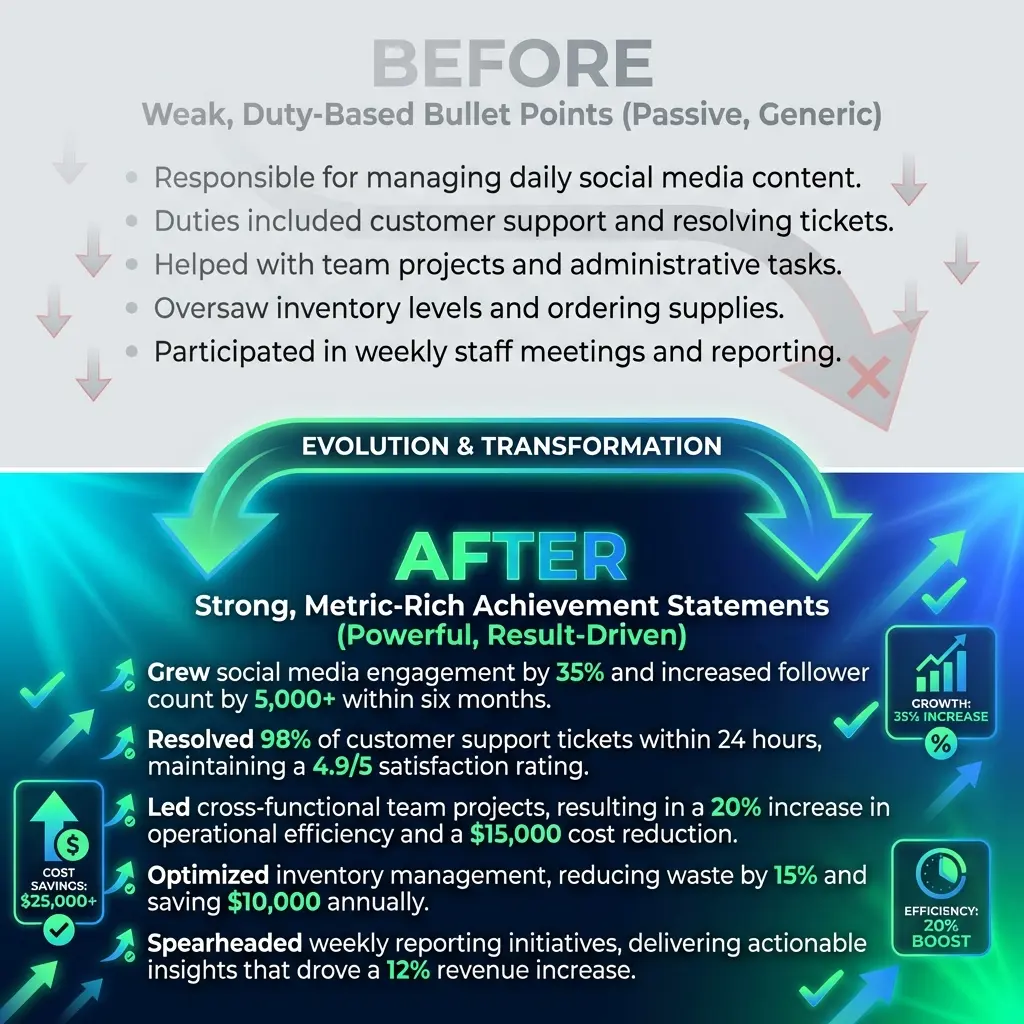
The "So What?" Test for Every Bullet Point

Introduction
I've reviewed over 50,000 resumes. You know what most of them have in common? Bullets that describe activity, not value.
"Managed social media accounts." "Assisted with customer support." "Responsible for project coordination."
Okay. So what? Why should I care?
That's the test every bullet on your resume needs to pass. It's not enough to list what you did. You need to show why it mattered.
In this guide, I'll show you the "So What?" audit framework I use to separate weak bullets from strong ones—and how to fix the weak ones so they actually prove your value. For the complete methodology on transforming job duties into measurable business value, see our Ultimate Experience Translation Guide.
The "So What?" Test Explained
The test is simple. Read a bullet point from your resume out loud. Then immediately ask:
"So what? Why does this matter to the company hiring me?"
If you can answer with a clear business impact (faster, cheaper, better, more revenue, fewer errors), the bullet passes.
If you can't—or if your answer is vague ("it shows I'm a team player")—the bullet fails.
Example of a bullet that fails:
- "Managed team of 5 developers"
So what? What did the team accomplish? Did they ship a product? Hit a deadline? Improve performance?
Revised bullet that passes:
- "Led team of 5 developers to ship MVP 3 weeks ahead of schedule, enabling early customer feedback that shaped roadmap"
Now I know why this mattered. Early delivery = faster learning = better product decisions.
That's the difference between a duty and an achievement.
Activity vs. Value: Spotting the Difference
Most resume bullets describe activity—what you spent your time doing. Recruiters don't care about activity. They care about value—what the company gained because you did it.
Notice the pattern: Value bullets include context (scale, timeline, constraints) and outcomes (metrics, results, business impact).
The 3-Part Formula for Bulletproof Bullets
Every strong bullet has three components:
1. Action Verb (What you did) 2. Context (Scale, constraints, who was involved) 3. Outcome (Measurable result or business impact)
Let me break this down with examples.
Weak Bullet (Activity Only)
"Managed social media"
This tells me nothing. Every intern "manages social media." There's no scale, no outcome, no proof of value.
Stronger (Added Context)
"Created content for Instagram, Facebook, and LinkedIn with weekly posting schedule"
Better. Now I know the platforms and cadence. But still—so what? What happened because you did this?
Strongest (Added Outcome)
"Grew Instagram following from 2K to 15K in 6 months through daily posting and influencer partnerships, driving 30% increase in website traffic"
Now I care. You didn't just "do social media." You delivered measurable growth that impacted the business.
Common Bullet Weaknesses (And How to Fix Them)
Weakness 1: Vague Responsibility Statements
Weak: "Responsible for customer onboarding"
This is a job description, not an achievement. Everyone in your role was "responsible" for something.
Fix: Add what you improved or delivered.
Strong: "Redesigned customer onboarding flow, reducing time-to-first-value from 14 days to 7 days and improving activation rate by 25%"
Weakness 2: Passive Verbs
Weak: "Helped improve team efficiency"
"Helped" is passive. It signals you were supporting someone else's work, not leading it.
Fix: Use ownership verbs. What did you specifically do?
Strong: "Automated reporting process using Python scripts, saving team 10 hours per week and reducing manual errors by 80%"
Weakness 3: No Metrics
Weak: "Improved sales performance"
How much? By when? Compared to what?
Fix: Quantify everything you can. Revenue, time, percentage, volume.
Strong: "Increased quarterly sales by 35% ($200K) by implementing targeted email campaigns and refining lead qualification process"
Weakness 4: Missing Context
Weak: "Led project to completion"
What project? How big? What constraints?
Fix: Add scale and constraints.
Strong: "Led cross-functional team of 8 across Engineering, Design, and Marketing to launch feature on time despite 30% budget cut, achieving 95% customer satisfaction score"
Weakness 5: Duties, Not Achievements
Weak: "Attended client meetings"
Attending meetings isn't an achievement. It's participation.
Fix: What resulted from those meetings?
Strong: "Facilitated weekly client meetings to align on priorities, resulting in 20% reduction in change requests and stronger client retention"
The Audit Process: Step-by-Step
Here's how to apply the "So What?" test to your entire resume:
Step 1: Pick one bullet from your resume.
Step 2: Read it out loud.
Step 3: Ask: "So what? Why does this matter?"
Step 4: If you can't answer with a clear business impact, mark the bullet as weak.
Step 5: Rewrite using the 3-part formula: Action + Context + Outcome.
Step 6: Read the new bullet. Ask "So what?" again. If it passes, move to the next bullet.
Repeat for every single bullet on your resume. No exceptions.
You should be able to audit a 10-bullet resume in 15-20 minutes. Take the time. It's worth it.
Real Examples: Before and After
Example 1: Marketing Role
Before: "Managed email marketing campaigns"
So What? What campaigns? What results?
After: "Designed and executed 12 email campaigns in Q3, achieving 28% open rate (15% above industry average) and generating $75K in attributed revenue"
Example 2: Engineering Role
Before: "Worked on backend improvements"
So What? What improvements? What impact?
After: "Refactored backend API to reduce latency by 40%, improving user experience and supporting 2x traffic growth without infrastructure cost increase"
Example 3: Operations Role
Before: "Responsible for inventory management"
So What? What did you improve?
After: "Optimized inventory tracking system, reducing stockouts by 60% and cutting excess inventory costs by $120K annually"
Example 4: Customer Success Role
Before: "Handled customer inquiries"
So What? What was the result?
After: "Resolved 150+ customer inquiries monthly with 95% satisfaction score, reducing churn by 18% quarter-over-quarter"
Notice the pattern: Before bullets describe tasks. After bullets describe results.
When You Don't Have a Metric (And That's Okay)
Not every bullet needs a number. But every bullet needs impact.
If you can't quantify the result, describe the outcome qualitatively:
These don't have hard metrics, but they clearly show value. The recruiter can infer the business impact.
The Ultimate Litmus Test
After revising all your bullets, do this final check:
Imagine you're hiring for your own role. Would these bullets convince you that this candidate delivered real value—or just showed up and did the job description?
If your bullets sound like they were copy-pasted from a job posting, they fail.
If your bullets show why the company was better off because you worked there, they pass.
That's the standard.
Frequently Asked Questions
What is the "So What?" test for resumes?
The "So What?" test is an audit framework where you read each bullet point and ask: "So what? Why does this matter to the company hiring me?" If you can't answer with a clear business impact, the bullet is weak and needs revision.
How do I make my resume bullets more impactful?
Transform activity statements into value statements. Instead of "Managed team of 5," write "Led 5-person team to deliver project 2 weeks ahead of schedule, saving $50K in contractor costs." Add context (scale, constraints) and outcomes (metrics, business impact).
What makes a resume bullet weak?
Weak bullets describe responsibilities without outcomes, use vague language like "helped" or "assisted," lack metrics or context, and don't explain why the work mattered to the business. They read like job descriptions, not achievements.
Should every resume bullet have a metric?
Not necessarily, but every bullet should show impact. If you can't provide a number, describe the outcome: "Redesigned onboarding process, reducing new hire ramp time from 4 weeks to 2 weeks" shows impact even without a dollar value. Metrics help, but clarity of value is essential.
How many bullet points should each job have on a resume?
3-5 bullets per role is optimal. Your most recent role can have up to 5-6 bullets. Older roles should have 2-3. Quality over quantity—every bullet must pass the "So What?" test. Weak bullets dilute strong ones.
What is the difference between a duty and an achievement?
A duty describes what you were responsible for ("Managed social media"). An achievement describes the result you delivered ("Grew Instagram following from 2K to 15K in 6 months, driving 30% increase in website traffic"). Duties are job descriptions. Achievements are proof of value.
Final Thoughts
I reject resumes every day because the bullets describe activity, not value. Candidates had the results—they just didn't put them on the resume.
Your resume isn't a log of what you did. It's proof of what you delivered.
Every bullet should answer the question: "Why was the company better off because you worked there?"
If it doesn't, rewrite it.
Run the "So What?" test on every single line. Be ruthless. Your resume will go from a list of duties to a case for hiring you.
That's the difference between getting tossed in six seconds and getting the interview.