The "Results vs Responsibilities" Resume Audit
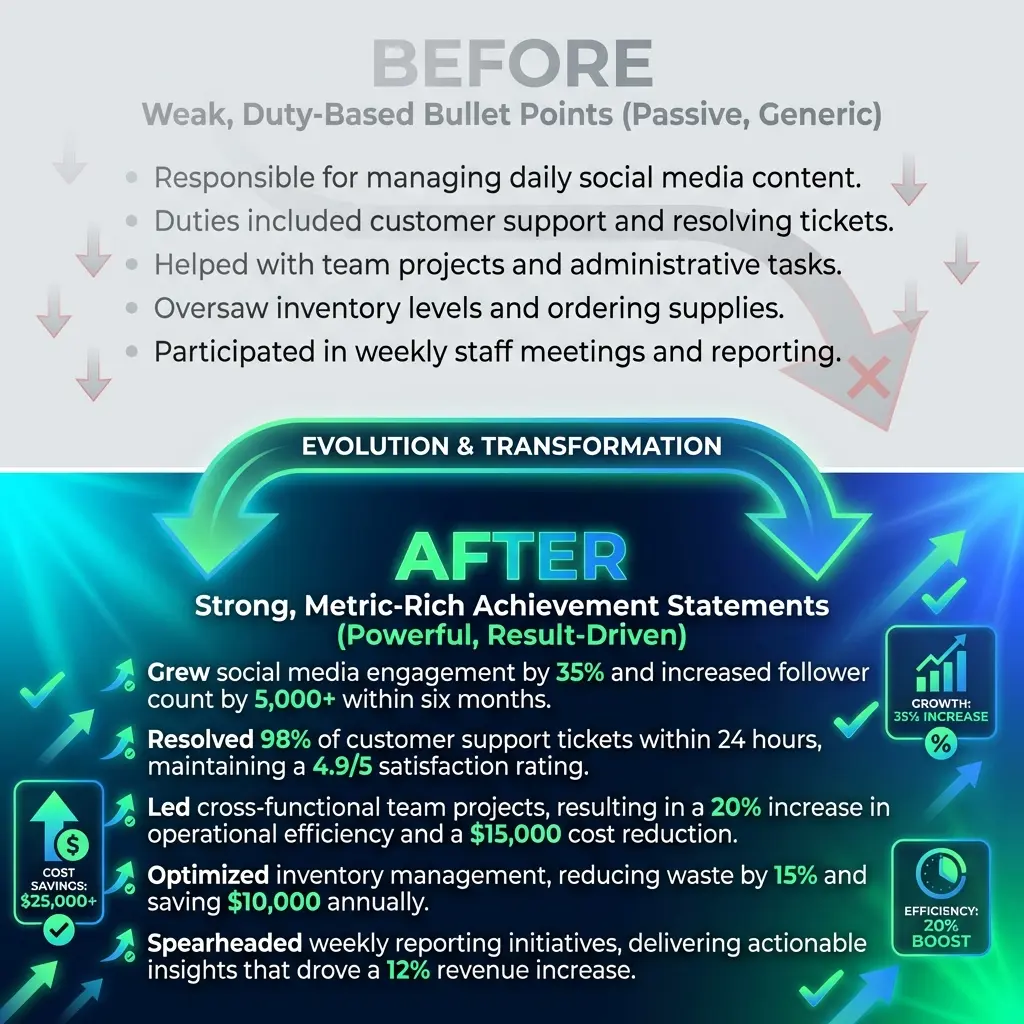
I'll never forget reviewing a resume for a marketing manager who had 8 years of experience. Every single bullet point started with "Responsible for." Not one achievement. Not one metric. Just a list of things she was supposed to do.
When I asked her, "What were the outcomes of all these responsibilities?" she rattled off numbers off the top of her head: 40% email open rate increase. $2M in pipeline. 10K new followers. All of that impact—and none of it on her resume.
This is the most common resume mistake I see. Listing duties instead of demonstrating results.
Your resume isn't a job description. It's proof that you delivered value. Let me show you how to audit every bullet point and transform responsibilities into results that actually get you interviews.
The framework is simple—but it requires you to think differently about what belongs on your resume. For comprehensive strategies on translating experience into impact, our ultimate experience translation guide covers the complete methodology.
Turn your duties into achievements with our resume templates
The Problem: Duty-Based Bullets
Here's what most resumes look like:
Example Resume (Before Audit)
Marketing Coordinator | TechCorp | 2022-2024
What's wrong with this?
Every bullet describes a duty—things I'd expect any marketing coordinator to do. There's zero evidence this person did them well. They could have grown followers by 50% or lost 20%. I have no idea.
The recruiter's thought process:
"Okay, they managed social media. Everyone manages social media. Did they grow it? Did it drive leads? Did it do anything?"
Result: Resume skipped. Next candidate.
The Solution: The Results Audit
The Question That Changes Everything
For every bullet point on your resume, ask: "So what?"
Keep asking until you reach a measurable outcome that proves you delivered value.
Example:
Bullet: "Responsible for managing company social media accounts"
So what? → "I posted content regularly" So what? → "We gained followers" So what? → "We grew from 5K to 12K followers" So what? → "Those followers drove website traffic" So what? → "Website traffic increased 40%, generating 340 qualified leads"
Final bullet: "Grew social media following from 5K to 12K in 18 months, driving 40% increase in website traffic and 340 qualified leads for sales pipeline"
See the difference? Same work. Completely different story.
The Results Formula
Every achievement bullet should follow this structure:
[Action Verb] + [What You Did] + [Quantified Result]
Examples:
Notice: Every bullet has a number. Every bullet shows impact. Every bullet proves value.
Before & After Transformations
Transformation #1: Administrative Role
Before (Duties):
Administrative Assistant | FinanceCorpResponsible for:
• Managing executive calendars and scheduling meetings
• Coordinating travel arrangements for leadership team
• Handling incoming calls and correspondence
• Organizing company events and team offsites
What's wrong: Job description copy-paste. Shows up, did tasks. No evidence of quality or efficiency.
After (Results):
Administrative Assistant | FinanceCorp
• Managed calendar for C-suite of 5 executives, coordinating 100+ meetings monthly with zero scheduling conflicts
• Streamlined travel booking process, reducing average booking time from 2 hours to 20 minutes and saving $15K annually through preferred vendor partnerships
• Implemented new phone system routing, decreasing average wait time from 4 minutes to 45 seconds and improving customer satisfaction scores 30%
• Organized 4 company offsites (100-200 attendees each) under budget, achieving 95% employee satisfaction rating
What changed: Added volume, time saved, cost savings, satisfaction metrics. Proved operational excellence.
Transformation #2: Software Engineer
Before (Duties):
Software Engineer | TechStartup
Responsibilities included:
• Developing features for mobile app
• Writing unit tests and fixing bugs
• Participating in code reviews
• Collaborating with product team on requirements
What's wrong: Generic engineering duties. Could describe any developer. No indication of impact or technical depth.
After (Results):
Software Engineer | TechStartup
• Developed user authentication system supporting 50K+ active users with 99.9% uptime
• Reduced bug count 60% by implementing automated testing framework covering 85% of codebase
• Accelerated feature deployment 40% through code review process improvements and CI/CD pipeline optimization
• Built real-time analytics dashboard enabling product team to track user behavior across 12 key metrics, informing roadmap decisions worth $2M in prioritization
What changed: Added scale (50K users), quality metrics (99.9% uptime, 60% bug reduction), efficiency gains (40% faster deployment), business impact ($2M decisions).
Transformation #3: Customer Support
Before (Duties):
Customer Support Specialist | SaaS Company
Daily responsibilities:
• Responding to customer tickets via email and chat
• Troubleshooting technical issues
• Escalating complex problems to engineering
• Documenting common issues in knowledge base
What's wrong: Task list. No indication of quality, volume, or customer satisfaction.
After (Results):
Customer Support Specialist | SaaS Company
• Resolved 50+ customer tickets daily with 95% first-contact resolution rate, maintaining 4.8/5 customer satisfaction score
• Diagnosed and resolved technical issues 30% faster than team average through systematic troubleshooting methodology
• Reduced engineering escalations 40% by creating detailed troubleshooting guides for 15 most common issues
• Built knowledge base from 20 to 150 articles, decreasing repeat tickets 35% and enabling customer self-service for 60% of common issues
What changed: Added throughput (50 tickets daily), quality (95% FCR, 4.8 rating), efficiency (30% faster, 40% fewer escalations), scale (150 articles, 35% reduction).
Transformation #4: Sales Role
Before (Duties):
Account Executive | B2B Software
Job duties:
• Prospecting and qualifying leads
• Conducting product demos
• Managing sales pipeline
• Closing deals and meeting quota
What's wrong: Every AE does this. No differentiation. No proof of performance.
After (Results):
Account Executive | B2B Software
• Generated $2.4M in new business (140% of quota) through consultative selling approach, securing 15 enterprise deals averaging $160K ACV
• Converted 25% of prospects from demo to close (vs 12% team average) by tailoring presentations to specific industry pain points
• Managed pipeline of 80+ opportunities worth $5M, maintaining 90% forecast accuracy across 4 consecutive quarters
• Achieved fastest ramp time in company history, reaching full quota 2 months ahead of standard 6-month ramp period
What changed: Added revenue ($2.4M), quota attainment (140%), conversion rate (25% vs 12%), pipeline size ($5M), forecast accuracy (90%), competitive benchmarks (fastest ramp).
Transformation #5: Project Manager
Before (Duties):
Project Manager | Construction Firm
Responsible for:
• Planning project timelines and budgets
• Coordinating with contractors and vendors
• Tracking project progress and reporting status
• Ensuring projects meet quality standards
What's wrong: PM 101. Describes the job title, not the person. Zero differentiation.
After (Results):
Project Manager | Construction Firm
• Delivered 8 commercial construction projects ($1M-$5M each) on time and within budget, maintaining 100% client satisfaction across all engagements
• Reduced average project timeline 20% by implementing agile planning methodology and weekly stakeholder syncs
• Negotiated vendor contracts saving $400K annually while improving material quality and delivery reliability
• Prevented $200K in potential rework by implementing quality checkpoint system catching 95% of issues before final inspection
What changed: Added project volume (8), budget range ($1M-$5M), on-time/budget record (100%), efficiency (20% faster), cost savings ($400K), quality (#200K prevented rework).
The Audit Process: Step-by-Step
Step 1: Print Your Resume
Action: Print a physical copy. Use a highlighter.
Highlight these red flags:
If 80%+ of your resume is highlighted, you have a responsibility-based resume. Let's fix it.
Step 2: For Each Highlighted Bullet, Extract the Outcome
The questions to ask:
Worksheet example:
Duty: "Managed social media accounts"
- How many accounts? → 5 platforms
- How much content? → 3-5 posts per week
- How fast did we grow? → 5K to 12K followers in 18 months (140% growth)
- What was the impact? → 40% increase in website traffic, 340 leads generated
Result: "Grew social media presence across 5 platforms from 5K to 12K followers in 18 months, driving 40% increase in website traffic and 340 qualified leads"
Step 3: Rewrite With The Results Formula
Structure: [Strong Verb] + [Specific Action] + [Quantified Outcome]
Choose verbs by impact level:
Junior/Mid-level verbs:
- Improved, increased, reduced, developed, created, built, launched
Senior/Leadership verbs:
- Led, directed, transformed, architected, pioneered, scaled, drove
Example rewrites:
| Duty | Result |
|---|---|
| "Responsible for customer onboarding" | "Onboarded 200+ new customers with 92% retention rate through personalized training program" |
| "Assisted with budget planning" | "Contributed to $5M budget optimization identifying $400K in cost savings through vendor consolidation" |
| "Handled customer complaints" | "Resolved complex customer escalations with 85% satisfaction rate, preventing $120K in estimated churn" |
Step 4: Verify The Transformation
The final test—read each bullet and ask:
What If You Don't Have Metrics?
You always have metrics. You just haven't looked for them.
Where to find hidden metrics:
Example: "I don't track metrics for my teaching role"
Find them anyway:
- How many students taught? (120 per year)
- What was their test score improvement? (Average 15-point increase)
- How many lesson plans created? (200+ over 4 years)
- Parent satisfaction? (98% positive feedback in end-of-year surveys)
Result bullet: "Designed and delivered 200+ lesson plans for 120 students annually, achieving 15-point average test score improvement and 98% positive parent feedback"
Common Pushback (And Rebuttals)
"But my job doesn't have measurable results"
Every job has outcomes. You may not have tracked them, but they existed.
- Admin: Meeting efficiency, cost savings, satisfaction scores
- Creative: Engagement rates, brand awareness, project delivery speed
- Operations: Process efficiency, error reduction, time saved
If you truly can't find a metric: Describe the outcome qualitatively but specifically.
Weak: "Improved team morale" Better: "Initiated weekly team retrospectives, reducing reported roadblocks from 15+ per sprint to 3, as noted in team satisfaction surveys"
"Won't recruiters think I'm inflating or lying?"
Only if your numbers don't make sense or you can't defend them.
The interview question you must be ready for: "Walk me through how you achieved this result."
If you can explain the methodology, time period, and context—you're fine. If you made up a number, you'll get caught.
"My manager won't let me share company metrics"
Use ranges, percentages, or relative comparisons:
| Instead of | Use |
|---|---|
| "Generated $2.4M revenue" | "Generated $2M+ in new business" |
| "Saved $400K in costs" | "Reduced operational costs 25%" |
| "Managed $5M budget" | "Managed multi-million dollar budget" |
Or use volume/frequency:
- "Managed 50+ accounts" (doesn't reveal dollar value)
- "Led team of 12" (doesn't reveal budget)
- "Reduced processing time 40%" (shows improvement without absolute numbers)
Your Audit Checklist
The Bottom Line
Responsibilities tell recruiters you know how to show up. Results tell them you know how to deliver.
Your resume isn't a job description. It's a highlight reel of your measurable impact.
Run the audit. Ask "So what?" after every duty. Find the metric. Prove the value.
Because the difference between "Managed social media" and "Grew followers 140% driving 340 leads" is the difference between getting skipped and getting interviewed.
Stop listing what you were supposed to do. Start proving what you actually achieved.