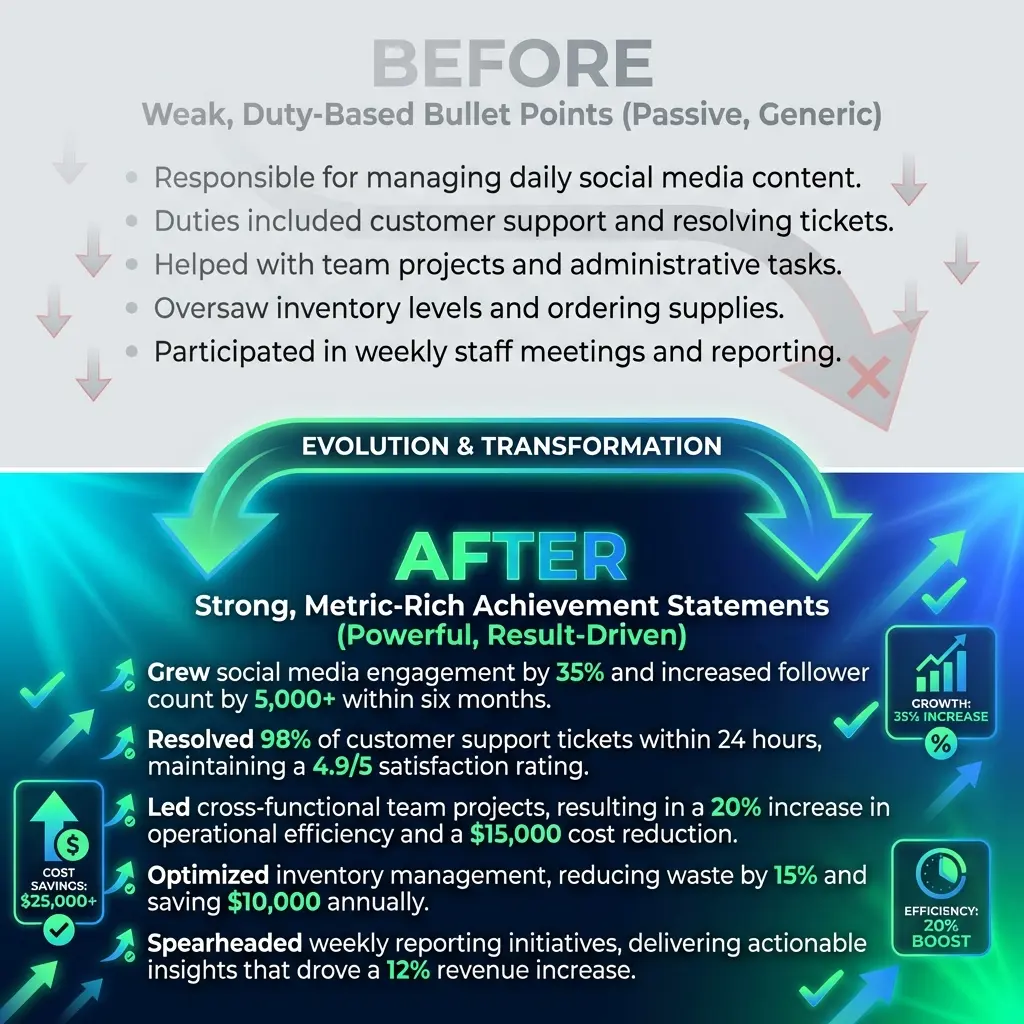
How to Write Accomplishments on Your Resume: The Complete 2026 Guide

Why Accomplishments Beat Job Duties Every Time
I've reviewed over 50,000 resumes in my recruiting career, and the pattern is unmistakable: resumes filled with duties get skipped, resumes packed with accomplishments get interviews. The difference between "Managed social media accounts" and "Grew Instagram following from 5K to 50K in 8 months, generating 2,000 monthly website visits" is the difference between a rejection and a callback.
Hiring managers spend an average of six seconds on initial resume scans. In those seconds, your accomplishments need to prove you can deliver results—not just show up and perform tasks. Every company you apply to has problems to solve. Your resume must demonstrate you are a problem-solver who produces measurable outcomes.
This guide teaches you how to transform ordinary job descriptions into extraordinary achievement statements that demand attention. For comprehensive strategies on translating your experience, our ultimate experience translation guide covers the complete framework.
The Accomplishment Formula That Works
The most effective accomplishments follow a simple structure: Challenge-Action-Result (CAR). This formula ensures every bullet point demonstrates your impact.
The CAR Framework
Challenge: What problem or opportunity existed? Action: What specific steps did you take? Result: What measurable outcome did you achieve?
The CAR formula is a variation of the STAR method commonly used in interviews. You can also use Google's XYZ formula to structure your bullet points: "Accomplished [X] as measured by [Y], by doing [Z]."
CAR in Practice
Before (Duty): "Responsible for managing customer support tickets"
After (CAR Accomplishment): "Reduced customer support response time from 24 hours to 4 hours by implementing ticket prioritization system and knowledge base, improving customer satisfaction scores by 35%"
The duty tells hiring managers what you were supposed to do. The accomplishment proves you made things better.
Before writing any bullet point, ask yourself: "If a recruiter reads this and thinks 'So what?', does it have a clear answer?" This simple audit separates activity-based descriptions from value-driven accomplishments. For the complete systematic audit framework with five-step process, common failures by role, and before/after transformations across all functions, see our "So What?" Test for Every Bullet Point guide.
Quantifying When Numbers Seem Impossible
The most common objection I hear: "But I don't have access to metrics in my role." Every job produces measurable outcomes if you know where to look.
Questions to Uncover Hidden Metrics
Conservative Estimation Techniques
When exact numbers are unavailable, estimate conservatively:
Hiring managers understand not everything has precise data. Reasonable estimates demonstrate your impact better than vague descriptions.
Accomplishment Categories with Examples
Different types of achievements resonate with different hiring priorities. Include variety to demonstrate range.
Revenue and Growth Accomplishments
Efficiency and Process Accomplishments
Leadership and Team Accomplishments
Quality and Customer Accomplishments
For guidance on how to present achievements specific to your industry, explore our role-specific resume examples.
Transform Your Resume with Powerful Accomplishments
Transforming Duties into Accomplishments: Real Examples
Here are before-and-after transformations across common job functions:
Sales and Business Development
Duty: "Called prospects and closed deals"
Accomplishment: "Exceeded quarterly sales quota by 130% through cold outreach strategy, closing $1.2M in new contracts and ranking #2 among 15 sales representatives"
Marketing and Communications
Duty: "Managed email marketing campaigns"
Accomplishment: "Redesigned email nurture sequences achieving 42% open rate and 8% click-through rate, generating 340 qualified leads monthly and contributing $800K to sales pipeline"
Operations and Administration
Duty: "Handled office management and scheduling"
Accomplishment: "Reorganized office operations reducing supply costs by 25% ($15K annually) while implementing scheduling system that eliminated 95% of meeting conflicts"
Technology and Engineering
Duty: "Developed software features"
Accomplishment: "Built authentication system serving 50,000 daily active users with 99.99% uptime, reducing login failures by 80% and support tickets by 200 per month"
Customer Service
Duty: "Resolved customer complaints"
Accomplishment: "Resolved average of 45 customer issues daily while maintaining 4.8/5 satisfaction rating, identifying recurring problem that led to product fix saving estimated $100K in refunds"
Human Resources
Duty: "Recruited new employees"
Accomplishment: "Filled 35 positions averaging 23 days time-to-hire (vs. 45-day industry average) while reducing cost-per-hire by 30% through optimized sourcing channels"
Strong Action Verbs for Every Situation
The verb you choose sets the tone for your entire accomplishment. Use verbs that convey agency and impact.
Achievement-Focused Verbs
Leadership Verbs
Analysis and Problem-Solving Verbs
Growth and Financial Verbs
Common Accomplishment-Writing Mistakes
Mistake 1: Leading with Responsibilities
Wrong: "Responsible for managing a team of 8 sales representatives"
Right: "Led team of 8 sales representatives to exceed annual quota by 140%, achieving $4.2M in combined revenue"
Starting with "Responsible for" signals duties, not accomplishments. Lead with action verbs and results.
Mistake 2: Missing Context
Wrong: "Increased sales by 25%"
Right: "Increased regional sales by 25% within 6 months, ranking first among 12 territories and earning President's Club recognition"
Context makes accomplishments credible and impressive. Include timeframes, scope, and recognition.
Mistake 3: Being Too Vague
Wrong: "Improved customer satisfaction significantly"
Right: "Improved customer satisfaction scores from 72% to 91% by implementing feedback-response program and reducing resolution time by 40%"
"Significantly" means nothing without numbers. Quantify whenever possible.
Mistake 4: Claiming Team Accomplishments as Individual
Wrong: "Increased company revenue by $50M" (when it was a team effort)
Right: "Contributed to $50M revenue increase as key member of 5-person sales team, personally closing $8M in enterprise accounts"
Be honest about your contribution level. Hiring managers will ask for details in interviews.
Mistake 5: Ignoring Soft Accomplishments
Not everything is about revenue and efficiency. Recognition, awards, and relationship achievements matter:
Accomplishments for Career Changers
Switching industries? Frame accomplishments to highlight transferable impact.
Translating Industry-Specific Results
Original (Restaurant Management): "Managed restaurant generating $2M annual revenue with 25 staff members"
Translated (Retail Management): "Led 25-person team in high-volume service environment, managing $2M P&L while maintaining 4.5-star customer ratings and reducing turnover by 30%"
Focus on universal metrics: team size, budget, customer satisfaction, efficiency gains. These translate across industries.
Highlighting Transferable Skills
Accomplishments for Entry-Level Candidates
No work history? Accomplishments come from everywhere.
Academic Accomplishments
Volunteer and Extracurricular Accomplishments
Personal Project Accomplishments
Entry-level accomplishments demonstrate initiative, leadership, and follow-through—exactly what employers want.
Tailoring Accomplishments for Each Application
Generic accomplishments waste space. Customize for each target role.
The Relevance Check
For each accomplishment, ask: "Does this directly relate to what this employer needs?" If not, either reframe it or replace it with something more relevant.
Keyword Optimization
Study the job description. If it mentions "stakeholder management," include an accomplishment demonstrating stakeholder management. If it emphasizes "data analysis," lead with your analytics achievements.
Priority Ordering
Put your most relevant, impressive accomplishments first within each job section. Hiring managers may not read every bullet—make the first ones count. When tailoring for specific applications, consider using AI tools to help identify relevant keywords and reframe your experience efficiently.
Frequently Asked Questions
What is the difference between duties and accomplishments on a resume?
Duties describe what you were responsible for—tasks and roles. Accomplishments describe what you achieved—specific results with measurable outcomes. Hiring managers care about accomplishments because they predict future performance.
How do I quantify accomplishments without having exact numbers?
Estimate conservatively using ranges, percentages, or comparisons. Ask yourself: How many? How often? How much? How fast? If exact numbers are unavailable, use approximations like "50+" or "doubled" or "reduced by approximately 30%."
What is the STAR method for resume accomplishments?
STAR stands for Situation, Task, Action, Result. For resumes, condense this into achievement statements: What challenge did you face, what action did you take, and what measurable result did you achieve?
How many accomplishments should I include per job?
Include 3-5 achievement-focused bullet points per role for recent positions. Earlier roles can have 2-3 bullets. Quality matters more than quantity—each accomplishment should demonstrate clear value.
Can I use accomplishments if I have no work experience?
Yes. Academic achievements, volunteer work, personal projects, and extracurricular activities all provide accomplishment opportunities. Quantify where possible: led a team of 5, managed $10,000 budget, increased club membership by 40%.
Final Thoughts
Your resume is a marketing document, and accomplishments are your proof points. Every bullet should answer the hiring manager's unspoken question: "What can this person do for us?"
Start with your most recent role and identify 3-5 genuine accomplishments. Apply the CAR formula to structure them. Add specific metrics wherever possible. Use strong action verbs that convey ownership and impact.
Your Next Steps
Before you start rewriting your bullets, you might also want to review our guide on resume education sections to ensure every section of your resume is optimized.
Review your current resume right now. Count how many bullets describe duties versus accomplishments. If duties outnumber accomplishments, you have work to do.
For each duty-focused bullet, ask: "What happened because I did this well?" The answer is your accomplishment. Transform every bullet using the techniques in this guide, and your resume will tell a completely different story—one of a candidate who delivers results.
The Interview Connection
Remember: every accomplishment you claim becomes a potential interview question. Be prepared to discuss the context, your specific contribution, and the details behind your metrics. Honest, well-documented accomplishments become your strongest interview assets.
The best resumes don't just list what you did—they prove what you're capable of doing next. Make sure every accomplishment points forward to the value you'll bring.