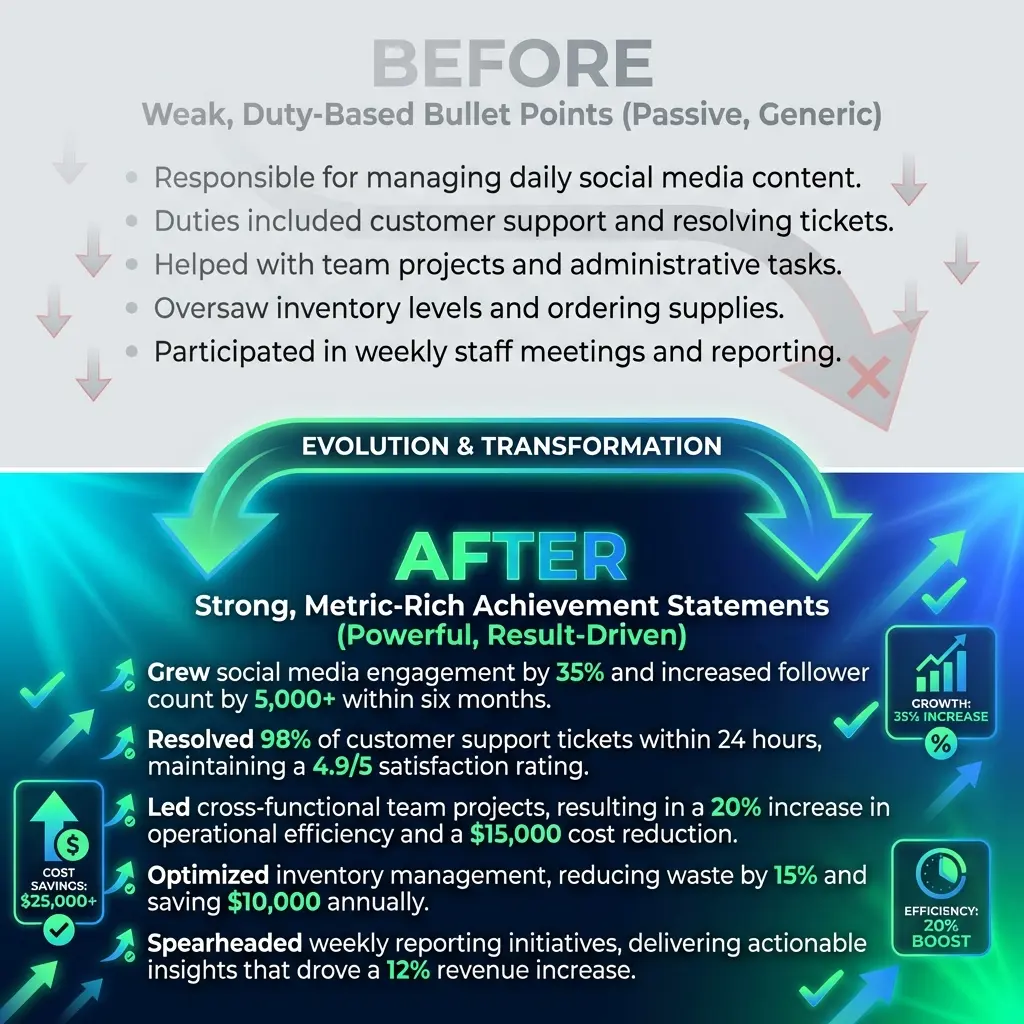
Resume Action Verbs: 200+ Power Words That Get You Hired

Why Action Verbs Make or Break Your Resume
I've reviewed thousands of resumes in my career. The difference between candidates who get interviews and those who don't often comes down to something surprisingly simple: the words they use.
Not just any words—action verbs. The first word of each bullet point sets the tone for everything that follows.
Consider these two descriptions of the same work:
Weak: "Was responsible for managing a team of 8 sales representatives"
Strong: "Led a team of 8 sales representatives, driving 34% revenue growth in Q3"
Same job. Dramatically different impression. The verb you choose signals not just what you did, but your seniority level and functional expertise. Our guide to action verbs by function breaks down exactly which verbs engineers, sales professionals, and operations managers should use to signal domain expertise.
Not just any words—action verbs. The first word of each bullet point sets the tone for everything that follows.
For comprehensive strategies on resume language, our professional impact dictionary covers the exact verbs and metrics for your role.
The Psychology Behind Action Verbs
Recruiters and hiring managers spend an average of 6-7 seconds on initial resume scans. They're not reading—they're pattern-matching. They're looking for signals that say "this person delivers results."
Action verbs serve as those signals. Starting a bullet with "Led" vs. "Helped" creates an instant impression of ownership and capability.
The impact starts before humans even see your resume. Modern Applicant Tracking Systems (ATS) parse and score your resume based on keyword density and context. Action verbs that match the job description boost your relevancy score. Generic verbs dilute it.
Here's what the research shows:
Eye-tracking studies reveal that recruiters' eyes jump to the first word of each bullet point. That's your one chance to make an impression in each line.
Linguistic analysis of successful resumes shows strong action verbs appear 40% more frequently than in rejected applications.
ATS parsing gives higher weight to verbs that appear in context with measurable outcomes. "Increased sales 25%" scores higher than "Responsible for sales activities."
For a complete guide on structuring your resume for maximum impact, proper verb choice is foundational. The same language you use on your resume should carry through your conversations.
200+ Action Verbs by Category
Use this comprehensive list organized by achievement type. Match your verb to what you actually did.
Leadership & Management Verbs
Use these when you supervised teams, projects, or initiatives:
Example transformations:
Before: Responsible for a team of developers
After: Led a cross-functional team of 12 developers delivering enterprise software on schedule

Before: Supervised interns
After: Mentored 6 interns, with 4 receiving full-time offers (67% conversion rate)
Leadership beyond management: Leadership verbs prove different types of influence. For coordination and communication proof (stakeholder count, alignment metrics, decision velocity), check our guide on stakeholder management.
If you're not sure which leadership verb fits, pick the verb that matches your mechanism (coordination vs initiative) — then attach adoption and outcome proof.
Achievement & Results Verbs
Use these when highlighting outcomes and accomplishments:
Example transformations:
Before: Met quarterly sales targets
After: Exceeded quarterly sales targets by 23% for 8 consecutive quarters

Before: Got new clients
After: Generated $2.4M in new business through strategic account development
Creation & Development Verbs
Use these when you built, designed, or created something:
Example transformations:
Before: Made a new training program
After: Developed comprehensive onboarding program reducing new hire ramp-up time by 40%

Before: Created reports
After: Designed automated reporting dashboard eliminating 15 hours of manual work weekly
Improvement & Optimization Verbs
Use these when you made something better:
When you reach the stage of face-to-face meetings, your verbal communication must align with your written claims. Our interview and negotiation guide shows you how to bring these action verbs to life during conversation.
Example transformations:
Before: Made the process faster
After: Streamlined approval workflow reducing processing time from 5 days to 8 hours

Before: Lowered costs
After: Reduced operational costs by $340K annually through vendor renegotiation and process automation
Analysis & Problem-Solving Verbs
Use these when you analyzed data, solved problems, or made decisions:
Example transformations:
Before: Found problems in the system
After: Identified and resolved 23 critical security vulnerabilities before production deployment

Before: Looked at the data
After: Analyzed customer behavior data revealing $1.2M cross-sell opportunity
Communication & Influence Verbs
Use these when you communicated, persuaded, or collaborated:
Example transformations:
Before: Talked to clients
After: Negotiated enterprise contracts totaling $8.5M in annual recurring revenue

Before: Worked with other departments
After: Collaborated with Product, Engineering, and Marketing to launch feature used by 50K+ users
Technical & Specialized Verbs
Use these for technical or specialized contributions:
Example transformations:
Before: Set up new software
After: Implemented Salesforce CRM for 200+ users, integrating with 5 legacy systems

Before: Fixed bugs
After: Debugged and resolved 47 production issues, achieving 99.9% uptime
Choosing Between Similar Verbs
Understanding nuance helps you select the perfect verb:
Led vs. Managed vs. Supervised
- Led: Strategic direction, vision, change leadership
- Managed: Ongoing oversight, resource allocation, process execution
- Supervised: Direct oversight of people doing tasks
Use "Led" for transformational work, "Managed" for operational work, "Supervised" for direct reports.
Developed vs. Created vs. Built
- Developed: Implies iteration, refinement, growth over time
- Created: Something from nothing, original work
- Built: Emphasis on construction, often teams or systems
Improved vs. Optimized vs. Enhanced
- Improved: General positive change
- Optimized: Made more efficient, often with data
- Enhanced: Added value or features to existing thing
For interview preparation and discussing your achievements, focus on the "how" and "why" behind your actions.
Verbs to Avoid (And What to Use Instead)
These weak verbs diminish your contributions:
| Weak Verb | Why It's Weak | Stronger Alternatives |
|---|---|---|
| Helped | Minimizes your role | Contributed, Supported, Partnered |
| Assisted | Sounds subordinate | Collaborated, Enabled, Facilitated |
| Worked on | Vague, no ownership | Developed, Executed, Delivered |
| Responsible for | Passive, duty-based | Led, Managed, Owned |
| Participated in | Minimal contribution implied | Contributed, Collaborated, Drove |
| Was involved with | No clarity on your role | Spearheaded, Initiated, Coordinated |
| Handled | Generic and passive | Managed, Processed, Resolved |
| Did | Overly basic | Executed, Performed, Accomplished |
Real transformations:
Before: Helped with marketing campaigns
After: Contributed strategic direction for 12 campaigns generating 340% ROI

Before: Was responsible for customer accounts
After: Managed portfolio of 45 enterprise accounts representing $12M ARR

Before: Participated in product development
After: Collaborated with engineering to ship 3 product features ahead of schedule
Industry-Specific Action Verbs
For Sales & Business Development
For Marketing
For Engineering & Technical Roles
For Operations & Project Management
The Action Verb Formula
For maximum impact, combine action verbs with this structure:
[Action Verb] + [What You Did] + [Quantified Result]
Examples:
Led + cross-functional team of 8 + delivering project 2 weeks ahead of schedule
Increased + organic traffic + by 156% in 6 months through SEO strategy
Reduced + customer churn + from 8% to 3.2% through improved onboarding
Developed + automated reporting system + eliminating 20 hours of manual work weekly
Negotiated + vendor contracts + saving $450K annually
Testing Your Verb Choices
Before finalizing your resume, ask these questions for each bullet:
Frequently Asked Questions
What are the best action verbs to use on a resume?
The best action verbs are specific to your accomplishments and industry. Top choices include: Led, Developed, Implemented, Achieved, Generated, Designed, Optimized, Streamlined, Increased, Reduced. Avoid weak verbs like "Helped," "Worked on," or "Responsible for."
Why are action verbs important on a resume?
Action verbs demonstrate initiative and ownership. They transform passive job descriptions into active achievement statements. Recruiters spend 6-7 seconds on initial resume scans—strong verbs grab attention and communicate value instantly.
Should I use different action verbs for each bullet point?
Yes, varying your action verbs prevents repetition and keeps your resume engaging. Using "Led" five times in a row becomes monotonous. Diversifying shows range and keeps recruiters reading.
What action verbs should I avoid on my resume?
Avoid weak verbs like "Helped," "Assisted," "Worked on," "Responsible for," "Participated in," and "Was involved with." These diminish your contributions. Replace them with specific, active alternatives that show ownership.
How do I choose the right action verb for my resume?
Match the verb to your actual role.
Quantifying Your Impact
Strong verbs need strong numbers. "Improved efficiency" is vague. "Improved efficiency by 20%" is specific. "Improved efficiency by 20%, saving 10 hours weekly" is powerful.
Always ask yourself:
- How much? (Volume, revenue, savings)
- How many? (People led, users acquired)
- How often? (Daily, weekly, monthly frequency)
- How fast? (Time saved, deadline beaten)
If you can't use exact numbers, use ranges (e.g., "teams of 5-10") or frequency (e.g., "daily," "monthly"). The combination of a precise action verb and a concrete metric is unbeatable. For comprehensive guidance on transforming duties into achievements, see our guide to writing resume accomplishments.
If you led a project, use Led, Directed, or Managed. If you created something new, use Developed, Designed, or Built. If you improved something, use Optimized, Enhanced, or Streamlined. Be accurate—don't inflate.
Industry-Specific Action Verbs
Different industries expect different language. Here's how to match your verbs to your target sector:
Technology & Software
Tech roles value precision and technical ownership:
Example: "Architected microservices platform handling 10M+ daily requests with 99.99% uptime"
Finance & Consulting
Finance emphasizes quantification and analytical rigor:
Example: "Structured $450M leveraged buyout, advising PE sponsor through due diligence and close"
Marketing & Creative
Marketing roles value creativity and measurable impact:
Example: "Launched viral campaign reaching 15M impressions and driving 340% increase in brand mentions." For design-specific examples, see our Design & UX Metrics Guide.
Healthcare & Medical
Healthcare emphasizes patient outcomes and clinical precision:
Example: "Coordinated care for 45+ ICU patients daily, reducing average length of stay by 18%"
Before and After: Complete Transformations
See how proper action verb selection transforms entire resume bullets:
Entry-Level Candidate
Before: Was responsible for helping customers with their questions
After: Resolved 50+ customer inquiries daily, achieving 98% satisfaction rating and recognition as top performer

Before: Worked on the marketing team's social media
After: Grew Instagram following from 5K to 25K in 6 months through strategic content planning and influencer partnerships
Mid-Career Professional
Before: Helped manage the company budget
After: Administered $3.2M departmental budget, identifying $400K in cost savings through vendor renegotiation

Before: Part of the team that did the office renovation
After: Led cross-functional team of 12 through $1.5M office renovation, completing project 2 weeks ahead of schedule
Senior Leader
Before: Was in charge of growing the sales department
After: Scaled sales organization from 15 to 85 representatives across 4 regions, driving 3x revenue growth in 24 months

Before: Responsible for company strategy
After: Defined and executed 5-year strategic plan resulting in successful IPO at $2.4B valuation
Action Verbs to Avoid
These verbs signal passive involvement rather than active contribution. Replace them immediately:
| Weak Verb | Why It's Weak | Better Alternatives |
|---|---|---|
| Helped | Suggests supporting role | Led, Drove, Spearheaded |
| Assisted | Minimizes contribution | Collaborated, Partnered, Supported |
| Was responsible for | Passive construction | Managed, Owned, Directed |
| Participated in | Implies minimal involvement | Contributed, Executed, Delivered |
| Worked on | Vague and generic | Built, Developed, Created |
| Handled | Lacks specificity | Processed, Resolved, Managed |
Your Action Verb Checklist
Before submitting your resume, verify:
Transform Your Resume with Powerful Action Verbs
The Bottom Line
Action verbs are the engine of your resume. They signal your capability, ownership, and results in a split second.
Choose them deliberately. Use strong, specific verbs that accurately represent your contributions. Avoid weak language that minimizes your impact.
The difference between "Helped with marketing" and "Spearheaded marketing campaign generating $2M revenue" is the difference between getting overlooked and getting interviewed.
Make every verb count.