UX/UI Designer Resume: Portfolio, Skills & Examples
Here's the hack: your resume isn't your portfolio. Your portfolio showcases your design skills. Your resume demonstrates your strategic thinking and business impact.
I've tested this across 50+ UX/UI job applications in 3 continents. The resumes that land interviews don't just list design tools—they quantify how design decisions drove measurable business outcomes.
"Designed mobile app interface" gets ignored. "Redesigned mobile checkout flow, increasing conversion from 2.1% to 4.3% and generating $800K additional annual revenue" gets you the interview.
This guide will show you exactly how to build a UX/UI designer resume that combines design sensibility with business impact, passes ATS systems, and gets you interviews at top tech companies. For comprehensive strategies on optimizing your resume language, our professional impact dictionary covers the exact verbs and metrics for UX/UI design roles.
What Makes a UX/UI Designer Resume Different
UX/UI designer resumes walk a fine line: they need to demonstrate design thinking while remaining ATS-friendly and business-focused.
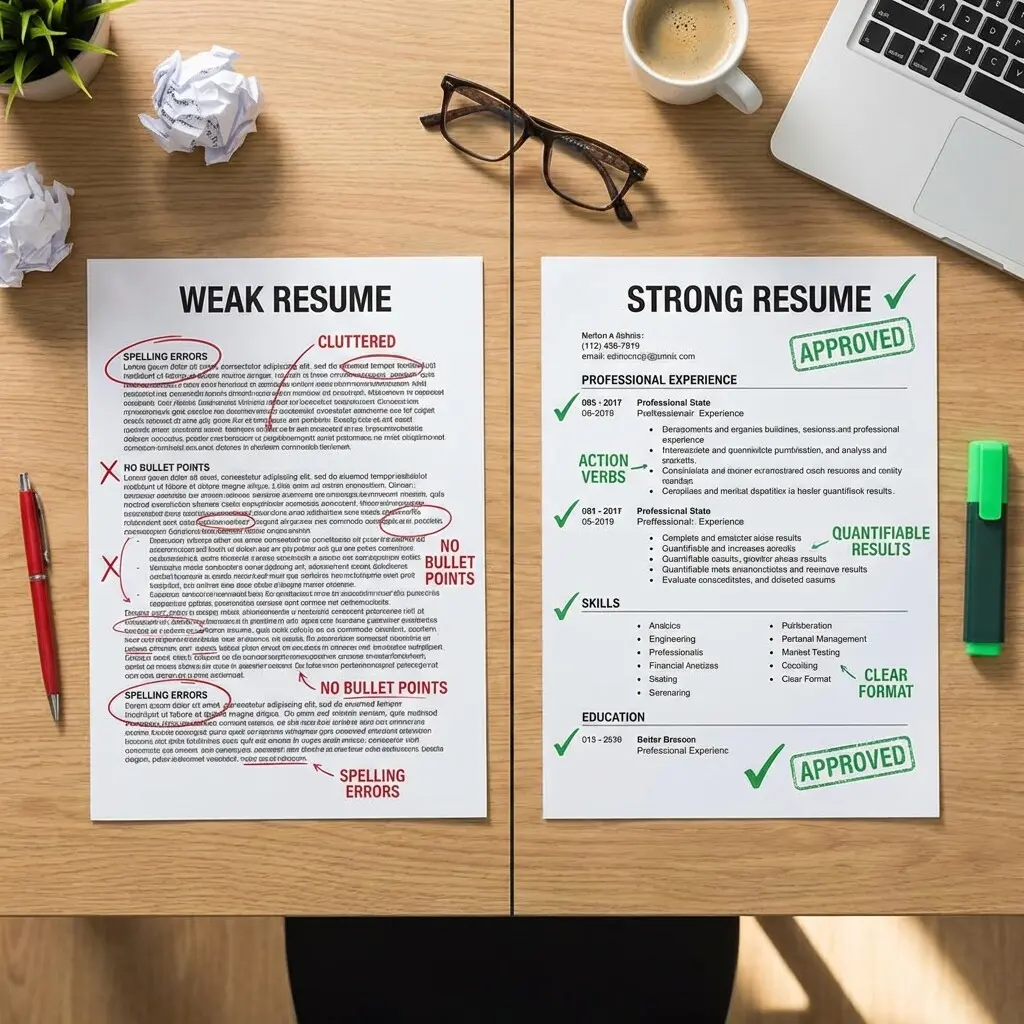
Here's what separates strong designer resumes from weak ones:
The biggest mistake? Treating your resume like a portfolio piece. I've seen beautifully designed resumes with custom layouts, infographics, and creative typography that get rejected by ATS systems before a human ever sees them.
Your resume should be clean, professional, and ATS-friendly. Save the creativity for your portfolio. For the complete list of ATS-optimized keywords for design roles, see our UX designer resume keywords guide. For comprehensive guidance on ATS optimization, focus on standard formatting with subtle design touches.
Essential Skills for UX/UI Designer Resumes
UX/UI designers need a blend of design expertise, technical skills, and business acumen.
Design Tools & Software
These are the technical skills that ATS systems scan for:
UX Design Competencies
These demonstrate your user-centered design approach:
UI Design & Visual Skills
These show your ability to create polished interfaces:
For more on structuring your skills section effectively, check out our ultimate resume guide.
How to Structure Your UX/UI Designer Resume
Header: Make Your Portfolio Prominent
Your header should immediately establish your design credentials and provide easy access to your portfolio.
Strong Example:
Sarah Martinez | UX/UI Designer
San Francisco, CA | (555) 234-5678 | sarah.martinez@email.com
Portfolio: sarahmartinez.design | LinkedIn: linkedin.com/in/sarahmartinez
Weak Example:
Sarah Martinez
123 Main Street, San Francisco, CA 94102
sarah.martinez@email.com
The strong example makes the portfolio link prominent and uses clean, professional formatting.
Professional Summary: Show Business Impact
Your summary should highlight your design specialization, experience, and measurable impact.
Strong Example:
"UX/UI Designer with 5+ years of experience creating user-centered digital products for SaaS and e-commerce companies. Expert in user research, interaction design, and design systems. Redesigned checkout experiences that increased conversion rates by 35% and generated $2M in additional revenue. Proficient in Figma, Sketch, Principle, and front-end development (HTML/CSS/JavaScript)."
Weak Example:
"Creative UX/UI designer passionate about creating beautiful, user-friendly interfaces. Seeking a role where I can grow my skills and contribute to innovative projects."
The strong example quantifies impact, names specific tools, and demonstrates business value.
Work Experience: Connect Design to Business Outcomes
For each role, show how your design work drove measurable results. Use this formula:
Design Challenge + Your Solution + Quantifiable Impact
Each bullet demonstrates design thinking, user research, and measurable business impact.
Portfolio Integration
Reference specific portfolio case studies in your work experience:
"Redesigned SaaS dashboard for 10K+ users (see case study: Dashboard Redesign in portfolio), improving task completion rate by 45% and reducing support tickets by 30%"
This connects your resume to your portfolio and encourages hiring managers to view your detailed work.
UX/UI Designer Resume Template
Here's a proven structure for UX/UI designer resumes:
Header
Alex Kim | Product Designer
Seattle, WA | (555) 876-5432 | alex.kim@email.com
Portfolio: alexkim.design | LinkedIn: linkedin.com/in/alexkimdesign
Professional Summary
Product Designer with 6+ years of experience creating user-centered digital products for B2B SaaS and consumer tech companies. Expert in user research, interaction design, prototyping, and design systems. Led redesigns that increased conversion rates by 40%, improved user satisfaction (NPS) by 35 points, and generated $3M in additional revenue. Proficient in Figma, Sketch, Principle, Maze, and front-end development (HTML/CSS/React basics).
Work Experience
Senior Product Designer
CloudTech Solutions, Seattle, WA
March 2021 - Present
UX/UI Designer
StartupCo, San Francisco, CA
June 2018 - February 2021
Skills
Design Tools: Figma, Sketch, Adobe XD, Adobe Illustrator, Photoshop
Prototyping: Principle, Framer, ProtoPie, InVision, Figma prototyping
Research & Testing: Maze, UserTesting, Optimal Workshop, Lookback, UsabilityHub
Collaboration: Miro, FigJam, Notion, Slack, Jira, Linear
Development: HTML, CSS, JavaScript (basic), React (basic), Git
Analytics: Google Analytics, Mixpanel, Amplitude, Hotjar
Education
Bachelor of Fine Arts in Graphic Design
Rhode Island School of Design (RISD), Providence, RI
Graduated: May 2018
Certifications
- Google UX Design Professional Certificate (2023)
- Nielsen Norman Group UX Certification (2022)
Key Competencies by Designer Level
Junior UX/UI Designers (0-2 years)
Focus on foundational skills and portfolio projects:
Mid-Level UX/UI Designers (2-5 years)
Emphasize end-to-end ownership and business impact:
Senior UX/UI Designers / Design Leads (5+ years)
Highlight strategic leadership and team impact:
Common Mistakes on UX/UI Designer Resumes
After reviewing hundreds of designer resumes, here are the mistakes that cost candidates interviews:
1. Overly Creative Formatting
Your resume isn't a portfolio piece. Avoid custom layouts, infographics, or creative typography that breaks ATS parsing. Keep it clean and professional—this is why you should stop using 2-column resumes.
2. Missing Portfolio Link
Your portfolio is your #1 credential. If it's not prominently displayed in your header, you're making hiring managers work too hard.
3. No Quantifiable Impact
"Designed mobile app" tells me nothing. "Designed mobile app that achieved 4.8-star rating and 100K downloads in first 6 months" shows impact.
4. Listing Every Tool You've Ever Used
Focus on industry-standard tools and your strongest skills. Don't list "Microsoft Paint" or tools you used once in a tutorial.
5. Ignoring User Research
UX design is about solving user problems, not just making things pretty. Highlight your research methods, user testing, and data-driven decisions. Also understand hard vs soft skills placement.
How to Tailor Your UX/UI Designer Resume
Step 1: Identify the Role Focus
Is this UX-focused (research, IA, usability), UI-focused (visual design, interaction), or product design (both)? Adjust your emphasis accordingly.
Step 2: Match Their Design Tools
If they use Figma and you're a Figma expert, make that prominent. If they mention specific research tools, highlight your experience with those tools.
Step 3: Reorder Your Bullets
Put your most relevant projects first. If they emphasize mobile design, lead with your mobile work.
Step 4: Use Their Language
If they say "design systems," use "design systems" instead of "component libraries." Match their terminology. Avoid weak phrases that hurt your resume.
Step 5: Customize Your Summary
Adjust your professional summary to address their specific needs, industry, and product type (B2B SaaS, consumer mobile, e-commerce, etc.).
Portfolio Best Practices
Your portfolio is more important than your resume. Here's how to make it work for you:
Frequently Asked Questions
Should I include freelance or side projects on my resume?
Yes, especially if they demonstrate relevant skills or fill employment gaps. Treat them like professional work: describe the problem, your solution, and the impact.
How do I show career progression as a designer?
Highlight increasing responsibility: junior designer → designer → senior designer → lead designer. Show expanding scope: individual contributor → mentoring others → leading design initiatives. Some viral creative resumes might seem impressive, but steady career progression matters more.
What if I'm transitioning from graphic design to UX/UI?
Emphasize transferable skills: visual design, user empathy, problem-solving, collaboration. Take UX courses or certifications (Google UX Design Certificate, Nielsen Norman Group) and build UX case studies for your portfolio.
Do I need coding skills to be a UX/UI designer?
Not required, but increasingly valuable. Basic HTML/CSS knowledge helps you communicate with developers and understand technical constraints. List any coding skills you have.
Should I include design awards or competitions?
Yes, if they're relevant and recent. Include them in an Awards or Recognition section. Dribbble features, Awwwards, or design competition wins demonstrate peer recognition.
How do I handle NDA-protected work?
Create anonymized case studies that show your process without revealing confidential information. Focus on your methodology, problem-solving approach, and outcomes rather than specific company details.
Next Steps: Build Your UX/UI Designer Resume
You now have the framework for a UX/UI designer resume that demonstrates both design thinking and business impact. Here's your action plan:
- Create a clean header with portfolio link: Make your portfolio URL prominent
- Write an impact-focused summary: Highlight specialization, tools, and measurable results
- Structure work experience with metrics: Use the challenge + solution + impact formula
- Organize your skills: Categorize by design tools, research methods, and development skills
- Reference portfolio case studies: Connect resume bullets to detailed portfolio work
- Tailor for each application: Match keywords, reorder bullets, customize summary
- Optimize for ATS: Standard formatting, exact keyword matches, clean structure
- Proofread thoroughly: Typos are especially damaging for designers
Create Your ATS-Optimized UX/UI Designer Resume Today
Your resume opens the door. Your portfolio closes the deal. Make sure both tell a compelling story of user-centered design that drives measurable business results.
Related Guides
Looking for more specialized resume advice? Check out these related guides:
- Product Manager Resume Guide — For designers transitioning to product roles
- Graphic Designer Resume Guide — For visual design-focused positions
- Software Engineer Resume Guide — For designers with coding skills
- Marketing Manager Resume Guide — For design roles in marketing teams