Skills Section: Hard Skills vs. Soft Skills (And Where to Put Them)
I remember staring at my first resume draft, completely confused. I had a list of 30+ skills—everything from "Microsoft Excel" to "team player" to "attention to detail." My career counselor took one look and said, "This is a mess. You're mixing apples and oranges."
She was right. I was treating all skills the same when they're fundamentally different. Hard skills are your technical toolkit—the measurable, teachable abilities you bring to the job. Soft skills are your interpersonal superpowers—how you work with others and solve problems.
Here's the thing most people get wrong: where you put these skills matters just as much as what skills you list. Put them in the wrong place, and ATS systems might miss them. Recruiters might skim right past them. Your resume might look amateurish.
When I applied for my first marketing coordinator role, I listed: "Google Analytics, HubSpot, Canva, SEO fundamentals, email marketing automation." Every single one of those appeared in the job description. I got the interview. For comprehensive strategies on translating your experience, our ultimate experience translation guide covers the complete framework.
Let me show you exactly how to organize your skills section so it works for both robots (ATS) and humans (recruiters).
Build your skills section with our ATS-optimized resume templates
What Are Hard Skills? (And Why They Matter)
Hard skills are technical, measurable abilities you can prove through certifications, portfolios, or tests. They're the "can you do the job?" skills.
Why recruiters love hard skills:
- They're easy to verify
- They match job requirements directly
- ATS systems scan for them automatically
- They show you can hit the ground running
Example from my own resume:
What Are Soft Skills? (And Why You Can't Just List Them)
Here's the catch: Everyone claims to have soft skills. "Excellent communicator." "Strong leader." "Team player." These phrases mean nothing without proof.
The right way to show soft skills: Don't list them—demonstrate them through your achievements.
Wrong:
Skills: Leadership, Communication, Problem-Solving
Right:
Led cross-functional team of 8 to launch product 2 weeks ahead of schedule, resolving 15+ stakeholder conflicts through clear communication and collaborative problem-solving.
See the difference? The second version proves you have those skills through concrete results. For a complete system on turning intangible soft skills like "communication" and "leadership" into measurable metrics (stakeholder count, meeting cadence, mentorship outcomes), see our guide on Quantifying Soft Skills.
Where to Put Hard Skills on Your Resume
Option 1: Dedicated Skills Section (Recommended)
Placement: Right after your professional summary, before work experience.
Why this works:
- ATS systems scan the top third of your resume first
- Recruiters spend 6 seconds on initial screening—make skills visible
- Shows qualifications immediately
Format:
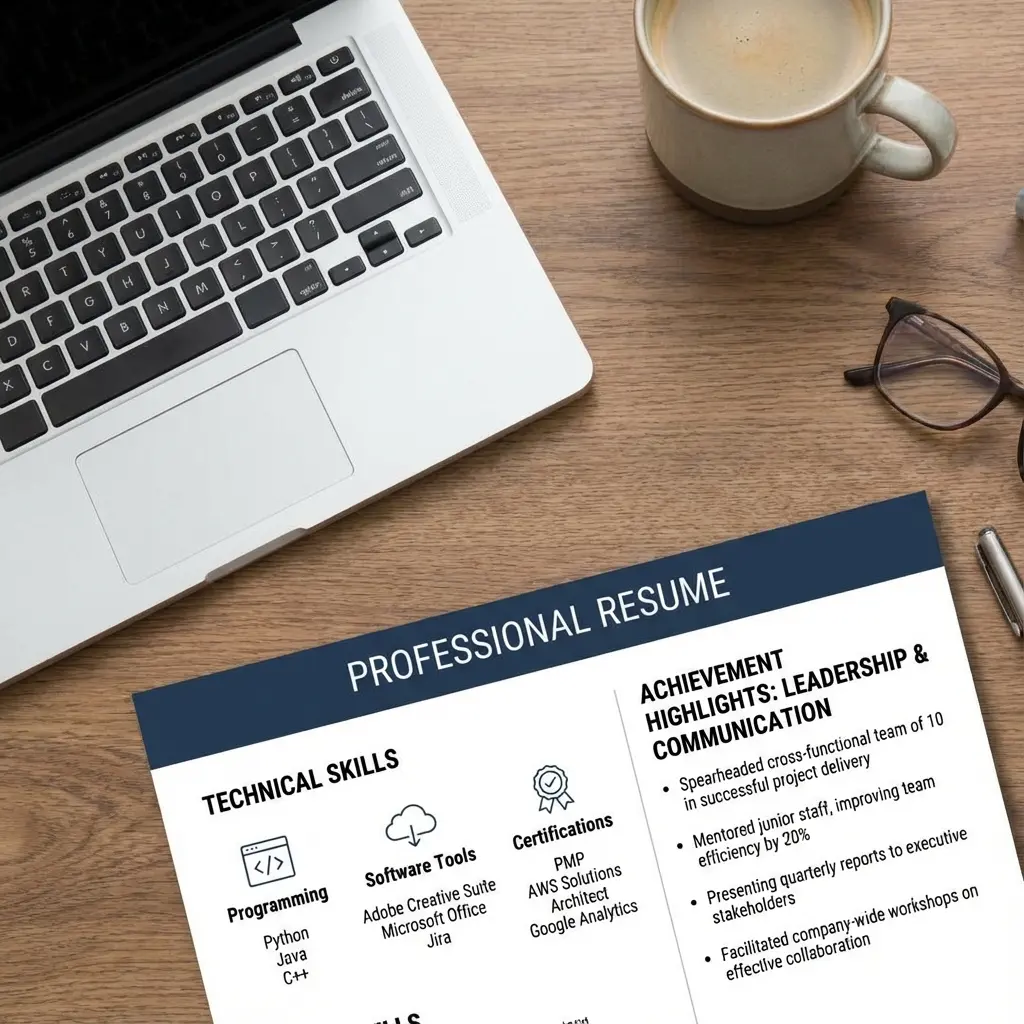
TECHNICAL SKILLS
Programming: Python, JavaScript, SQL, R
Tools: Tableau, Power BI, Google Analytics, Salesforce
Certifications: AWS Solutions Architect, PMP
Languages: Spanish (fluent), French (conversational)
Pro tip from my recruiting friends: Use the exact keywords from the job description. If they say "Salesforce CRM," don't write "CRM software." ATS systems look for exact matches.
For detailed guidance on organizing 8+ skills by functional category (Programming Languages, Frameworks, Databases, Cloud/DevOps), consider grouping them with clear subheaders to maintain readability while passing ATS checks.
Option 2: Skills Integrated into Experience
When to use this: If you have limited space or want to show progression in skills over time.
Example:
Marketing Manager | TechCorp | 2022-Present
• Managed $500K digital ad budget using Google Ads, Facebook Business Manager
• Analyzed campaign performance with Google Analytics, Tableau dashboards
• Led team of 5 using Asana for project management, Slack for communication
This approach shows you didn't just learn the skills—you applied them successfully.
Option 3: Hybrid Approach (Best for Technical Roles)
Use both: A dedicated technical skills section + skills woven into experience.
Why this works for developers, engineers, data analysts:
- Skills section = ATS optimization
- Experience section = proof of application
Where to Put Soft Skills on Your Resume
Short answer: Don't create a separate soft skills section. Ever.
Why? Because listing "Communication, Leadership, Teamwork" is meaningless. Everyone does it. It's resume filler.
Instead, demonstrate soft skills in three places:
1. Professional Summary
Example:
Marketing professional with 5+ years leading cross-functional teams to deliver campaigns that increased engagement by 40%. Known for translating complex data insights into clear, actionable strategies for non-technical stakeholders.
Soft skills shown: Leadership, communication, analytical thinking—all proven with results.
2. Experience Bullet Points
Use the CAR method (Challenge, Action, Result) to showcase soft skills:
Challenge: What problem did you face? Action: How did you solve it? (This reveals your soft skills) Result: What was the outcome?
To master writing these result-driven bullets, use our results vs responsibilities audit to transform every duty into an achievement.
Example:
Challenge: Team missed Q1 deadline due to miscommunication between departments. Action: Implemented daily stand-ups and created shared Slack channel for real-time updates. Result: Q2 project delivered 1 week early; team collaboration score increased 35%.
Soft skills demonstrated: Problem-solving, communication, leadership, adaptability.
3. Achievements Section (Optional)
If you have space, create a "Key Achievements" section that highlights soft skills through impact:
Each achievement implies soft skills (mentorship, communication, problem-solving) without explicitly stating them.
Common Mistakes to Avoid
Mistake #1: Creating a "Soft Skills" Section
Don't do this:
SOFT SKILLS
• Communication
• Leadership
• Problem-Solving
• Teamwork
Why it fails: Zero proof. Every resume says this. Recruiters ignore it.
Mistake #2: Using Skill Bars or Graphics
Don't do this:
Python ████████░░ 80%
Communication ██████████ 100%
Why it fails:
- ATS systems can't read graphics
- Self-rating is meaningless (who rates themselves below 70%?)
- Takes up valuable space
Mistake #3: Listing Outdated or Irrelevant Skills
Don't list:
- Microsoft Word (assumed for most jobs)
- "Proficient in email" (seriously, I've seen this)
- Skills from 10+ years ago that aren't relevant
Do list:
- Current, in-demand technical skills
- Industry-specific software
- Skills that match the job description
Mistake #4: Overloading with Too Many Skills
The problem: Listing 40 skills makes you look desperate or dishonest.
The fix: Quality over quantity. 8-12 highly relevant hard skills is perfect.
How to choose:
- Read the job description
- Highlight required and preferred skills
- Match your skills to their requirements
- Prioritize the most important ones
Industry-Specific Skills Placement
For Tech Roles (Software Engineer, Data Analyst)
Format:
TECHNICAL SKILLS
Languages: Python, JavaScript, Java, SQL
Frameworks: React, Node.js, Django, Flask
Tools: Git, Docker, AWS, Jenkins
Databases: PostgreSQL, MongoDB, Redis
Why this works: Technical recruiters scan for specific technologies. Make them easy to find.
For Creative Roles (Designer, Writer, Marketer)
Format:
CORE COMPETENCIES
Design: Figma, Adobe Creative Suite, Sketch, InVision
Marketing: Google Analytics, HubSpot, Mailchimp, SEMrush
Content: SEO writing, copywriting, content strategy, AP style
Why this works: Shows both technical tools and creative expertise.
For Business Roles (Project Manager, Analyst, Consultant)
Hybrid approach:
TECHNICAL PROFICIENCIES
Project Management: Asana, Jira, MS Project, Smartsheet
Analysis: Excel (advanced), Tableau, Power BI, SQL
Certifications: PMP, Six Sigma Green Belt, Scrum Master
Then weave soft skills into experience:
Led 12-person cross-functional team through $2M system migration, resolving stakeholder conflicts and delivering project 10% under budget through proactive risk management.
How to Organize Your Skills by Industry
Different industries prioritize different skills. Here's how to tailor your skills section:
Technology Industry
Priority order:
- Programming languages
- Frameworks and libraries
- Tools and platforms
- Methodologies (Agile, DevOps)
- Certifications
Healthcare Industry
Priority order:
- Clinical certifications (RN, MD, PA-C)
- Medical software (Epic, Cerner, Meditech)
- Specialized skills (phlebotomy, IV therapy)
- Compliance knowledge (HIPAA, OSHA)
- Languages (especially Spanish)
Finance Industry
Priority order:
- Financial certifications (CFA, CPA, Series 7)
- Financial software (Bloomberg, QuickBooks, SAP)
- Analysis tools (Excel, SQL, Tableau)
- Regulatory knowledge (SOX, GAAP)
- Languages
ATS Optimization for Skills Section
ATS (Applicant Tracking Systems) scan for exact keyword matches. Here's how to beat them:
Rule #1: Use Exact Job Description Keywords
Job description says: "Salesforce CRM" You write: "Salesforce CRM" (not "CRM software" or "customer relationship management")
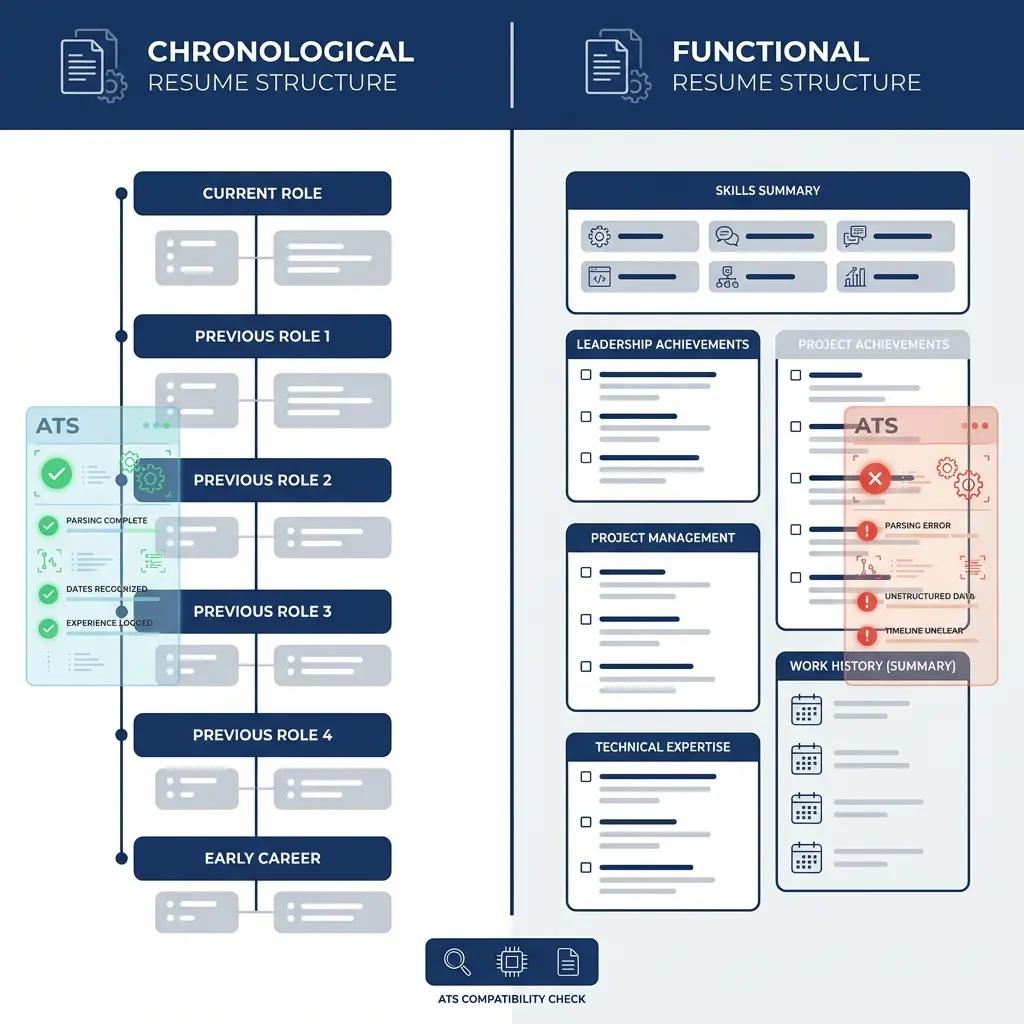
Rule #2: Avoid Tables and Graphics
ATS systems can't read:
- Tables
- Text boxes
- Images
- Skill bars
- Charts
Use simple text formatting:
SKILLS
Project Management: Asana, Jira, MS Project
Data Analysis: SQL, Python, Tableau, Excel
Rule #3: Include Acronyms AND Full Names
Example:
- Search Engine Optimization (SEO)
- Customer Relationship Management (CRM)
- Application Programming Interface (API)
Why: Some ATS search for acronyms, others for full names. Cover both.
Rule #4: Don't Keyword Stuff
Wrong:
SKILLS
Excel Excel Excel Python Python SQL SQL SQL Tableau
Right:
SKILLS
Data Analysis: Excel (advanced), Python, SQL, Tableau
Frequently Asked Questions
What's the difference between hard skills and soft skills?
Hard skills are technical, teachable abilities you can measure (like Python, Excel, or Photoshop). Soft skills are interpersonal qualities that show how you work (like communication, leadership, or problem-solving).
Should I list soft skills on my resume?
Yes, but don't just list them. Demonstrate soft skills through your achievements and experience descriptions. Only list them in a skills section if the job description specifically mentions them.
How many skills should I put on my resume?
Aim for 8-12 hard skills in a dedicated skills section. Soft skills should be woven into your experience descriptions rather than listed separately.
Where should the skills section go on a resume?
Place your skills section right after your professional summary or objective, before your work experience. This ensures ATS systems and recruiters see your qualifications immediately.
Should I include Microsoft Office on my resume?
Only if the job description specifically requires it or if you have advanced skills (like Excel macros, VBA, or complex formulas). Basic Word and email proficiency is assumed for most professional roles.
Final Checklist: Skills Section Done Right
Your Next Steps
Now that you know the difference between hard and soft skills—and exactly where to put them—it's time to audit your resume.
Action items:
- List all your hard skills
- Match them to your target job description
- Create a dedicated skills section (8-12 skills max)
- Review your experience bullets—are you demonstrating soft skills through results?
- Remove any standalone "soft skills" section
Remember: Hard skills get you past the ATS. Soft skills (demonstrated through achievements) get you the interview. Both matter, but they belong in different places on your resume.
Your skills section should take a recruiter 5 seconds to scan and immediately answer: "Can this person do the job?" Make it count.